Kalshi Compute Markets: How to Trade AI Capacity (2026 Guide)
Category: Tool Dynamics
Excerpt:
Kalshi compute markets would let you hedge GPU capacity costs. See the $40B funding numbers, how the contracts work, and a 5-step starter plan.
This analysis was written by the aifreetool Editorial Team — a group of full-time AI-industry researchers and writers who verify every claim against primary sources. Last updated November 6, 2026. We keep no affiliate relationship with the companies covered here.
TL;DR: Kalshi closed a $1 billion Series G at a $40 billion valuation on October 29, 2026, co-led by Wellington Management and Sequoia — twenty times its valuation sixteen months earlier. Buried in the announcement is the more interesting product: compute markets, contracts that let traders and AI companies hedge the price of GPU capacity itself. Below: the funding numbers, how trading AI compute would work, and a practical path to getting started without getting burned.
Key takeaways:
- $40 billion post-money valuation, up from $22 billion in May 2026 and $2 billion in June 2025 — a 20x jump in sixteen months.
- Over $1 trillion in annualized trading volume across 30 million accounts; annualized revenue above $4 billion, with non-sports products past $1 billion.
- The roadmap adds stock index markets, single-stock perpetual futures, and compute markets — turning AI capacity into a tradable asset.
- Regulatory friction is the real risk: a lawsuit against Missouri and a wave of state-level pushback shadow every new product.
Kalshi compute markets are the newest item on the prediction-market operator's roadmap, and they may matter more to AI buyers than the $40 billion headline that dominated the funding coverage. On October 29, 2026, Kalshi announced a $1 billion Series G co-led by Wellington Management and Sequoia Capital, joined by Andreessen Horowitz, Coatue, CapitalG, Morgan Stanley Investment Management, Baillie Gifford, Stripes, Hudson River Trading, and Balyasny. Sequoia partner Alfred Lin even published the company's original Series A pitch deck from six years ago, with the founders' consent a rare bit of transparency in a raise this size.
The Numbers Behind the $40 Billion
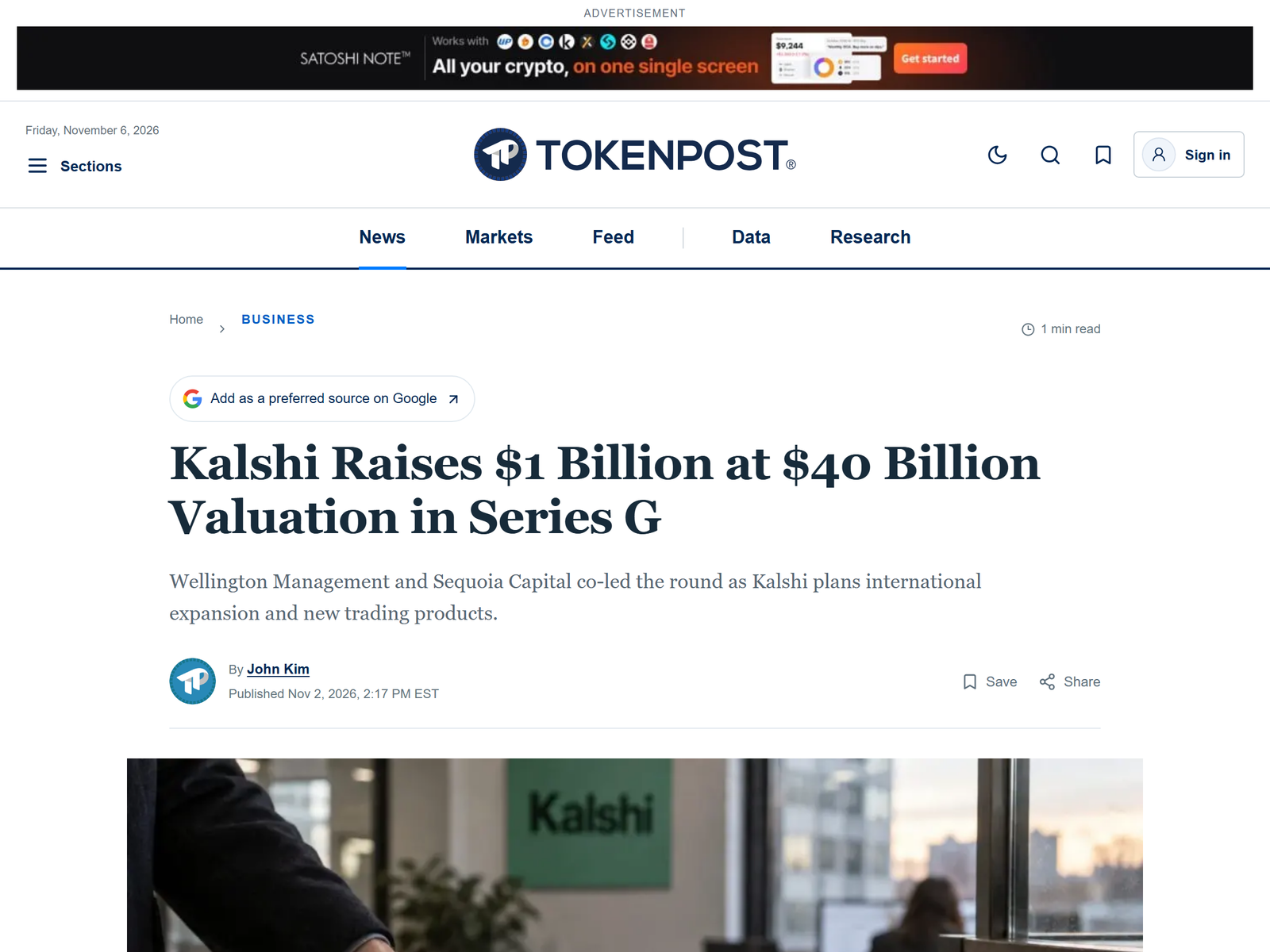
The valuation math is aggressive but not baseless. Kalshi reached a $2 billion valuation in June 2025, a $22 billion round led by Coatue in May 2026, and now $40 billion — an 82% step-up in five months and the second billion-dollar raise in that window. What changed is the business mix. The platform runs at more than $1 trillion in annualized trading volume across over 30 million accounts and holds more than 75% of US prediction-market volume. Annualized revenue has passed $4 billion, and non-sports products alone exceed a $1 billion run rate.
The division-level numbers show where growth is coming from. Commodities generated more than $100 million in annualized trading fees within three months of launch. Crypto volume reached $140 billion annualized. Politics cleared $8 billion. The perpetual futures business, live since September 2026 after CFTC approval, hit $83 billion in volume with over 500,000 traders. International retail, launched a year ago in more than 140 countries, is approaching $100 million in annualized fees (Gaming Intelligence carried the full breakdown, and TokenPost confirmed the investor list). CEO Tarek Mansour frames the endgame as a general-purpose financial exchange with prediction markets at the foundation.
What Compute Markets Actually Are
Compute markets are the piece AI teams should watch. The idea: list contracts whose value tracks the price or availability of computing capacity — GPU rental rates, compute indices, possibly capacity commitments from specific facilities. Kalshi's stated roadmap already includes markets tied to stock indexes, single-stock perpetual contracts, and computing capacity. Kalshi's own pitch makes the logic explicit: advances in AI change the demand for energy and compute, so markets should let people price that uncertainty.
Why does this matter? GPU rental prices swing wildly. A startup booking a year of H100-class capacity in a tight quarter can pay a multiple of what the same hours cost six months later. A tradable compute contract works like fuel hedging for airlines: an AI company that expects to need capacity can lock in economics today, while traders who believe a capacity crunch is coming can take the other side. The same mechanism that let farmers hedge grain prices since the 1800s now applies to inference hours. Whether the contracts settle on published rental indices, exchange capacity data, or third-party benchmarks will determine how hard they are to manipulate — and that detail has not been announced.
How to Approach Kalshi Compute Markets: A Practical Walkthrough
If compute contracts go live, here is the sequence I would follow, based on how the platform's existing markets behave:
- Create and verify an account early. Kalshi runs KYC checks, and verification queues lengthen during high-interest events.
- Learn the contract mechanics in liquid markets first. Most event contracts settle yes/no at $1; the perpetual futures launched in September are margin-based. Trade politics or economics markets with small size before touching anything new.
- Read the settlement spec before your first compute trade. The index definition is everything. If it references a single rental platform, expect volatility around that platform's pricing changes; if it aggregates several, expect smoother marks but slower settlement.
- Size it like a hedge, not a lottery ticket. If you run AI workloads, the rational position is small and offsetting — enough contracts to blunt a rental-price spike, not enough to make the position itself a balance-sheet event.
- Track the regulatory calendar. State actions can freeze product availability with little warning; Kalshi is currently suing Missouri over state regulatory attempts.
Traders who want charting and research depth alongside event contracts often pair Kalshi with dedicated analysis software — the TrendSpider market research and trading platform is one option our tools directory covers for technical work. Ongoing coverage of products like this lives in our Tool Dynamics section.
The Regulatory Overhang Nobody Underwrites
The funding coverage mostly ignored the legal position, and that is a mistake. Kalshi's perpetual futures cleared the CFTC in September 2026, but the broader prediction-market sector faces active state-level pushback, and Kalshi itself is litigating against Missouri. Every new product line — indexes, single-stock perps, compute — inherits that exposure. SCCG Management's analysis of the round put it plainly: unresolved US regulatory actions may push Kalshi toward institutional channels over retail access. A market you cannot legally access in your state has a valuation of zero to you, whatever Wellington paid.
My Take / The Bottom Line
I think compute markets are the most interesting product on this roadmap and the hardest to pull off. Hedging GPU costs is a genuine, unsolved need — any AI startup CFO will tell you that. But the product lives or dies on the settlement index, and indices built on prices from a handful of rental platforms invite disputes the moment real money sits on them. My take: Kalshi the exchange deserves the $40 billion conversation more than Kalshi the sports-book does, with $4 billion of annualized revenue and 75% market share doing the talking. The trade-off for newcomers is real, though — between regulatory risk and an unproven settlement mechanism, the smart first move is small hedges in liquid markets while the compute contracts prove themselves. Who wins here matters beyond one company: if compute markets work, AI capacity stops being a procurement problem and becomes a financial one.
Frequently Asked Questions
What did Kalshi's Series G value the company at?
$40 billion post-money on a $1 billion raise announced October 29, 2026, co-led by Wellington Management and Sequoia Capital. That is up 82% from the $22 billion Coatue-led round in May 2026 and 20x the $2 billion valuation of June 2025.
What are Kalshi compute markets?
Planned contracts whose value tracks the price or availability of computing capacity, such as GPU rental rates or compute indices. They would let AI companies hedge capacity costs and let traders take positions on compute scarcity, similar to how airlines hedge fuel.
Is Kalshi bigger than Polymarket?
By regulated US volume, yes — Kalshi reports more than $1 trillion in annualized trading volume and over 75% of prediction-market volume, with 30 million registered accounts. Polymarket's volumes are crypto-settled and not directly comparable, but Kalshi holds the clear US regulatory foothold.
What are the main risks of trading on Kalshi?
State-level regulatory actions that can restrict market access, settlement disputes on new index-based products, and the usual leverage risk on margin products like perpetual futures. Kalshi is currently in litigation with Missouri over state regulatory attempts.