Tencent HyMT3 Review: Open-Source MT for 102 Languages (2026)
Category: Tech Deep Dives
Excerpt:
Tencent's open-source HyMT3 covers 102 languages with 43% fewer mistranslations. What it means for game localization, and how to run it today.
This analysis was written by the aifreetool Editorial Team - a group of full-time AI-industry researchers and writers who verify every claim against primary sources. Last updated November 27, 2026. We keep no affiliate relationship with the companies covered here.
TL;DR: Tencent open-sourced HyMT3 on Nov. 24, 2026 - a translation model family (1.8B, 7B, and 30B-A3B MoE) covering 102 languages with 43% fewer mistranslations than its predecessor. It ranks near closed frontier models at a fraction of the compute, and game localization is where it genuinely separates from generic LLMs. Self-host it now; hosted API access is still one generation behind.
Key Takeaways

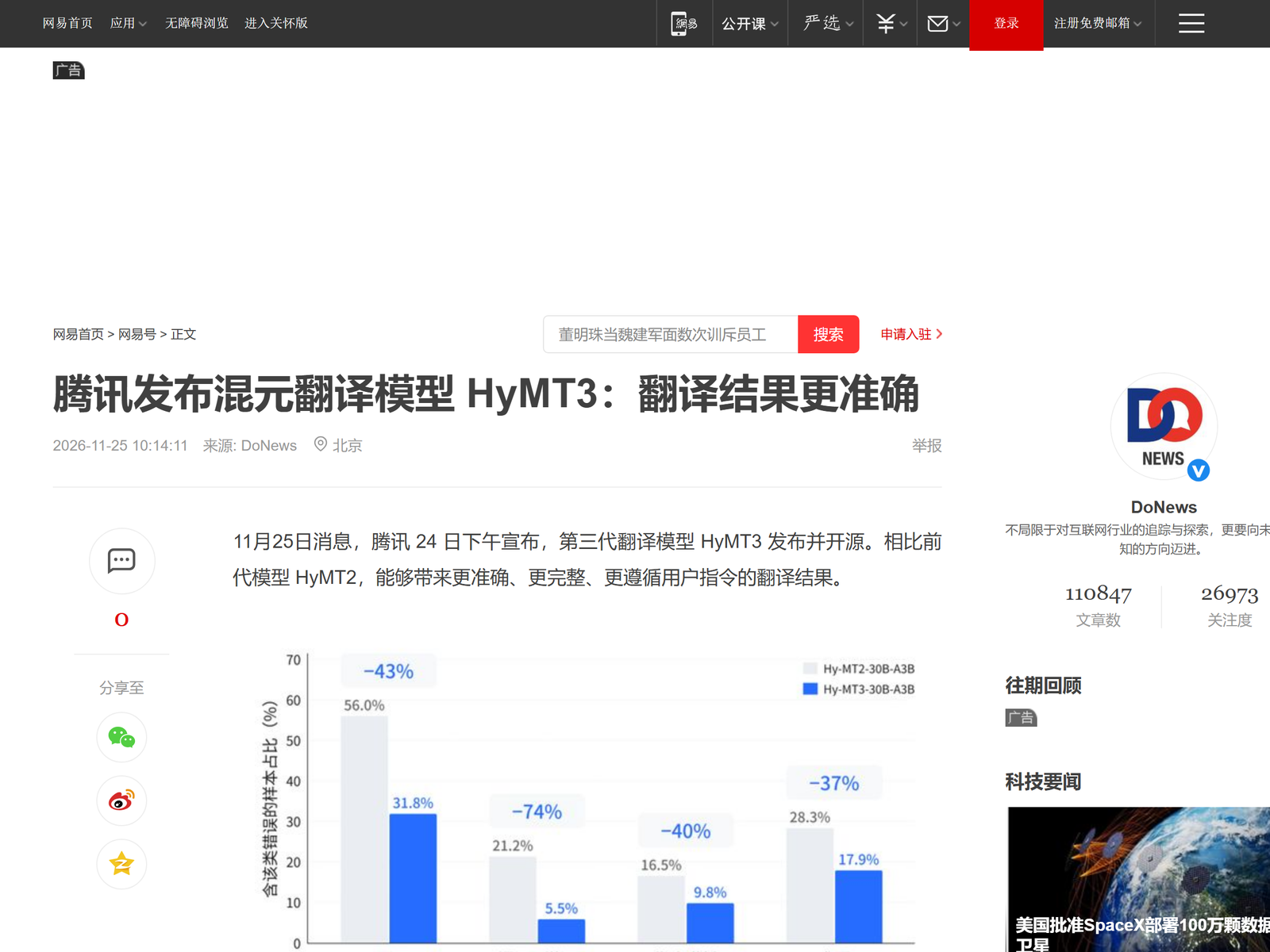
- HyMT3 expands language coverage from 38 to 102 and cuts mistranslated samples by 43%, omissions/additions by 74%, and instruction-following errors by 40% versus HyMT2.
- The 30B-A3B variant is a Mixture-of-Experts that activates only ~3B parameters per inference - frontier-tier quality at small-model cost.
- In fast-thinking-mode comparisons it beats Qwen3.8-Max, Kimi-K3.1-Pro, and DeepSeek-V4.1-Flash, and outperforms models using 30x its compute.
- Tencent co-trained game localization with the Honor of Kings team; core localization metrics beat Gemini 3.1 Pro.
- Catch: no official hosted API for MT3 yet - you self-deploy the open weights or use the older MT2 series on TokenHub.
What HyMT3 Actually Is

Tencent HyMT3 is the third generation of the Hunyuan translation model line, released and open-sourced on Nov. 24, 2026. The lineup is three sizes - 1.8B and 7B dense models plus a 30B-A3B Mixture-of-Experts - spanning phone and PC edge deployment up to server grade. Coverage jumped from 38 languages to 102, and the published quality deltas are specific rather than vague: on real-scenario data, the mistranslated-sample ratio dropped 43%, omission and addition errors fell 74%, and instruction-following mistakes (keep the HTML tags, keep placeholders, output translation only) dropped 40% against HyMT2. Jwview carried the full official spec sheet on release day.
That instruction-following number deserves more attention than it gets. Most translation complaints in production pipelines are not about vocabulary - they are about a model rewriting your file structure, dropping a <span> tag, or merging two strings. A 40% reduction there is a direct CI-failure reduction for any localization team.
Benchmarks: Frontier Quality, Small-Model Compute
Tencent's cross-model evaluation claims HyMT3-30B-A3B is the strongest overall model in "fast thinking" mode, ahead of Qwen3.8-Max, Kimi-K3.1-Pro, and DeepSeek-V4.1-Flash, and close to the top closed reasoning models of this cycle - GPT-6.1-Sol and Gemini-4-Argon. The efficiency claim is the bold one: it beats models whose estimated inference compute is 30 times higher, measured as roughly 2x activated parameters x token count. The eval stack is transparent for a change - FLORES-200 plus WMT26 plus a Chinese-minority-language set for general coverage, WildMTBench-202611 for real-world scenarios, IFMTBench for instruction following, all scored with TransRubric, which Tencent also open-sourced and which beat other automatic evaluators on the WMT26 track.
Healthy skepticism applies: the vendor picked the benchmarks. But the evaluation artifacts are public, so third parties can rerun them - which is more than most closed-model claims allow. Tencent Cloud developers published same-day hands-on tests reporting the error-reduction numbers hold up in practice on game-copy material.
Game Localization Is the Real Story
The most concrete vertical win is games. Tencent built the training and evaluation loop with the Honor of Kings team - yes, the biggest mobile game on the planet - contributing domain data and a professional evaluation system stratified by text length, rich text, placeholders, and term-dense long strings. On those core localization metrics, HyMT3-30B-A3B matches or beats Gemini 3.1 Pro. Why this matters: game strings are the hardest translation problem in production. Skill names must stay short, flavor lines must keep their tone, terminology must stay identical across 10,000 strings, and a dropped placeholder crashes the client. Honor of Kings also open-sourced its game-translation toolchain, pluggable into multi-platform, multi-format pipelines - so the whole loop, model plus workflow, is reproducible outside Tencent.
Image translation got a parallel upgrade: better context handling and higher tolerance for OCR errors, which matters for screenshots, posters, and any pipeline where the text arrives pre-mangled.
How to Run It Today - and the Catch
Consumer side is live now: the Hy Translation app and mini-program, plus Chrome and Edge extensions. The extension is the interesting one - it is currently the only major translation extension that installs a local model, auto-fitting NPU/GPU/CPU, and Tencent partnered with AMD on FastFlowLM acceleration for Ryzen AI 300/400-series NPUs, so translation runs fully offline. HyMT already powers Bilibili's live danmu translation and Immersive Translate, and the ecosystem shows real adoption: over 100 community GitHub repos (pyVideoTrans, AiNiee, PlayTranslate), official support merged into ONNX Runtime, NVIDIA NeMo, Alibaba MNN, and LLaMA-Factory. During the APEC summit in Shenzhen it served roughly 100,000 people with 3.5 million-plus translations.
The catch for developers: there is no official hosted API for MT3 yet. Your two paths are downloading the open weights and self-deploying, or calling Hunyuan translation APIs on TokenHub - which currently serve the previous MT2 generation. Plan your migration accordingly. If your pipeline is document-heavy rather than game-string-heavy, pairing HyMT3 with a dedicated checker like LanguageTool catches the residual grammar-layer issues; for marketing-asset localization, StoreLocale covers the app-store screenshot angle HyMT3 does not touch.
My Take / The Bottom Line
Our verdict: HyMT3 is the first open translation model that treats localization as an engineering discipline instead of a chatbot afterthought - format preservation, term consistency, and a public eval harness are exactly what production teams have begged for since LLM translation arrived. Who wins: indie game studios and app teams localizing into long-tail languages, who previously faced a choice between expensive agencies and quality-collapse generic LLM output; a 30B-A3B model that runs near Gemini-class localization quality on consumer hardware changes their unit economics outright. Who loses: generic-LLM translation wrappers selling thin API reskins, and mid-tier agencies whose moat was terminology management that is now open-source. The risk to watch is vendor-benchmark inflation - rerun TransRubric on your own strings before committing. Test it yourself on the hardest 50 strings in your product before trusting the headline numbers, and follow our tech deep dives for the follow-up benchmarks as third-party runs land. More tool-level coverage lives in tool dynamics.
Frequently Asked Questions
How many languages does Tencent HyMT3 support?
102, up from 38 in the HyMT2 generation, covering major and long-tail languages across the FLORES-200 evaluation set.
Is HyMT3 free to use?
The model weights are open-source and free to self-deploy in all three sizes (1.8B, 7B, 30B-A3B). The consumer Hy Translation app is free; there is no official hosted MT3 API yet.
How good is HyMT3 compared to closed models?
Tencent's evaluations put HyMT3-30B-A3B ahead of Qwen3.8-Max, Kimi-K3.1-Pro, and DeepSeek-V4.1-Flash, close to GPT-6.1-Sol and Gemini-4-Argon, and ahead of Gemini 3.1 Pro on game-localization metrics.
Can HyMT3 run offline?
Yes. The Hy Translation browser extension installs a local model that adapts to NPU, GPU, or CPU, with AMD Ryzen AI NPU acceleration via FastFlowLM - data never leaves the device.