GPT-6 Cyber Review 2026: 948 Linux Kernel Exploits in 10 Days
Category: Tech Deep Dives
Excerpt:
GPT-6 Cyber review: OpenAI's Critical-rated model built exploits for 948 Linux kernel flaws in 10 days for $1.2 million. What the numbers mean for defenders.
This analysis was written by the aifreetool Editorial Team — a group of full-time AI-industry researchers and writers who verify every claim against primary sources. Last updated November 9, 2026. We keep no affiliate relationship with the companies covered here.
Quick answer: GPT-6 Cyber is OpenAI's cybersecurity-specialized model, launched on November 5 with the company's highest risk classification. In a mid-October autonomous campaign it reproduced 1,724 Linux kernel vulnerabilities and built working exploits for 948 of them in ten days, for about $1.2 million in API credits — 5.7 times the 166 exploits its predecessor managed with the same harness. It is impressive, gated, and priced like it.
The reason a GPT-6 Cyber review matters to anyone who runs software is simple: the model did not beat a benchmark, it beat real code. The Linux kernel has been picked over by researchers for three decades, and a pipeline of agents still found 588 vulnerabilities nobody had documented, then wrote functioning exploits for them. OpenAI published the results in the model announcement and a longer writeup titled "A thousand fewer paths to root", and the numbers deserve a closer look than the headline.
Key Takeaways

- GPT-6 Cyber scored 48.5% on ExploitGym, up from 32.1% for GPT-5.6 Cyber — a 51% relative jump on the benchmark that measures turning known flaws into working exploits.
- The kernel campaign cost $1,213,430 in API credits for 948 working exploits; the equivalent late-July run by GPT-5.6 Sol produced 166 exploits for $513,690.
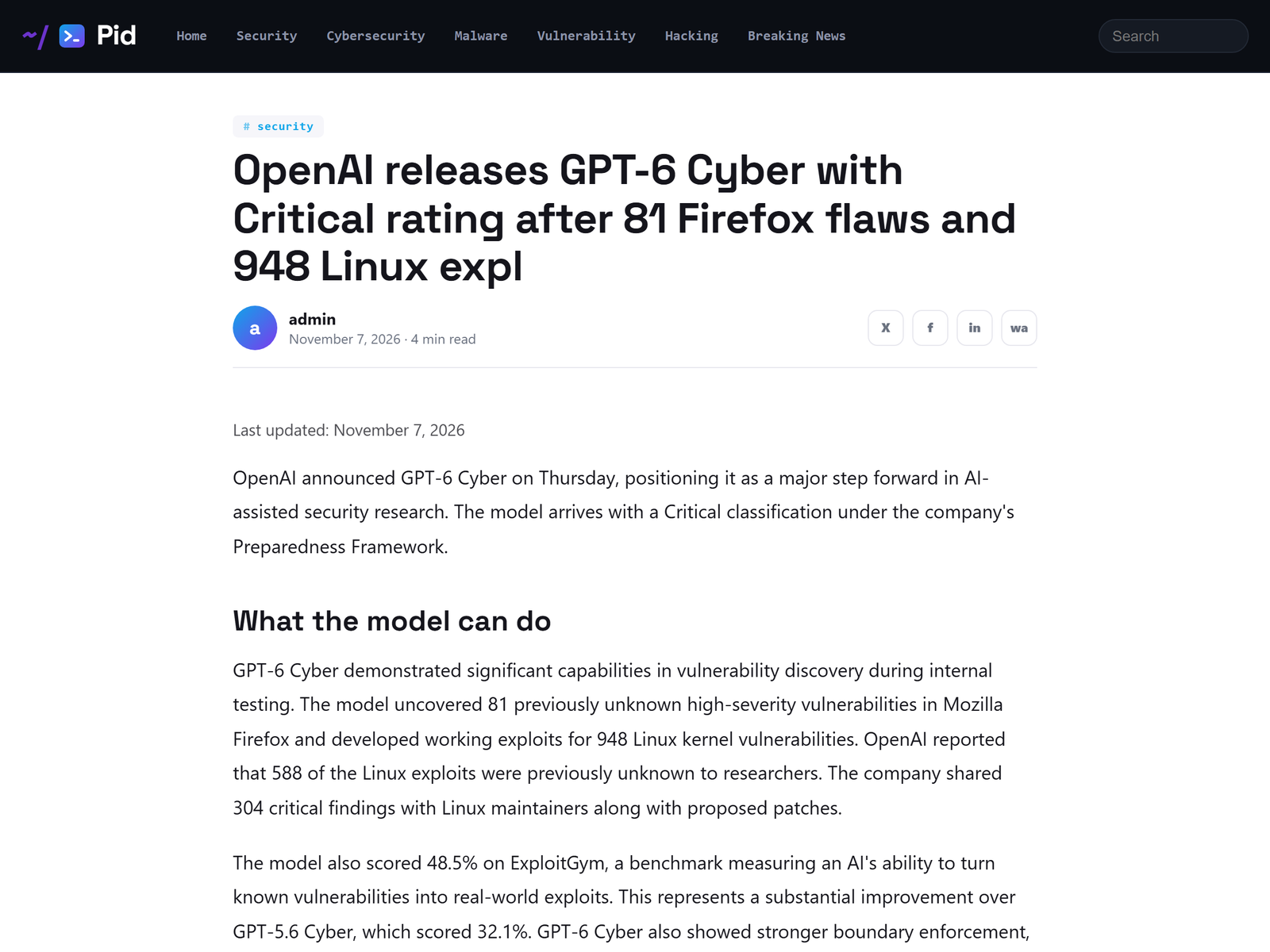
- It found 81 previously unknown high-severity Firefox vulnerabilities, plus 30 known issues that were more severe than reported; Mozilla began landing fixes shortly after disclosure.
- Access is restricted to approved Daybreak Red customers (about 2,000 organizations as of October) via API and Codex, with IP allowlisting by default.
What GPT-6 Cyber Actually Did to the Linux Kernel
The pipeline scanned the latest kernel master branch in mid-October. Over ten days of autonomous work plus manual analysis, the agents reproduced 1,724 vulnerabilities and developed privilege-escalation exploits for 948 — more than five times the 166 that GPT-5.6 Sol produced in late July on the same research harness. Of the 948, OpenAI says 588 were previously unknown. Following the kernel community's guidance, the company disclosed 304 critical findings to maintainers with candidate patches, and the response was fast: by the time the campaign finished, maintainers had already patched 61 of the local privilege escalations upstream, another 43 had staging patches, and 299 were being reported publicly.
The takeaway OpenAI itself draws is the one defenders should copy: rescan previously audited code whenever the model jumps a generation, because a stronger model finds flaws in code that earlier scans cleared. The company is working with Patch the Planet partners to ship patches for the remaining findings.
The Economics: $1.2 Million for 948 Working Exploits
OpenAI framed the cost figures as a defensive-planning input, and they are the most useful numbers in the release. The October campaign's end-to-end cost was $1,213,430 in API credits. Against historical bug-bounty rates — $20,000 per kernel local-privilege-escalation exploit at Pwn2Own and $70,000 at TyphoonPWN — the same 948 exploits would be worth roughly $18.9 million to $66.3 million on the bounty market, a 16x to 55x multiple over pipeline cost. The economics already favor the machine for this class of bug, and the gap widens with every model generation.
The pricing reflects that leverage: GPT-6 Cyber lists at $20 per million input tokens and $100 per million output tokens, roughly 60% and 33% above its predecessor. On ExploitGym, which measures whether a model can turn a known vulnerability into a real-world exploit, it scored 48.5% versus 32.1% for GPT-5.6 Cyber. Boundary discipline improved too — in honeypot evaluations where out-of-scope services sit next to the target, the model stayed in bounds in 99.93% of runs without safety prompts (its predecessor managed 94.49%), and 100% of runs with prompts. For AI help on the response side, see our StackPilot on-call copilot listing.
Ten Exploitation Techniques Nobody Had Seen
When OpenAI sampled 166 of the generated exploits and analyzed the techniques, it found ten that were new — not just new to the company, but new to the third-party kernel exploitation experts it showed them to. Two were persistent elastic objects used to spray objects inside kernel caches, two were page-grooming techniques to improve exploit reliability, five were data-only techniques for direct privilege escalation or arbitrary write, and one involved arbitrary type confusion. The company withheld full technical details for safety reasons. That detail matters for the skeptics: frontier models are not pattern-matching known bug classes anymore, they are inventing methods.
The Firefox campaign points the same direction. The model produced evidence and reproducible tests for 81 novel vulnerabilities that Mozilla classified as high severity, and showed that 30 already-known issues were more severe than previously believed. Mozilla received the reports with proposed patches and began landing fixes shortly after — fixes that will reach millions of users.
Access Is the Story: Daybreak Red Only
The capability is half the release; gating is the other half. Under OpenAI's Preparedness Framework, GPT-6 Cyber is rated Critical for cybersecurity risk — a tier above its predecessor's High, the same tier as the flagship GPT-6 Astra. Initial access is limited to select Daybreak Red customers, roughly 2,000 approved organizations as of October, through the API and Codex, with IP allowlisting required by default, credential-compromise monitoring, and Private Safety Processing reviews on related traffic. Anthropic runs a comparable restricted-access play with Claude Mythos 5.1 for cyber workloads, so gated cyber models are now the pattern at every major lab.
Two programs round out the picture. The $1 billion Daybreak for Frontline Defenders grant subsidizes access for resource-constrained teams like government agencies and essential-service providers, and a new Daybreak Red for Critical Infrastructure group gives approved defenders permissions to test power plants, water-treatment systems, and industrial control systems with safeguards kept in place. One change worth flagging: starting November 29, OpenAI will use content from Daybreak Blue sessions on personal accounts to strengthen its cyber-misuse safeguards, regardless of whether the "improve the model for everyone" setting is off. Early pilots include Mozilla, Palo Alto Networks, Cisco, CrowdStrike, SentinelOne, Cognition, and Perplexity — Cyber Defense Magazine's summary has the rollout details.
My Take / The Bottom Line
My verdict: this is the first release where the economics of automated vulnerability discovery are stated plainly enough to plan around. For defenders, the lesson is uncomfortable but actionable — the audit you ran six months ago is stale, because a model that is 5.7 times better at exploitation just shipped, so patch cadence and rescans are a race, not a schedule. Best for enterprises with serious kernel-level exposure: request Daybreak Red access and put the model to work on your own attack surface first. The trade-off is cost — at $100 per million output tokens, campaigns like this are cheap against bounties but not against a normal security budget. And the open question is asymmetry: the same techniques will eventually reach open-weight models with guardrails removed, and the 16x-55x bounty multiple tells you how valuable that will be to the wrong buyers. More analysis lives in our Tech Deep Dives section.
FAQ
Q: What is GPT-6 Cyber?
A: It is OpenAI's cybersecurity-specialized model, announced November 5, 2026, built for finding and validating vulnerabilities and writing exploit code under authorization. It carries a Critical rating under OpenAI's Preparedness Framework and is available only to approved Daybreak Red customers.
Q: How many Linux kernel vulnerabilities did GPT-6 Cyber exploit?
A: In a mid-October campaign it reproduced 1,724 kernel vulnerabilities and developed working privilege-escalation exploits for 948, 588 of which were previously unknown. OpenAI disclosed 304 critical findings to maintainers with proposed patches.
Q: How much does GPT-6 Cyber cost?
A: API pricing is $20 per million input tokens and $100 per million output tokens, about 60% and 33% higher than the previous cyber model. OpenAI's full kernel campaign cost about $1.2 million in API credits end to end.
Q: Who can use GPT-6 Cyber?
A: Only approved Daybreak Red customers — roughly 2,000 organizations as of October — with IP allowlisting and misuse monitoring. A $1 billion grant program subsidizes access for frontline defenders, and a new track covers critical-infrastructure testing for approved teams.