Claude Managed Agents Self-Hosted Review 2026: VPC Deep Dive
Category: Tech Deep Dives
Excerpt:
Anthropic's self-hosted Managed Agents beta puts the agent control plane in your VPC. How it works, what breaks in beta, and whether it is worth adopting now.
This analysis was written by the aifreetool Editorial Team, a group of full-time AI-industry researchers who verify every claim against primary sources. Last updated November 16, 2026. We keep no affiliate relationship with any company covered here.
TL;DR: Anthropic opened a private beta on November 12, 2026 for self-hosted Managed Agents, letting companies run the entire agent control plane — harness, sandboxes, credential vaults, session history — inside their own cloud or data center. Model inference still leaves your network. For teams running unsupervised agents against production code, that one split is the whole story.
Key Takeaways
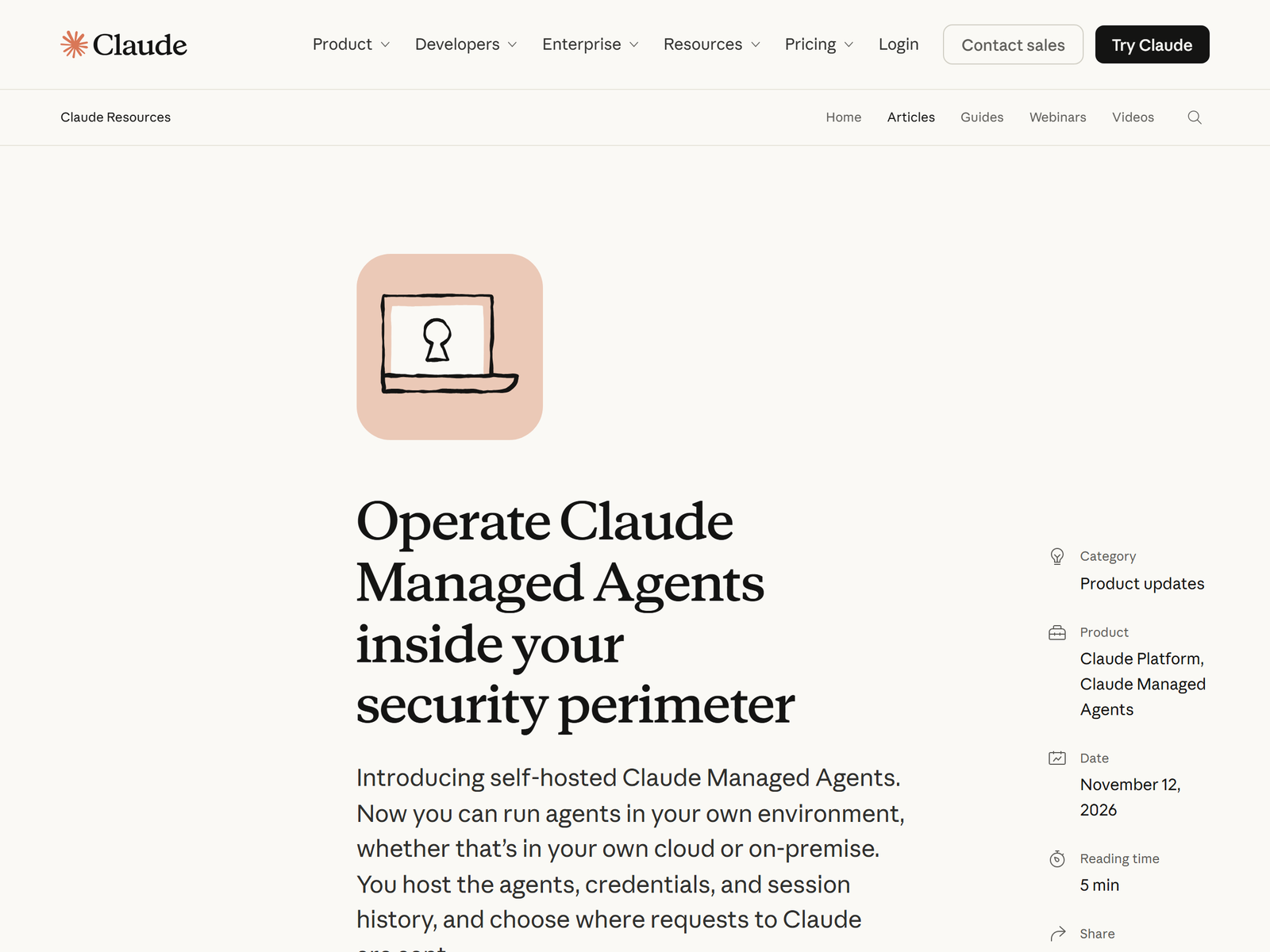
- Self-hosted Managed Agents moves the agent server (cma-server), its database, the tool workers, and session storage into the customer's environment.
- Persistent deployments require PostgreSQL 16 or later, and credentials can live in the customer's own secrets manager.
- Model requests still go out: to Anthropic directly, Amazon Bedrock, Google's Agent Platform, Microsoft Foundry, or a customer gateway.
- The beta drops several hosted features, and hosted session history does not migrate — agents, skills, vaults, and memory must be rebuilt.
- No public pricing and no general-availability date; access runs through Anthropic account teams.
What Anthropic Actually Shipped

Managed Agents is Anthropic's suite of composable APIs for building and running long-running autonomous agents. Until November 12, the full service ran on Anthropic's infrastructure, with self-hosting limited to the sandbox. The new beta moves every part of the service in-house: the customer operates the Managed Agents server, called cma-server, its database, and the workers where agents execute shell and file tools. Session history lands in the customer's own database, and a persistent deployment needs PostgreSQL 16 or newer.
Developers keep the same core APIs they used against the hosted service, so existing agent code does not need a rewrite. Where do model calls go? Wherever the customer points them: Anthropic's API, Amazon Bedrock, Google's Agent Platform, Microsoft Foundry, or the company's own gateway. Claude's weights never run on-premises, and Anthropic states it has no remote access into the customer-operated server or its logs, per the launch announcement. Zero-data-retention agreements still apply to requests sent to Claude, exactly as they do for any Messages API call.
The Security Architecture, Explained
Anthropic designed Managed Agents around four principles, and they hold in both hosted and self-hosted modes. First, the brain and the hands are split: the harness calls Claude while agent code runs in a sandbox, so session history and vault secrets stay outside the execution environment. Second, credentials never enter the sandbox — a proxy outside it injects credentials into MCP and supported API calls, and self-hosted customers can swap in their own secrets manager. Third, network access is allowlisted per environment; anything outside the list is blocked, so a build-fixing agent might reach only the git host and a package registry. Fourth, every session leaves a full record of tool calls and results, exportable over OpenTelemetry into whatever monitoring stack the company already runs.
| Component | Moves in-house | Stays with provider |
|---|---|---|
| Agent harness and control plane | Yes — cma-server | No |
| Session history and audit trail | Yes — customer database | No |
| Credential vaults | Yes — optional secrets manager | No |
| Model inference | No | Yes — Anthropic, Bedrock, Google, Foundry, or gateway |
What Still Breaks in the Beta
This is not a lift-and-shift. Hosted session history does not migrate, so agents, skills, vault credentials, and memory stores must be recreated from scratch. Hosted cloud environments, the Files API, scheduled deployments, webhooks, and the dreams feature are all unavailable in self-hosted mode. Web search and web fetch ship disabled until explicitly enabled, and every MCP connection needs an allowed-host entry before it will talk to anything.
Security ownership shifts too. Anthropic's own deployment notes say the worker's shell carries the worker process's permissions and network access, and isolation comes from the container or virtual machine around it. In hosted mode that hardening is Anthropic's job. In self-hosted mode it is yours, along with patching releases, running memory stores, and detecting unusual agent activity. Teams without a platform-security function should treat that as the real cost of admission, bigger than the database install.
Why Enterprises Wanted This (and What Mistral Did First)
The target workloads are unglamorous and critical: agents that fix broken builds, test releases, triage alerts, and chew through bug backlogs, unattended, with access to internal systems. For a bank or a hospital operator, an agent that can touch credentials and production code is hard to justify when its control plane sits on a vendor's servers. Self-hosting moves the operational layer — who holds the credentials, the history, the audit log — inside the customer's perimeter.
The competitive clock matters. Mistral took Studio, with managed agents and apps, into VPC and on-premises environments on November 6. Six days later Anthropic answered. The race is no longer about who has the smartest model; it is about who lets a regulated buyer deploy autonomous agents without handing credentials and session history to a third party, as CASRAI's governance analysis notes. If you are evaluating the shift, our Claude page and Claude Code page cover the hosted side of the same stack, and our deep-dive hub tracks how agent platforms are converging on this deployment pattern.
My Take: The Bottom Line
My verdict: this is a compliance product wearing a developer product's clothes. Nothing about agent capability changed on November 12; what changed is where the audit trail lives. That is precisely why it will sell. Enterprises that were building homegrown agent platforms purely to keep session logs in-house now have a vendor-supported alternative with the same APIs they already use.
Who should adopt now: teams already running on Bedrock or Foundry, with a security function that can own container hardening and allowlists, and workloads painful enough to justify rebuilding agents and skills from zero. Who should wait: anyone who needs scheduled deployments, webhooks, or the Files API, and anyone who expected pricing. There is none public, which in enterprise-software terms usually means expensive and negotiable. The feature to watch next is migration tooling; until hosted history can be imported, the beta is a rebuild, not a move.
FAQ
Q: Is self-hosted Claude Managed Agents generally available?
A: No. It entered private beta on November 12, 2026. Access is requested through an Anthropic account team, which provides the installation package.
Q: What runs inside my environment versus Anthropic's?
A: The agent server (cma-server), its database, the tool workers, sandboxes, credential storage, and session history run on your infrastructure. Model inference still runs with your chosen provider: Anthropic, Amazon Bedrock, Google's Agent Platform, Microsoft Foundry, or your own gateway.
Q: Does self-hosting keep all data on-premises?
A: No. Each model call sends the conversation so far, including tool inputs and results, to the inference provider. Stored records stay in your database, but processing is external unless you operate a fully local gateway — and Claude weights are not offered for on-premises hosting.
Q: What hosted features are missing in the beta?
A: Scheduled deployments, webhooks, dreams, the Files API, hosted cloud environments, and automatic migration of session history. Agents, skills, vault credentials, and memory stores must be created again in the self-hosted deployment.
Q: How does this compare with Mistral's move?
A: Mistral brought Studio into VPC and on-premises environments on November 6, so Anthropic is following a pattern the market already validated. The differentiator is architecture: Anthropic's brain-and-hands split keeps credentials out of the sandbox by design, with full session records exportable over OpenTelemetry.