How to Make Money With Boomy AI Music in 2026
Category: Monetization Guide
Reviewed by the aifreetool.site editorial team. This is an independent guide; we earn no commission and have no affiliate relationship with Boomy.
You can make money with Boomy in 2026 by generating original, royalty-free background music and intro themes for YouTubers, podcasters, game developers, and small businesses, and by building your own streaming catalog that earns royalties while you sleep. Boomy's AI writes a full original song in seconds from a chosen style, lets you tweak tempo and instruments, and distributes finished tracks to more than 40 streaming platforms, so a solo operator can deliver custom audio without a studio. Charge $20 to $150 per custom track or $200 to $1,000 per month per client, while your software runs $10 to $30 a month, and keep 80 percent of any streaming royalties your catalog earns.
Quick answer: In 2026, the practical way to earn with Boomy is to sell custom royalty-free music to creators who need a unique sound but cannot license a library track, and to release your own catalog to streaming for passive royalties. The Pro plan at $29.99 a month includes full commercial rights and 250 WAV downloads, leaving you a margin above 90 percent on a $300 to $1,500 monthly side income.
What Boomy does and the plan you'd use
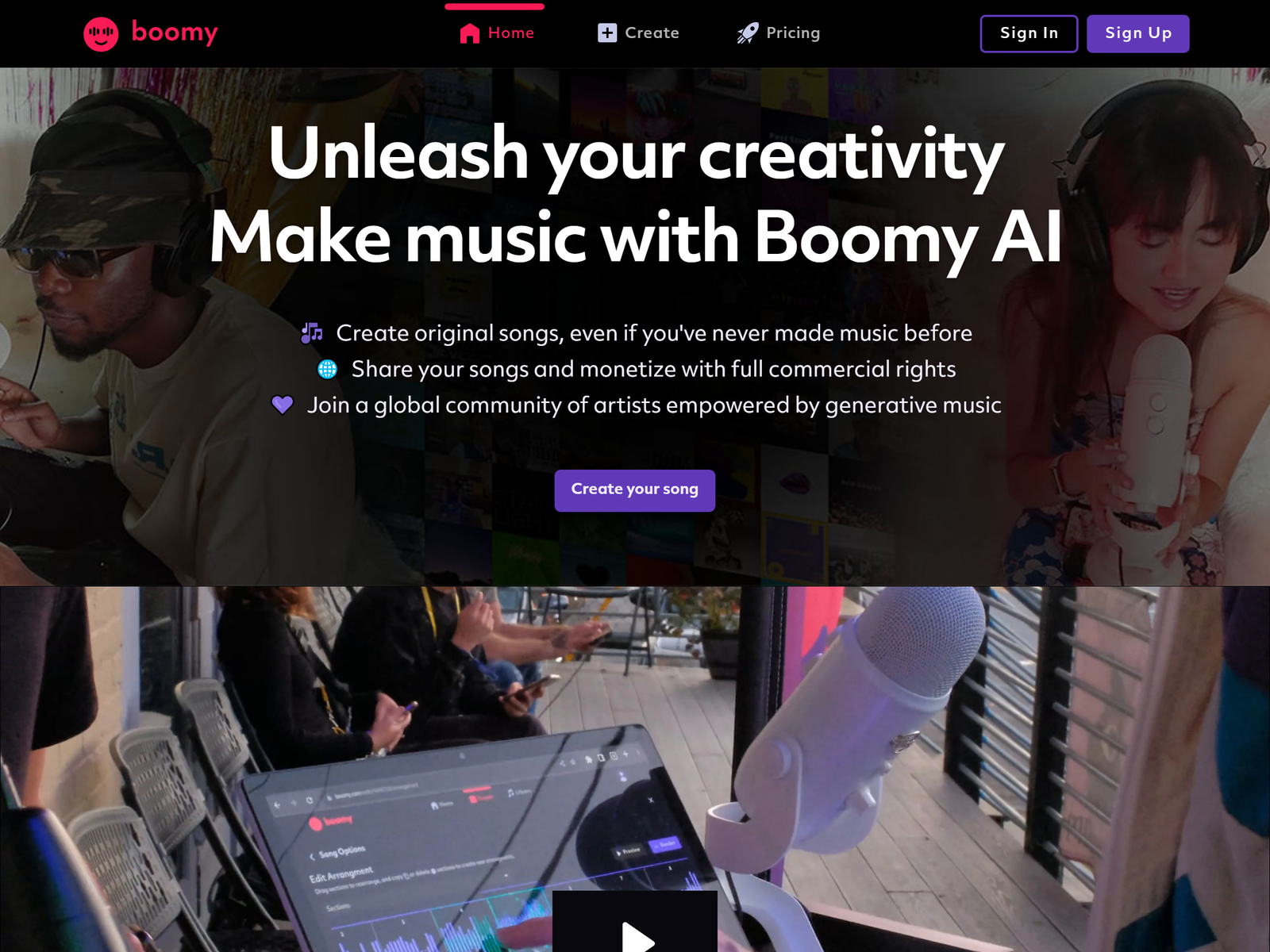
Boomy is an AI music creation and distribution platform. You pick a genre such as Lo-Fi, EDM, Cinematic, or Hip-Hop, adjust the mood, and the AI generates a complete song with melody, harmony, and arrangement in under 30 seconds. You can mute or swap sections, change tempo, adjust instrument levels, and add auto-vocals, then download the track or submit it for distribution to Spotify, Apple Music, Amazon, YouTube Music, and TikTok. Boomy states more than 20 million songs have been created on the platform, and paid subscribers keep 80 percent of net streaming revenue. On paid plans you receive full commercial rights to use the music in client videos, podcasts, and ads.
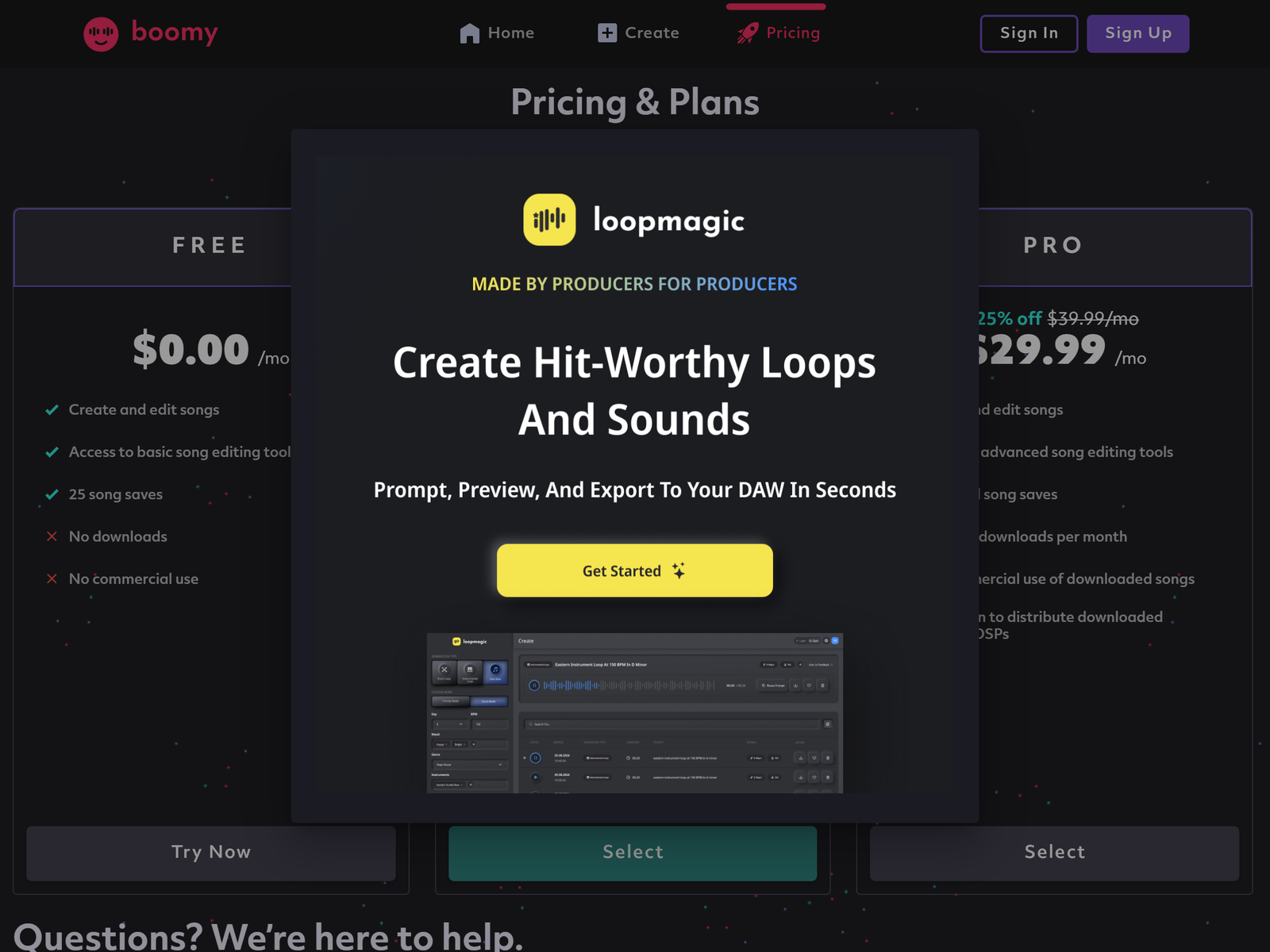
The free plan lets you create and edit unlimited songs with 25 saves and one release of up to three songs, but no downloads. The Creator plan at $9.99 per month gives 500 saves, 10 MP3 downloads a month, and three releases a month with non-commercial social rights. The Pro plan at $29.99 per month adds unlimited saves, 250 WAV downloads a month, distribution to all major platforms, stem-level editing, and full commercial rights. See the Boomy site and the pricing page for current figures.
The service to sell: custom tracks and a royalty catalog
The cleanest offer is a custom background-music package: a YouTuber or podcaster gets a unique intro, outro, and a few loopable beds that no one else can claim, instead of a generic library track. A creator will pay $50 to $150 because a signature sound builds a brand, and Boomy lets you deliver it the same day. A second offer is a game or app soundtrack for an indie developer who needs a handful of loops without hiring a composer, at $100 to $500 per project.
A third angle is your own passive catalog: you generate a library of Lo-Fi study beats or meditation soundscapes, release them as albums, and collect streaming royalties. Boomy handles the distribution and the royalty collection, and you keep 80 percent of net revenue. A local business package is an easy add-on too: a custom on-hold or lobby track.
Step-by-step: from sign-up to first paid client
Start the free plan and generate a few sample tracks in different genres, then download watermarks aside, use the web player to capture a clip as your portfolio. Pick one clean Lo-Fi and one Cinematic sample as your demo reel.
Find five creators or indie developers whose videos or games use generic or copyrighted music; a scroll through YouTube channels and indie game showcases shows who needs a sound. Send each a sample with a note: your content is great, but the music is someone else's, and here is a unique intro I made for you. Creators care about standing out, so lead with that.
Close a pilot at $20 to $50 for one custom intro. Deliver the WAV on a paid plan, show the client their own signature sound, then offer a full package and a monthly music retainer once they like the direction. Use the bulk generation to keep a client's channel stocked without renegotiating every track.
Pricing and margins
| Offer | Software cost | You charge | Gross margin |
|---|---|---|---|
| Single custom intro | $9.99/mo Creator | $20 to $150 | about 90 percent |
| Game or app soundtrack | $29.99/mo Pro | $100 to $500 | about 95 percent |
| Monthly music retainer | $29.99/mo Pro | $200 to $1,000 | about 97 percent |
Deliver four custom tracks a month at $80 each and you earn $320 against $10 in software. Add a game project and a streaming catalog and $500 to $1,500 a month part-time is realistic, plus slow royalty accrual from your releases.
Client management and quality control
Set the expectation that AI generates strong starting tracks, not a bespoke film score, so you present two directions and refine the chosen one. Tell clients commercial rights come with the Pro plan, and that streaming royalties on a released catalog are separate from a custom deliverable. Deliver as WAV and MP3 plus the license note, and keep the stems if the client wants later edits. For AI music in general, our Monetization Guides compare options, and a music rival like Mubert covers a different generation style if a client prefers royalty-free ambient beds on demand.
Pro tips and pitfalls
Reuse a short questionnaire per client so the AI gets a clear brief: genre, mood, length, and forbidden cliches. Lean on the royalty catalog as a second income line: a steady release schedule of study beats earns while you sleep. Generate the track from the client's brief so the result stays on brand, and keep the WAV exports as your deliverable proof.
The pitfall is shipping the first AI generation unchanged, and the catch is that clients can hear a template, so customize tempo and instruments on the winner. The risk is scope creep on just one more version, so price by track or by month, not by the hour. Do not promise a viral streaming payday, because per-stream royalties are tiny, and do not resell the same track to two competing creators in one niche.
Who this is and isn't for
This fits people with a basic ear for music who can turn a vague brief into a clear track. It suits freelancers, music students, and agency owners serving creators. It is not ideal if you dislike revision rounds or cannot meet a same-day turnaround, because music requests are often urgent. To explore the tool, visit the Boomy page on aifreetool.site, and browse the full directory at aifreetool.site.
My Take: The Bottom Line
Best for: freelancers who want a creative, high-margin service with a built-in second income line through streaming royalties. The trade-off is that Boomy is a music generator, not a composer; you must bring the taste and the client, or the track is pretty but empty. I think the custom-track service plus a personal royalty catalog is the smartest combo because it pays now and pays later. Skip it if you cannot stand last-minute can you try one more version requests, or if you expect streaming royalties to replace client work.
Frequently Asked Questions
Do I need music skills to start? A basic ear for genre and mood helps, but Boomy's generator does the heavy lifting. You mainly pick a direction and adjust tempo and instruments, which most people can learn in an afternoon.
How fast can I deliver a track? A custom track from a brief takes minutes including a couple of revisions. Same-day delivery is normal, and that speed is exactly what small creators pay for.
What should I charge a first client? Pilot at $20 to $50 for one intro, then move to a $100 to $500 soundtrack package or a $200 to $1,000 monthly retainer for ongoing music. Add $20 to $150 for a single custom bed.
Can clients use the music commercially? Yes. The Pro plan at $29.99 a month includes full commercial rights for client videos, podcasts, and ads. The free and Creator plans do not, so bill a Pro plan into any paid client work.
Will my streaming catalog actually earn? Boomy pays 80 percent of net streaming revenue, but per-stream payouts are small, so treat the catalog as a slow bonus on top of client work, not a replacement for it. A steady release schedule of study beats is the most reliable angle.