CuspAI Raises $450 Million to Invent the Next Generation of Materials With AI
Category: Industry Trends
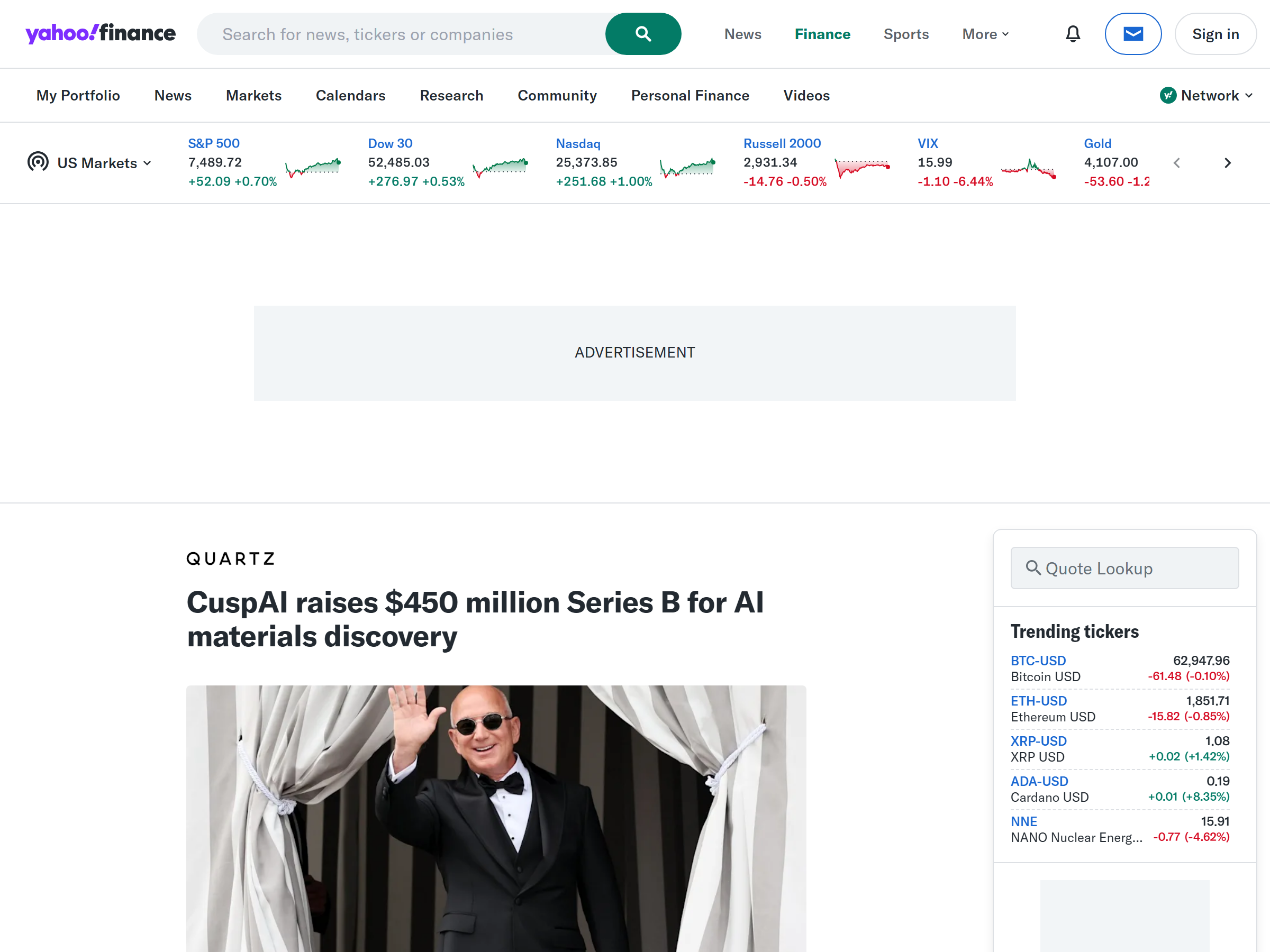
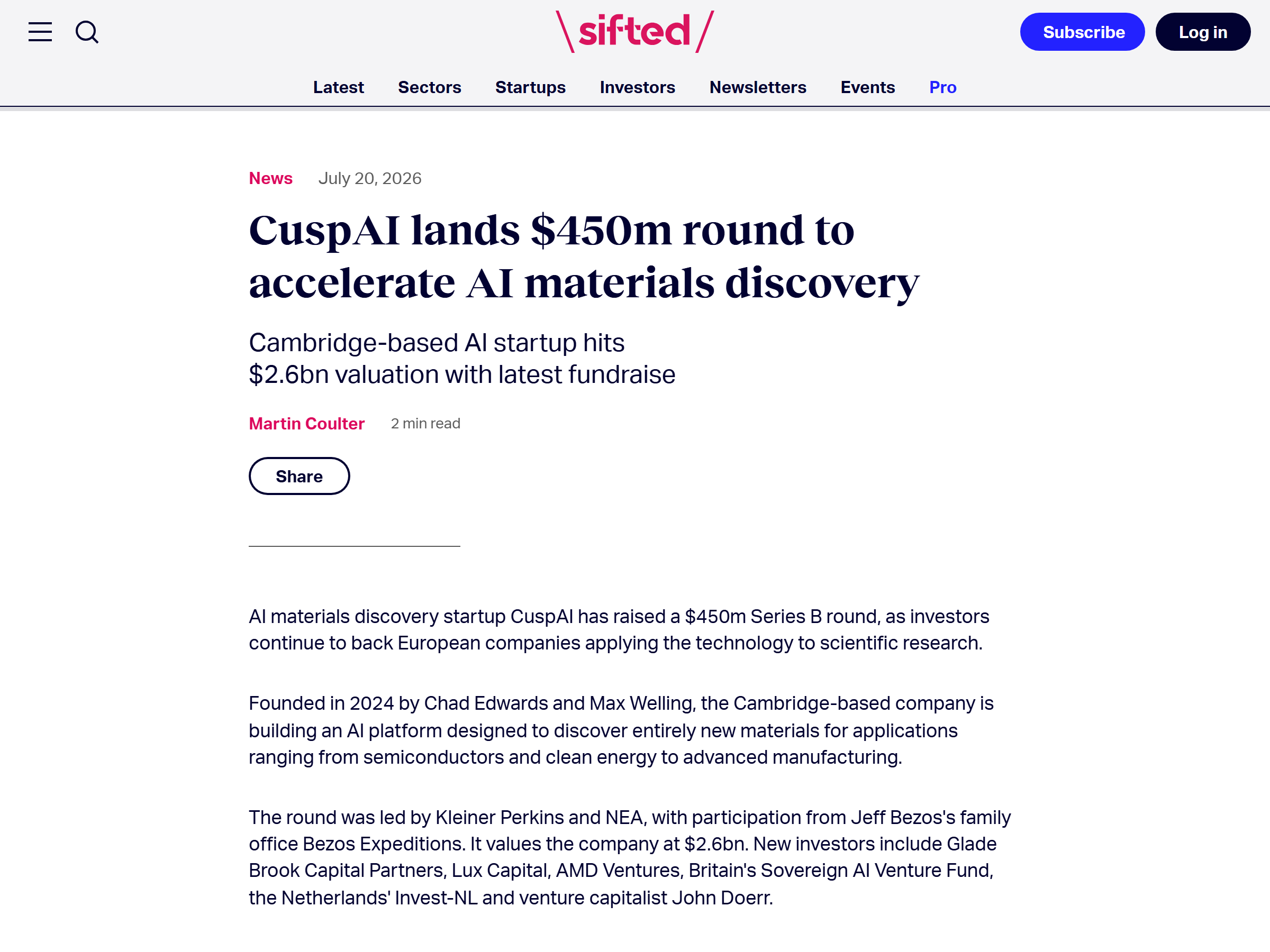
Most AI headlines chase bigger language models or faster chips. CuspAI, a two-year-old startup based in Cambridge, UK, is chasing something stranger and possibly more valuable: the atoms inside those chips. On July 20, 2026, the company announced a $450 million Series B round at a $2.6 billion valuation, led by Kleiner Perkins and NEA, with Jeff Bezos's Bezos Expeditions, AMD Ventures, Samsung, and the UK's Sovereign AI Venture Fund also joining. The bet is that AI can search the infinite space of possible materials and find the ones humans have missed.
From Carbon Capture to Chip Materials
CuspAI began in 2024 with a focus on carbon capture and water purification. Co-founders Chad Edwards, a former Quantinuum commercial executive, and Max Welling, an Amsterdam machine-learning professor known for variational autoencoders, built a platform called MIRA that predicts how a molecule will behave before anyone synthesizes it. The idea is simple in theory and brutal in execution: instead of testing materials one by one in a lab, use generative models to propose candidates, screen them in simulation, and only then run physical experiments.
That pitch pulled in $100 million-plus in a Series A just last September, valuing the company at $520 million. Nine months later, the valuation has quintupled. The reason is demand. Chipmakers and semiconductor suppliers, Edwards told Bloomberg, have been "literally pulled by all four limbs" toward the platform. The company now says 80% of its research bandwidth this year will go toward semiconductor materials, including efforts to remove or replace rare metals such as ruthenium and iridium from chipmaking workflows.
Semiconductors are a logical target. The industry is running into physical limits: transistors are approaching atomic scales, supply chains for critical metals are concentrated and fragile, and the cost of each new process node keeps climbing. If AI can predict a replacement material before it is ever made, the savings in time and money could be measured in billions.
The AI Materials Foundry Is the Real Product
Alongside the funding, CuspAI launched the AI Materials Foundry, a coalition of more than 45 organizations pooling computing, lab access, and scientific expertise. Founding members include Nvidia, Meta's Fundamental AI Research team, Samsung, Hyundai Motor Group, ASML, Hitachi High-Tech, Merck, and Lam Research. Nvidia is supplying compute infrastructure; Meta is contributing to a universal model for atoms; chip equipment makers are offering manufacturing know-how.
The structure is clever. CuspAI does not just sell software. It sits at the center of a flywheel: partners feed in data from real experiments, MIRA learns from those results, and the improved model designs better materials, which lead to more experiments. A project with Kemira, a water treatment company, illustrates the loop. CuspAI screened 300 trillion molecular structures and delivered twenty validated candidates in six months. The company claims traditional methods would have taken years.
The coalition also gives CuspAI something hard to copy: proprietary experimental data. Generative models for chemistry are increasingly commoditized; the training data from real labs is not. John Giannandrea, formerly head of AI at Apple and Google, joined part-time to help build the US foundry operations. Abhi Talwalkar, an AMD board member and Lam Research chairman, joined the advisory board. The advisors read like a who's who of AI and semiconductor leadership.
The Limits: No Commercial Product Yet
Here is the catch. For all the capital and partnerships, CuspAI has not advanced any project to commercial development. Neither have its main competitors. The materials discovery business is long. A promising candidate still needs synthesis, characterization, scaling, regulatory approval, and integration into existing manufacturing lines. Each step can take years. The $450 million is not revenue; it is runway.
Investors are betting that the platform itself becomes the asset. If MIRA can consistently produce validated candidates faster than traditional R&D, CuspAI could collect licensing fees, milestone payments, or joint-venture economics from every material that reaches production. But that is a future business model, not a present one. The valuation assumes the technology works at scale before it has actually done so.
Key Takeaways
- CuspAI raised $450 million in Series B funding on July 20, 2026, at a $2.6 billion valuation, up from $520 million in September 2025.
- The AI Materials Foundry includes Nvidia, Meta, Samsung, Hyundai, ASML, and more than 40 other partners sharing compute, labs, and expertise.
- Semiconductors now absorb 80% of the company's research focus, especially replacing rare metals like ruthenium and iridium.
- The MIRA platform screened 300 trillion molecular structures for Kemira and delivered twenty validated candidates in six months.
- No CuspAI project has yet reached commercial production; the round buys runway, not proven revenue.
My Take / The Bottom Line
CuspAI is the most credible attempt yet to turn AI into a genuine materials discovery engine, not just a chatbot for chemists. The partnership roster is the story: when Nvidia, Meta, ASML, and Samsung all show up, they are not buying hype, they are buying insurance against a materials bottleneck that could strangle the AI build-out itself. The risk is timing. Materials science moves slowly, and a $2.6 billion valuation demands results on a venture schedule. If MIRA delivers even one commercially viable chip material, the return could be enormous. If it does not, this round will be remembered as a very expensive science project. For readers tracking where AI actually creates value beyond text and images, CuspAI belongs on the watchlist.
FAQ
What does CuspAI actually do?
CuspAI builds an AI platform called MIRA that designs and screens new materials in simulation before they are physically tested, aiming to speed up discovery for semiconductors, clean energy, and advanced manufacturing.
Who invested in the $450 million round?
Kleiner Perkins and NEA led the round. Jeff Bezos's Bezos Expeditions, AMD Ventures, Samsung, the UK's Sovereign AI Venture Fund, Glade Brook Capital, Lux Capital, and existing investors Temasek and Prosus also participated.
Why are chipmakers interested in CuspAI?
Semiconductor manufacturers face physical scaling limits and fragile supply chains for rare metals. CuspAI's models could identify replacement materials faster than traditional lab experimentation.
Has CuspAI commercialized any material?
Not yet. The company and its competitors are still in the discovery and validation phase, with no candidate yet reaching commercial production.
What is the AI Materials Foundry?
It is a coalition of more than 45 companies and research organizations that pool computing, laboratory access, and expertise to accelerate AI-driven materials discovery on CuspAI's platform.
You can explore AI tools for research and model discovery on Hugging Face at aifreetool.site.