Google's Free Cash Flow Just Went Negative. That Is What the AI Infrastructure Bill Looks Like.
Category: Industry Trends
Alphabet reported something on July 22 that it has never reported since going public in 2004: negative quarterly free cash flow. The company burned through $5.9 billion in cash after capital expenditures hit $44.9 billion — more than double what it spent in the same quarter a year earlier. For anyone tracking AI infrastructure spending across the hyperscale cloud providers, Google's Q2 2026 earnings mark a financial threshold that reshapes how the industry thinks about the cost of competing in artificial intelligence.
The paradox is striking. Google's revenue grew 24% to $119.8 billion — its 12th consecutive quarter of double-digit growth. Google Cloud surged 82% to $24.8 billion, with operating income more than tripling to $8.8 billion. Gemini has 950 million monthly active users. The company started pre-training Gemini 4. None of that prevented free cash flow from going negative, because the infrastructure required to power all of it now costs more per quarter than Google's operations generate.
The Numbers Behind Google's First Negative Quarter
The earnings transcript and SEC filing lay out the mechanics plainly. CFO Anat Ashkenazi confirmed that Q2 capital expenditures totaled $44.9 billion, up from $22.4 billion in Q2 2025 — a 100% increase. Approximately 60% went to servers (GPUs and TPUs), and 40% to data centers and networking equipment. Operating cash flow was $39.1 billion, but after capex, free cash flow landed at negative $5.9 billion.
For comparison, Q1 2026 capex was $35.7 billion with positive free cash flow of $10.1 billion. The quarter-over-quarter acceleration — an additional $9.2 billion in spending — is what pushed Google past the break-even line. Ashkenazi did not frame this as a temporary spike. She raised the full-year 2026 capex guidance from $180–190 billion to $195–205 billion and said 2027 spending would 'still increase significantly.'
The spending is not going to acquisitions or buybacks. It is going to physical infrastructure: warehouses full of GPUs, TPUs, and the networking gear to connect them. Google also began recognizing revenue from TPU system sales to external customer data centers for the first time in Q2, meaning the company is now both a consumer and a vendor of AI compute. Q3 guidance includes expanding third-party compute procurement because Google's own capacity cannot meet demand.
| Metric | Q2 2025 | Q2 2026 | Change |
|---|---|---|---|
| Total Revenue | $96.4B | $119.8B | +24% |
| Google Cloud Revenue | $13.6B | $24.8B | +82% |
| Cloud Operating Income | $2.8B | $8.8B | +214% |
| Capital Expenditure | $22.4B | $44.9B | +100% |
| Free Cash Flow | Positive | -$5.9B | First negative since IPO |
| Cloud Operating Margin | 20.7% | 35.6% | +14.9pp |
Why Capex Keeps Climbing and Will Not Stop
Three forces drive the spending curve upward, and none show signs of flattening.
First, model training costs scale faster than efficiency gains. CEO Sundar Pichai confirmed that Google has started pre-training Gemini 4, which will require substantially more compute than Gemini 3.5 Pro (still in testing). The Gemini API now processes 22 billion tokens per minute, and the Gemini app's 950 million monthly active users generate inference demand that compounds daily. Daily active users have tripled over the past year.
Second, enterprise demand outstrips supply. Ashkenazi explicitly stated that Google remains 'in a capacity-constrained environment' where both external cloud customers and internal teams compete for the same compute. Google Cloud's 82% revenue growth would have been higher without these constraints. The Cloud backlog reached $514 billion — up $49 billion from the prior quarter — with more than half expected to convert to revenue within 24 months. Nearly 90% of the Fortune 100 now use Gemini Enterprise.
Third, the competitive landscape forces continuous investment. Microsoft, Amazon, Meta, and Oracle are all ramping capex at similar rates. Falling behind on compute means losing cloud customers to competitors who can provision GPUs faster — and losing benchmark rankings to rivals training on larger clusters. Google's decision to sell TPU systems externally suggests it sees infrastructure itself as a revenue stream, not just a cost center.
Moody's Warning: The Whole Sector Is Going Asset-Heavy
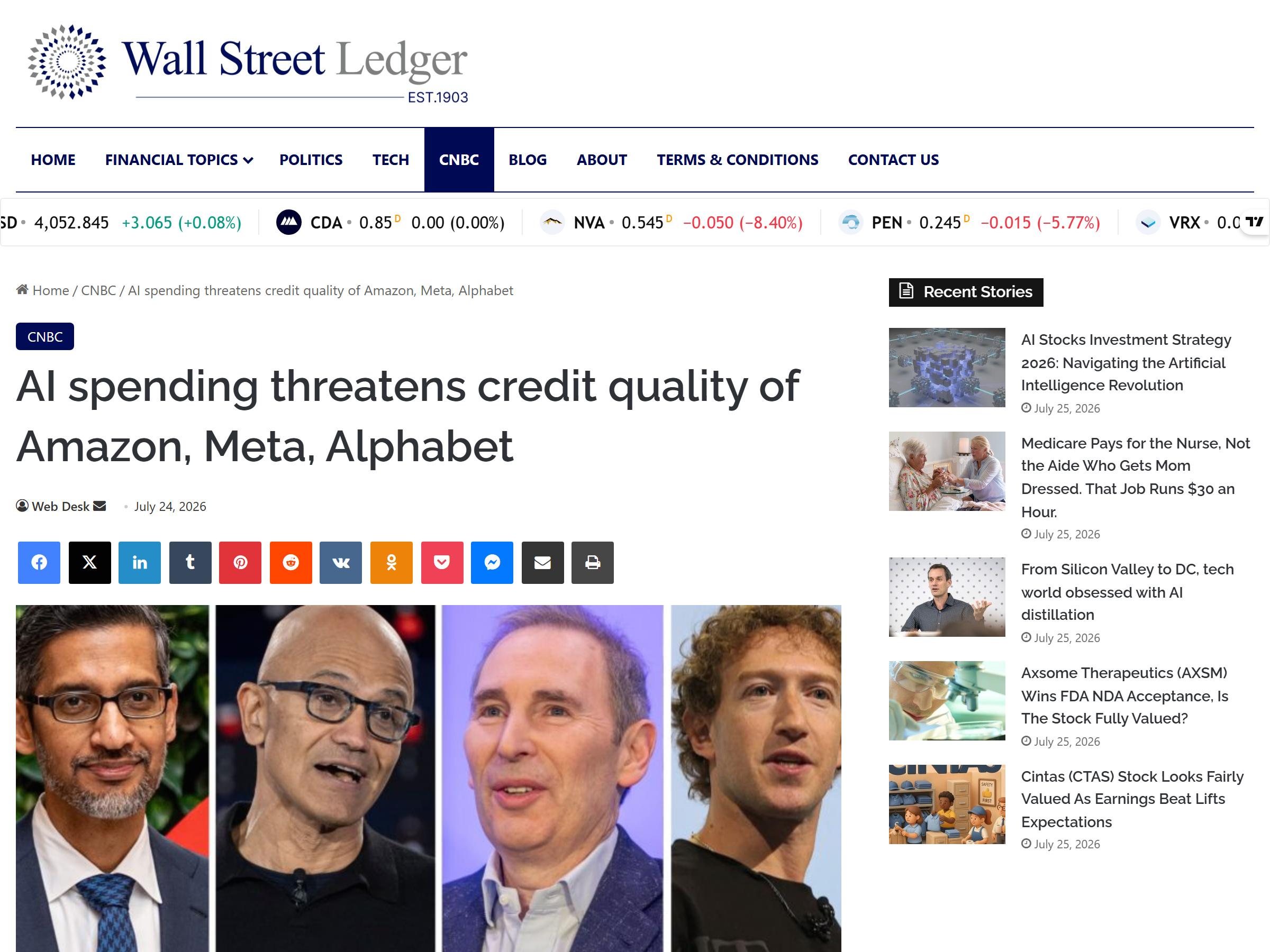
Google's negative quarter is not an isolated event. On July 22, Moody's Ratings published a research note warning that the AI infrastructure race is eroding the free cash flow of six hyperscalers: Microsoft, Amazon, Alphabet, Meta, Oracle, and CoreWeave. The rating agency projected their combined 2026 capital expenditures at $785 billion, rising to approximately $1 trillion in 2027. Morgan Stanley's separate estimate puts the top five at $805 billion in 2026 and $1.1 trillion in 2027 — a sum equivalent to roughly 3.2% of U.S. GDP.
Moody's highlighted that direct debt across these six companies has reached approximately $460 billion. Off-balance-sheet data center lease commitments have ballooned to $1.2 trillion, with over $820 billion tied to facilities still under construction. Alphabet alone announced an $85 billion equity sale — the largest in corporate history — to help finance the buildout.
The rating agency also flagged a structural concern it called a 'circular AI ecosystem': hyperscalers invest billions in AI labs like OpenAI and Anthropic, which then spend heavily on cloud computing from those same hyperscalers. This creates concentrated risk where the industry's largest players depend on the same customers and the same demand assumptions. While Moody's noted that Microsoft, Alphabet, Amazon, and Meta retain strong enough balance sheets to avoid imminent downgrade risk, the pressure is acute for lower-rated players. Oracle carries a Baa2 rating with a negative outlook — two notches above junk. CoreWeave operates at Ba3, deep in high-yield territory.
Key Takeaways
- Google's Q2 2026 free cash flow turned negative for the first time since its 2004 IPO as capex doubled to $44.9 billion.
- Full-year 2026 capex guidance was raised to $195–205 billion, with 2027 expected to increase further.
- Google Cloud revenue grew 82% to $24.8 billion with a 35.6% operating margin — highly profitable, but unable to self-fund the infrastructure it requires.
- Moody's projects six hyperscalers will spend $785 billion on capex in 2026, rising to $1 trillion in 2027, with $1.2 trillion in lease commitments.
- Google began selling TPU systems externally and will expand third-party compute procurement in Q3 — becoming both a compute producer and a compute buyer.
FAQ
Why did Google's free cash flow go negative in Q2 2026?
Capital expenditures reached $44.9 billion in Q2 2026, double the prior year. Operating cash flow of $39.1 billion could not cover this spend, producing negative free cash flow of $5.9 billion. The spending went primarily to AI servers, data centers, and networking equipment.
Is Google in financial trouble?
No. Alphabet holds $242.5 billion in cash and marketable securities and generated $40.8 billion in operating income this quarter. The negative free cash flow reflects a deliberate investment push, not a revenue problem. However, sustained capex escalation will pressure margins and may require continued debt and equity financing.
What does this mean for Google Cloud customers?
Google Cloud is capacity-constrained, meaning demand exceeds available GPU and TPU supply. Customers may face longer provisioning times. Google plans to expand third-party compute procurement in Q3 to bridge the gap, and its massive investment should expand capacity through 2027.
How does Google's capex compare to other tech giants?
Moody's projects the six largest cloud providers will spend a combined $785 billion in 2026 and approximately $1 trillion in 2027. Google's $195–205 billion guidance represents roughly a quarter of that total. Morgan Stanley estimates the top five alone will spend $805 billion in 2026.
Will Google cut spending if AI revenue does not materialize?
AI revenue is currently materializing — Cloud grew 82% and the backlog stands at $514 billion. But Pichai acknowledged that returns are 'still in early stages.' If growth slows, capex could be moderated, though the competitive dynamic makes near-term cuts unlikely.
My Take
The headline 'Google's cash flow goes negative' sounds alarming, but the more accurate read is that Google is making a calculated bet: spend whatever it takes to win the AI infrastructure race, because the company with the most compute will control the AI market. With $242.5 billion in cash and a $514 billion Cloud backlog, Google can sustain this burn rate for years.
The real risk is not to Google — it is to everyone who is not a hyperscaler. If six companies are spending $785 billion annually on AI infrastructure, every other enterprise is now structurally dependent on renting compute from one of them. For businesses evaluating AI tools and cloud platforms, this means infrastructure costs will likely stay high or rise before they fall. You can explore AI tools that help optimize cloud and infrastructure spending on aifreetool.site.
Moody's 'circular AI ecosystem' warning deserves more attention than it has received. When the same companies funding AI labs also sell them compute, and those labs' valuations depend on compute consumption, the feedback loop creates systemic risk. The question that matters is not whether Google can afford $200 billion a year — it clearly can. The question is whether the AI applications built on that infrastructure will generate enough economic value to justify the trillion-dollar bet the entire sector is making. That answer is still years away.