Google DeepMind's Gemini Robotics 2 Is the First AI to Control a Whole Humanoid. It Still Drops Things.
Category: Tech Deep Dives
Google DeepMind released Gemini Robotics 2 on July 30, 2026, and the headline is easy to miss behind the usual AI noise. For the first time, a single vision-language-action model controls an entire humanoid robot, from leg movement and balance through torso rotation to finger manipulation. The system is not perfect. In tests, removing a light bulb worked 92% of the time; installing one worked only 36%. Picking objects off the floor succeeded 46% of the time. The release is honest about those limits, and that honesty is what makes it interesting.
Three Models, One Body
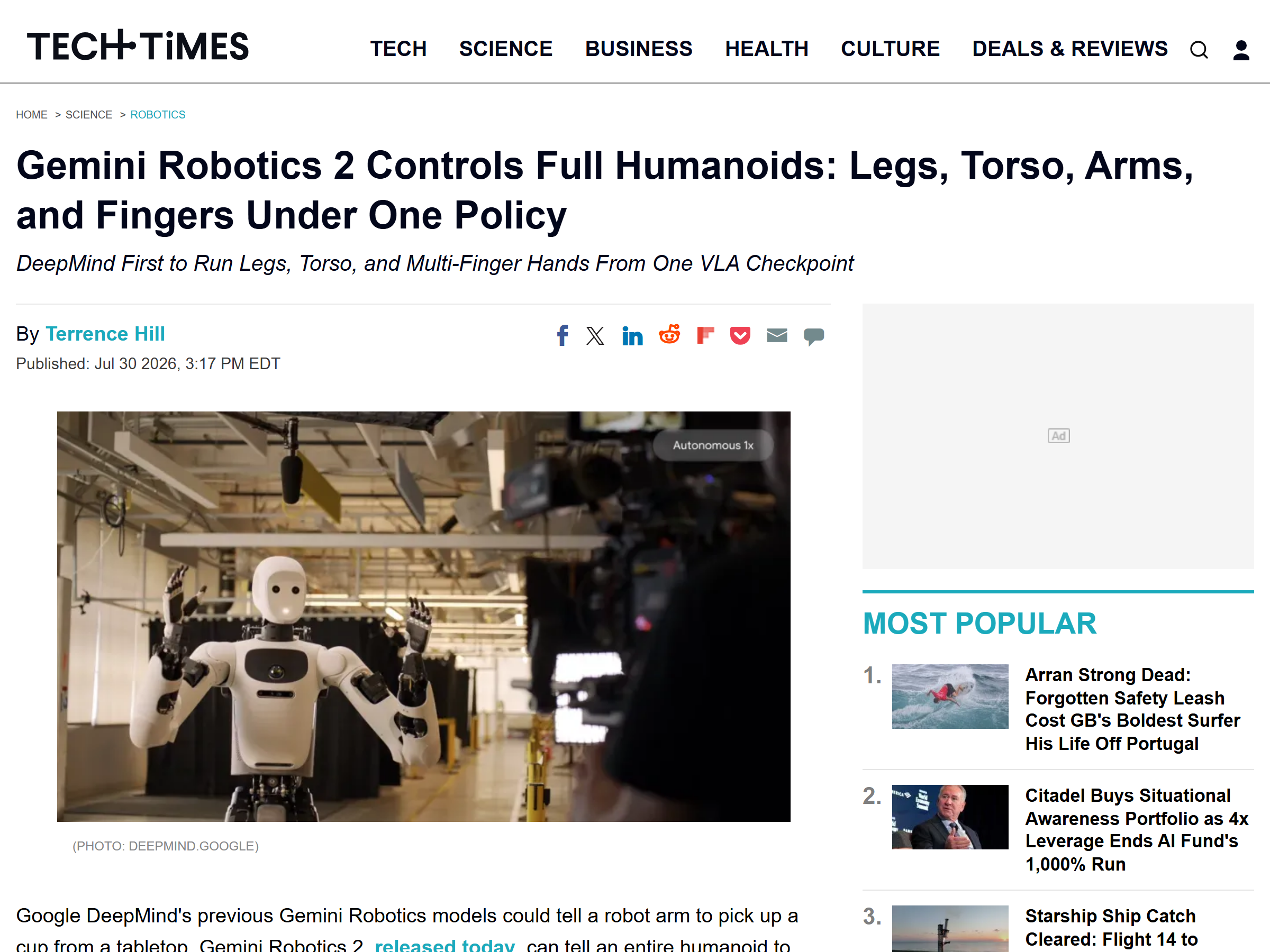
Gemini Robotics 2 is actually a family of three models. Gemini Robotics 2, the core VLA model, translates camera input and natural-language commands directly into motor signals. Unlike earlier versions that controlled only upper-body tabletop tasks, this one manages the whole body. Gemini Robotics ER 2 is the reasoning layer: it watches video, understands the environment, breaks multi-step tasks into hundreds of intermediate decisions, tracks progress, and coordinates multiple robots. Gemini Robotics On-Device 2 is a lightweight version that runs locally and can adapt to a new robot hardware design with roughly 200 examples or a few hours of data.
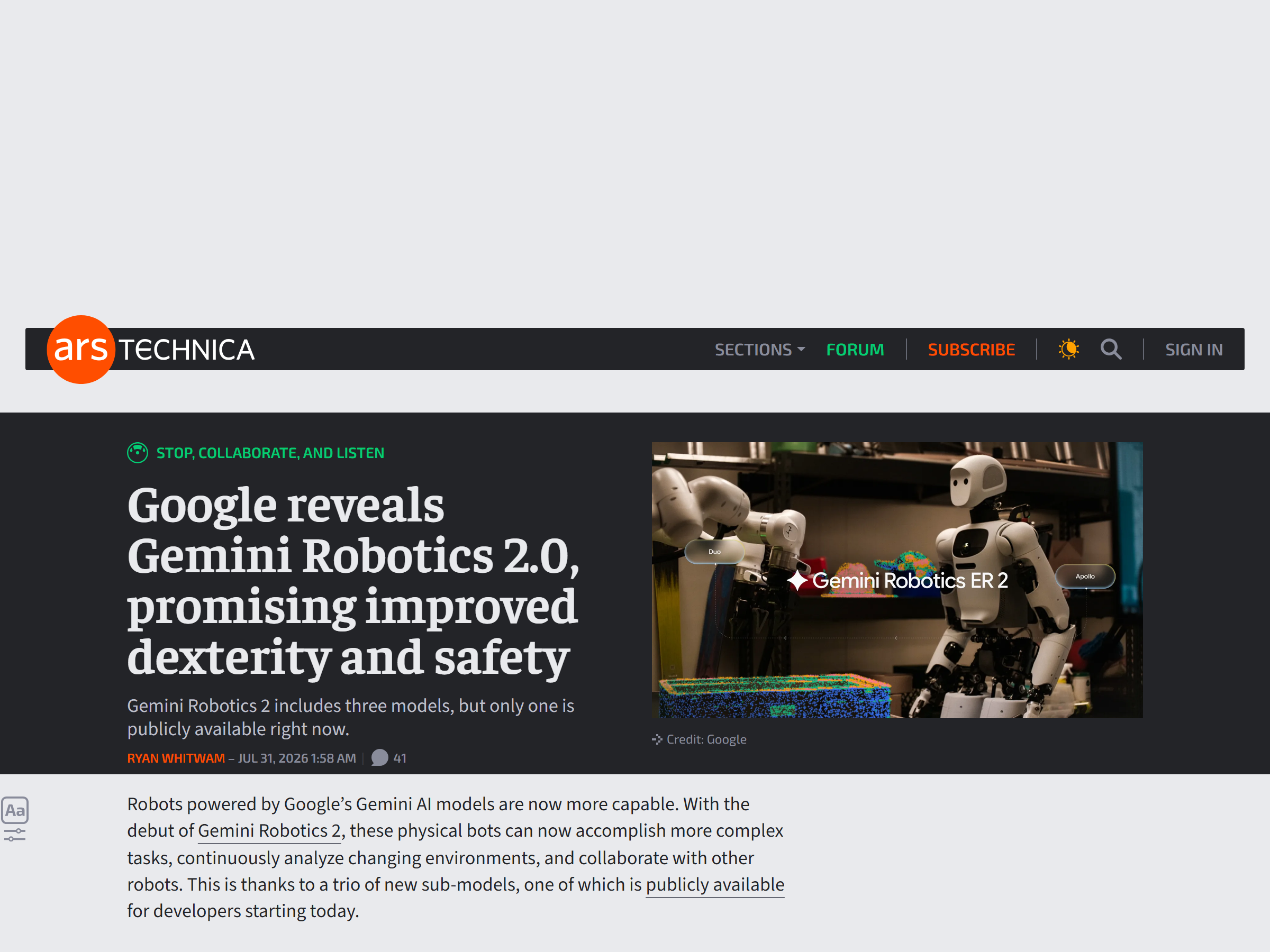
In a staged demonstration, the model controlled Apptronik's Apollo 2 humanoid. Given the instruction to put a watering can into a green bin on a bottom shelf, the robot walked across the room, picked up the object, crouched to clear the shelf height, and placed it. The same model checkpoint also ran on different hardware, including Apollo 2 with two different hands and a Franka Duo bi-arm platform. That cross-hardware transfer is the technical point DeepMind wants to prove.
Why Whole-Body Control Matters
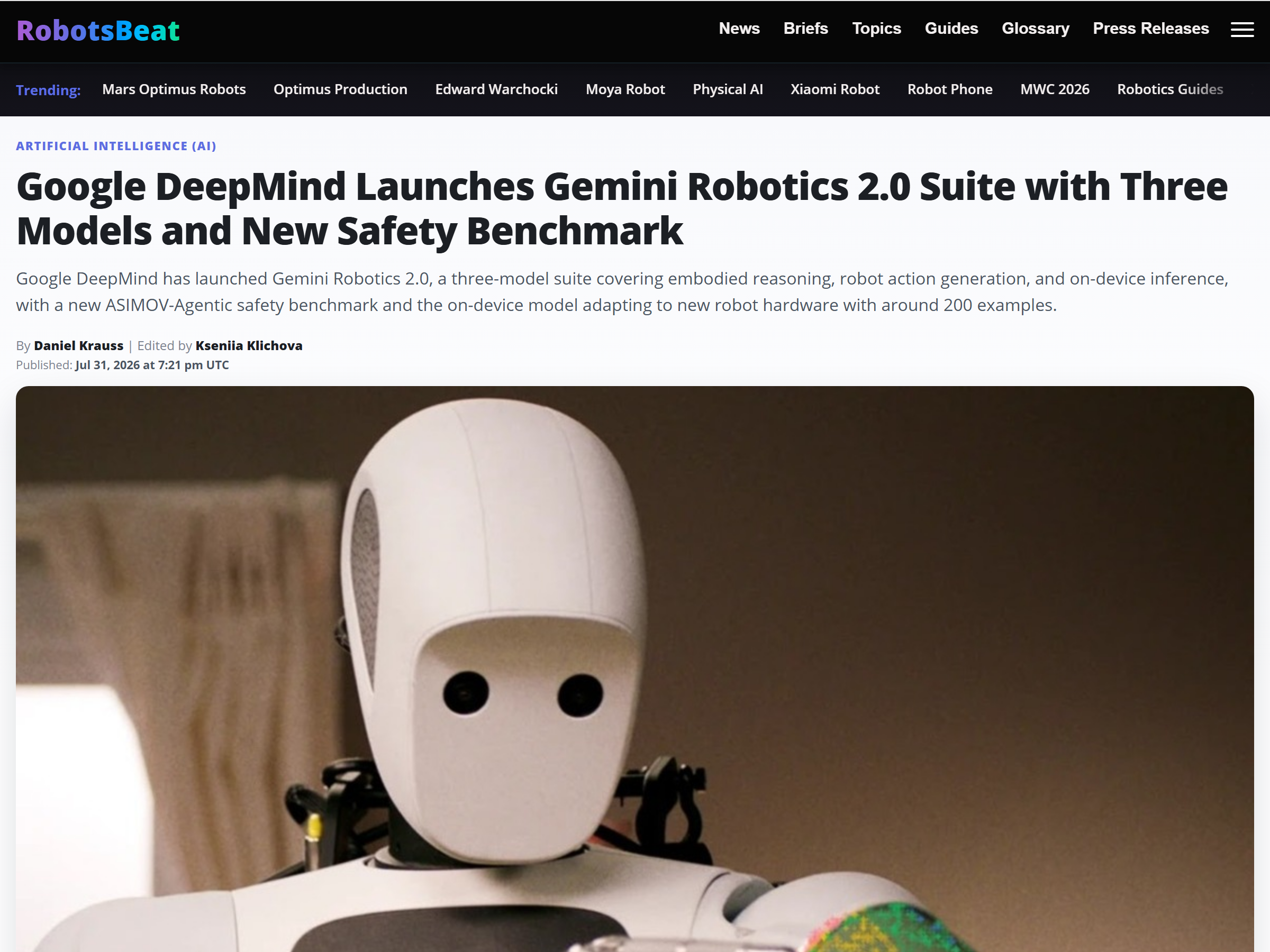
Most humanoid robots today stitch together separate systems. One controller handles walking and balance. Another handles grasping. A third handles high-level planning. The handoff between these systems is where robots fail in unstructured environments. They can walk or manipulate, but doing both smoothly, while reacting to a changed environment, remains hard.
Gemini Robotics 2 attempts to collapse those layers into a single policy. The theoretical advantage is large: a unified model can learn whole-body behaviors from training data instead of requiring engineers to reprogram the handoffs between subsystems. If a new skill is needed, you train the model, not the robot's control architecture. DeepMind is also using the 22-degree-of-freedom SharpaWave tactile hand, the same hardware Nvidia selected for its Isaac GR00T reference design, which suggests the industry is converging on high-dexterity end effectors as the standard.
Safety Becomes a First-Class Problem
When AI mistakes happen in chat, the cost is embarrassment. When they happen in a 70-kilogram humanoid sharing a workspace with people, the cost can be injury. DeepMind knows this and published a dedicated safety technical report alongside the launch. It also released ASIMOV-Agentic, a new open benchmark on Hugging Face that tests whether an embodied reasoning model will refuse unsafe tool calls, assess whether a task is physically feasible, and request human help when uncertain.
ER 2 is described as DeepMind's safest robotics model yet. It can halt a robot when a human gets too close and resume autonomously once the area is clear. That may sound basic, but reliable human-proximity detection is one of the gating features for deployment outside labs. The benchmark name nods to Isaac Asimov's fictional Three Laws of Robotics, though real safety engineering will need more than literary references.
Key Takeaways
- Google DeepMind released Gemini Robotics 2 on July 30, 2026, with full-body control of humanoid robots under a single AI policy.
- The suite includes Gemini Robotics 2 (VLA action model), ER 2 (reasoning and multi-robot coordination), and On-Device 2 (local execution).
- Demonstrations used Apptronik's Apollo 2 with the SharpaWave tactile hand; the same model checkpoint ran across multiple hardware platforms.
- Performance is mixed: unscrewing a bulb hit 92%, while installing one dropped to 36%, and floor pickup reached only 46%.
- DeepMind published ASIMOV-Agentic, an open safety benchmark on Hugging Face, alongside a dedicated safety technical report.
My Take / The Bottom Line
Gemini Robotics 2 is less a product launch than a research statement. Google is telling the robotics industry: we will own the intelligence layer, not the hardware. That is a strategic bet with real merit. Humanoid robots from Tesla, Figure, Boston Dynamics, and others could all run the same brain, just as Android runs on many phone brands. The problem is that the brain is still clumsy. A 46% floor-pickup success rate is not a factory-ready number; it is a laboratory result.
The honest benchmarks are what make this release credible. DeepMind is not claiming general-purpose physical AI has arrived. It is showing the architecture that could get there and admitting how far remains. For investors and engineers, the right question is not whether Gemini Robotics 2 works today, but whether the unified-policy approach improves faster than the vertical-stack approach pursued by Tesla and Figure. The winner of that race will define the robotics platform for the next decade.
FAQ
What is Gemini Robotics 2?
It is a family of three AI models from Google DeepMind that, for the first time, controls an entire humanoid robot, including legs, torso, arms, and fingers, under a single policy.
Can developers use Gemini Robotics 2 now?
ER 2, the reasoning model, is available via Google AI Studio and the Gemini API. The full-body VLA model and On-Device 2 are limited to early partners and trusted testers.
What robot hardware does it run on?
DeepMind demonstrated the model on Apptronik's Apollo 2 humanoid with a SharpaWave hand, and also showed it working on a Franka Duo platform. Boston Dynamics is listed as a partner.
How well does it perform?
Mixed. Removing a light bulb succeeded 92% of the time, but installing one succeeded only 36%. Picking objects from the floor reached 46%.
What is ASIMOV-Agentic?
It is an open safety benchmark published by DeepMind on Hugging Face that tests whether embodied AI models can refuse unsafe commands, assess task feasibility, and request human help.
For more AI tools that power research and development, visit Google Antigravity on aifreetool.site.