AI Video Startups Just Raised $26 Billion in 20 Days. The Real Story Is Who Gets Left Behind.
Category: Industry Trends
Between July 3 and July 23, 2026, five Chinese AI video generation startups announced funding rounds totaling more than $26.2 billion. Kling AI took $3 billion. Shengshu Technology raised $500 million. Aishi Tech closed $420 million. Zhixiang Future secured $210 million. FlovaAI, a company less than a year old, landed $80 million. In twenty days, more capital flowed into AI video generation than the entire sector had raised across 2024 and 2025 combined. Meanwhile, OpenAI had already shut down its consumer Sora app in April after burning through roughly a million dollars a day in compute costs against just $2 million in total revenue. Runway pivoted away from commercial video toward robotics and gaming. The AI video market is consolidating faster than anyone predicted — and the winners and losers are already clear.
The funding wave is not random. It reflects a structural shift: investors have stopped betting on model demos and started betting on revenue. Kling AI, the video generation unit spun out of Kuaishou, reported $96 million in Q1 2026 revenue, up over 300% year-over-year, with an annualized run rate approaching $500 million. That is real money from real customers — 100 million global users and nearly 50,000 enterprise clients. When the numbers look like that, $3 billion at an $18 billion valuation stops looking expensive and starts looking like the price of admission to a market that will not wait.
The Numbers: Who Raised What and Why

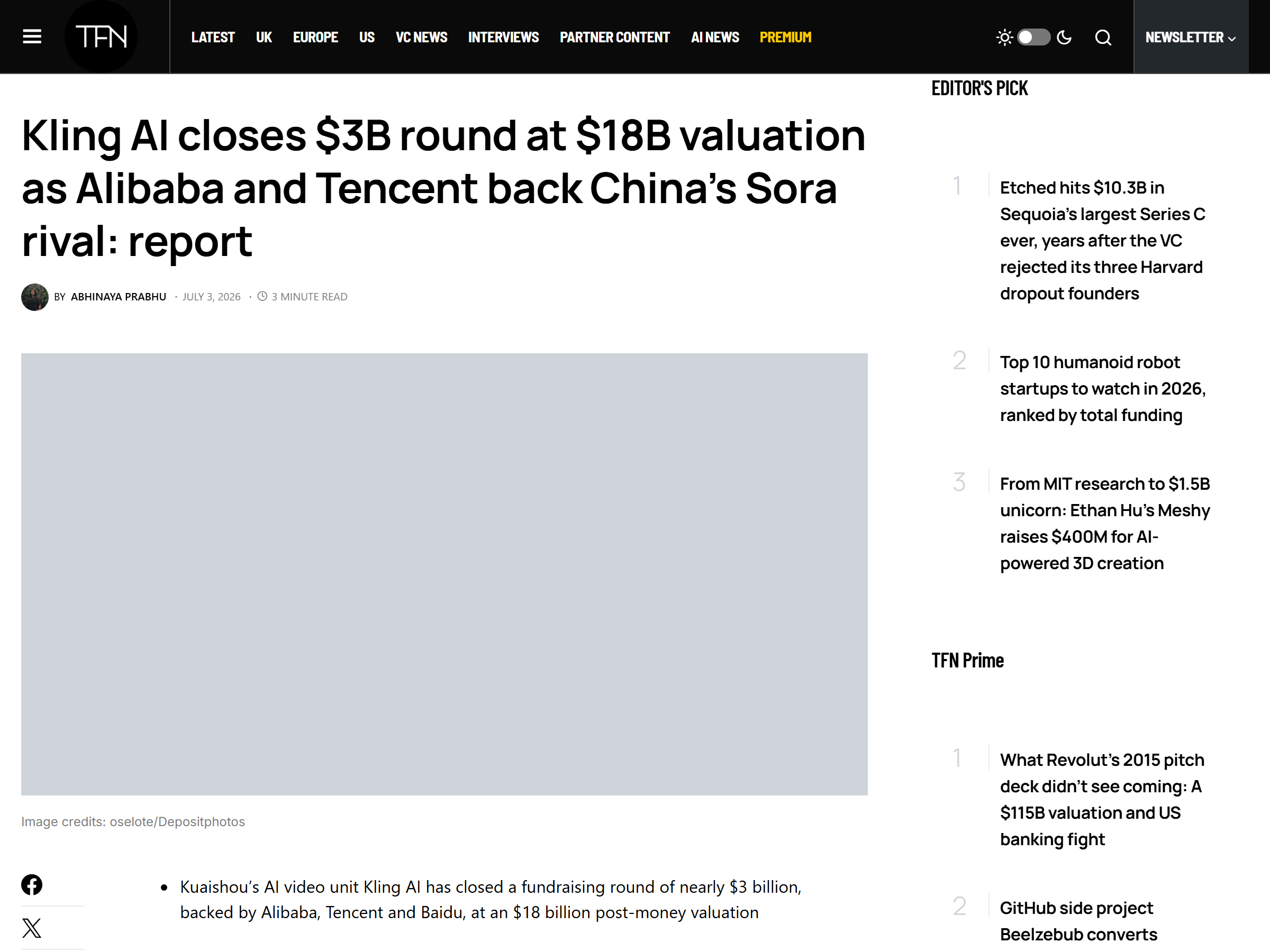
Kling AI's $3 billion round, announced July 2, set the record for the largest single financing in the global video model space. The investor list included a rare simultaneous appearance by Tencent, Alibaba Cloud, and Baidu — three competitors who each run their own video generation models but chose to invest in Kling anyway. CPE Yuanfeng, CITIC Securities, and 34 institutions total participated. Kuaishou retained 68.33% ownership. The deal includes a hard deadline: if Kling does not complete an IPO by October 2031, investors can demand buyback at principal plus 8% annual simple interest.
The other rounds tell a similar story of institutional conviction. Shengshu Technology's $500 million Series B+ on July 6 was its third round in five months, bringing total cumulative financing past $700 million. The company completed shareholding restructuring in March — a standard pre-IPO procedure — and market sources suggest a Hong Kong listing could launch as early as the first half of 2027. Aishi Tech's $420 million Series C+ on July 14 was led by Alibaba, which has now participated in three consecutive rounds for the company, valuing it at over $2 billion. Zhixiang Future's $210 million Series C, and FlovaAI's $80 million angel round for a company founded less than twelve months ago, round out a month that rewrote the sector's funding history.
Combined, the five companies raised approximately $4.22 billion in new equity during July 2026. That alone exceeds the sector's entire 2024-2025 funding total of roughly $3.5 billion. The broader $26.2 billion figure cited in some reports includes cumulative funding across all rounds for all five firms, but the July-specific new money is the real signal: capital is flowing into this sector at an unprecedented rate.
Why Now: The Sora Vacuum and Revenue Proof
OpenAI's Sora shutdown in April 2026 was the signal the market needed. Sora burned $1 million per day in compute while generating $2 million in total lifetime revenue — a ratio that made the consumer AI video business model look broken. Runway's pivot away from commercial video toward robotics and gaming confirmed the same message: pure-play consumer AI video is a cost sink unless you have distribution.
Chinese AI video companies have distribution. Kling is embedded in Kuaishou, one of China's largest short-video platforms with hundreds of millions of daily active users. Aishi's PixVerse has focused on gaming integrations and real-time video generation. Shengshu is building a "Foundation World Model" that positions video generation as a stepping stone to broader AI capabilities. ByteDance's Seedance 2.0, which dominates with over 80% market share by daily computing power consumption, has not raised external capital — it does not need to. Its parent company funds it directly.
The revenue numbers are what changed investor psychology. Kling's $500 million ARR in March 2026 is four times its March 2025 figure. The company's revenue is split between B2B enterprise API calls and consumer subscriptions, with 70% coming from overseas markets, primarily North America. That international traction — Kling contributed virtual scenes to the Chinese historical drama The Peaceful Year and hundreds of shots to the Hollywood series House of David — proves the product works across production environments, not just demo reels.
Kling's valuation deserves scrutiny. At $18 billion, it is worth roughly 80% of its parent company Kuaishou's total market capitalization, despite contributing less than 1% of Kuaishou's 2025 revenue. The company posted a net loss of approximately $280 million in 2025. Investors are pricing in growth, not profitability — and the 2031 IPO put option is their insurance policy if that growth stalls.
The World Model Pivot
Beneath the funding numbers is a technology shift. The AI video sector is moving from "generate a 15-second clip" to "build a model that understands the physical world." ByteDance's Seedance 2.0 achieved breakthrough performance by modeling the dynamic laws of physics — multi-shot editing, camera movement control, and cross-scene character consistency. Shengshu Technology explicitly calls its architecture a "Foundation World Model," with two branches: a World Generation Model for digital environments and a World Action Model for physical-world applications in robotics.
Aishi Tech co-founder Xie Xuzhang demonstrated PixVerse Game at the UN AI for Good Summit in July — the first real-time video game engine built on world model technology. The engine combines real-time video models, game mechanics, and user-customizable worldviews. It is a proof of concept for a much larger thesis: that video generation is a waypoint, not a destination. The endgame is interactive, persistent, AI-generated environments that respond to user input in real time.
This pivot explains why investors are willing to write nine-figure checks despite the sector's losses. If world models succeed, they unlock markets far larger than video generation — robotics training, autonomous vehicle simulation, architectural design, and interactive entertainment. A company that owns a world model owns a platform, not a feature. The current video generation products are just the first monetizable expression of that platform.
What Happens Next
The AI video sector is heading into a consolidation phase with three probable outcomes. First, IPO filings: Kling, Shengshu, and Aishi are all targeting Hong Kong listings within 12-18 months. The window will not stay open forever — public market appetite for unprofitable AI companies depends on continued revenue growth. Second, competitive pressure from ByteDance: Seedance's 80%+ market share, combined with ByteDance's unlimited internal funding, means every other player is fighting for the remaining 20%. That is a tough position for companies burning cash on both model training and compute. Third, the world model narrative will either vindicate itself or collapse: if interactive AI environments fail to materialize into revenue, the sector's current valuations will look like 2021 crypto prices. If they work, the $26 billion looks cheap.
For now, the market is betting on the latter. Alibaba, Tencent, and Baidu did not invest in Kling because they needed another video model — they invested because they needed a seat at the table if world models turn out to be the next platform shift. That is the real story behind the funding numbers. It is not about video. It is about who owns the infrastructure for generating reality.
Key Takeaways
- Five Chinese AI video companies raised over $4 billion in new funding during July 2026, with Kling AI's $3 billion round setting a global record for video model financing.
- Kling AI reported $96 million in Q1 2026 revenue (300%+ YoY growth) and a $500 million annualized run rate, with 70% of revenue from overseas markets.
- ByteDance's Seedance 2.0 dominates the market with over 80% share by computing power consumption, making life difficult for every other competitor.
- The sector is pivoting from video generation to "world models" — AI systems that understand physical dynamics and can power robotics, gaming, and interactive environments.
- Kling, Shengshu, and Aishi are all targeting Hong Kong IPOs within 12-18 months, with Kling's deal including a mandatory buyback clause if no IPO occurs by October 2031.
FAQ
How much did Kling AI actually raise in July 2026?
Kling AI closed a funding round of up to $3 billion at an $18 billion post-money valuation. The round included 21 initial investors contributing $2.028 billion and 15 additional investors adding $766 million, with a remaining $206 million window for late joiners. Thirty-four institutions participated, including Tencent, Alibaba Cloud, and Baidu — marking a rare simultaneous investment by all three Chinese internet giants.
Why did OpenAI shut down Sora?
OpenAI shut down the consumer version of Sora in April 2026 after it burned through roughly $1 million per day in compute costs against $2 million in total lifetime revenue. The economics of consumer AI video generation without a built-in distribution platform proved unsustainable.
What is a world model in AI?
A world model is an AI system that understands and can simulate the physical dynamics of the real world — how objects move, interact, and respond to forces over time. Unlike a video generation model that creates clips from prompts, a world model can generate persistent, interactive, physically consistent environments. Companies like Shengshu and ByteDance are betting that world models will unlock applications in robotics, gaming, architecture, and autonomous systems that are far larger than video generation alone.
Who is winning the AI video generation market?
ByteDance's Seedance 2.0 dominates with over 80% market share measured by daily computing power consumption. Kling AI holds approximately 14%. The remaining players — Shengshu, Aishi, Zhixiang, and others — split the remaining single-digit percentage. However, market share by compute does not directly translate to revenue share, and Kling's $500 million ARR suggests there is room for multiple profitable players.
Are these AI video companies profitable?
No. Kling AI reported a net loss of approximately $280 million in fiscal year 2025 despite $162 million in revenue. Shengshu, Aishi, and other players are also operating at significant losses. The investment thesis is based on revenue growth trajectory and the potential value of world model technology, not current profitability. The 2031 IPO buyback clause in Kling's deal reflects investor awareness of this risk.
My Take
The AI video funding wave is not a bubble — it is a land grab. When OpenAI shut down Sora and Runway pivoted away from commercial video, they left a market vacuum that Chinese companies were uniquely positioned to fill. Kling had distribution through Kuaishou. Shengshu had government backing and a world model narrative. Aishi had gaming integrations. The money is following the same logic as the 2023-2024 LLM funding wave: investors are not betting on which company has the best model today; they are betting on which companies will still exist when the sector consolidates to three or four players. The world model pivot adds an extra layer — if it works, the winners get a platform worth an order of magnitude more than a video generation feature. If it does not, those 2031 buyback clauses are going to get a lot of attention. Either way, $26 billion says the smartest money in tech thinks this is the next big platform shift. They have been wrong before. But they are rarely wrong alone.
Explore more AI video generation tools in our AI Video category.