Moonshot Kimi Just Closed a $3.5 Billion Round. The G-Round Is Already Open at $50 Billion Pre-Money.
Category: Industry Trends
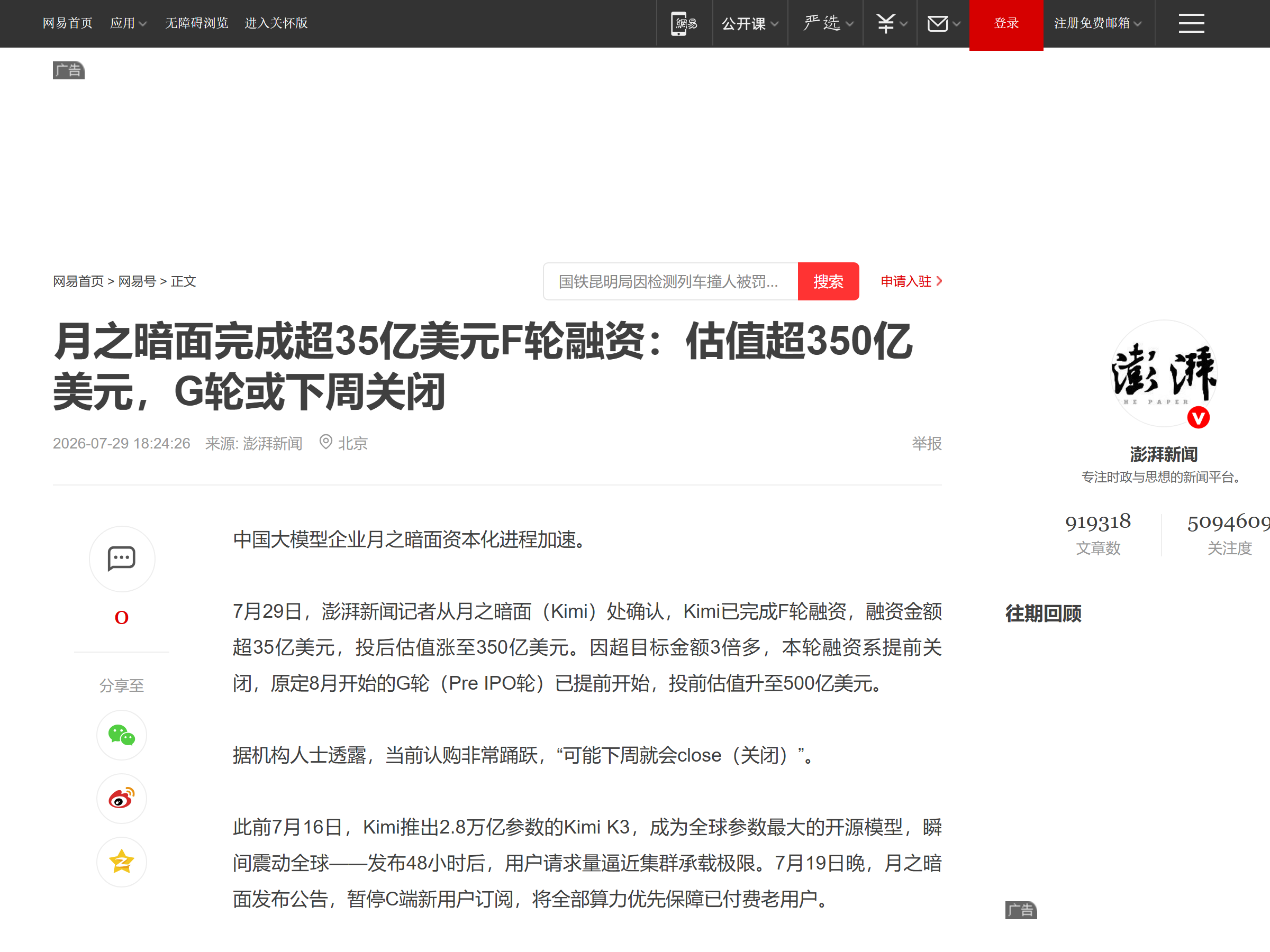
Two weeks ago Moonshot AI's Kimi K3 was the most talked-about open-source model on the internet. On July 29, 2026, it became the most expensive. Pengpai confirmed that Kimi has closed a Series F of more than $3.5 billion at a $35 billion post-money valuation — three times oversubscribed, closed early. The originally planned August G-round, which everyone in the Beijing AI circle had quietly marked as a pre-IPO step, has been pulled forward. Pre-money is now $50 billion. Subscriptions, by all accounts, are heavily oversubscribed again. This is no longer a Chinese AI company fighting for relevance. It is a company repricing the frontier.
For two years the consensus on Chinese model labs was that they would close the parameter gap and lose the price war. K3, released on July 16 with 2.8 trillion parameters, didn't just close the gap. Within 48 hours of release, user request volume pushed cluster capacity to its limit. On July 19, Moonshot paused new consumer signups to protect paying customers. The model is now fully open-sourced. Anyone can download it, fine-tune it, or embed it in a commercial product. That single decision is the reason a fund manager who passed on the E-round is now begging for G-round allocation.
Why $3.5 Billion, Why Now
Three things changed in the last month. First, K3's positioning. Foreign press has been calling it the "local Fable 5" — a reference to Anthropic's Claude Fable 5, currently the leading closed-source model on long-context reasoning. Ahmad, founder and CEO of North-American infrastructure startup Osmantic AI, posted on X that K3 is "free and downloadable, which makes Anthropic's trillion-dollar valuation meaningless." That is hyperbole. It is also the kind of quote that closes funding rounds in a single week.
Second, the price gap. K3 sits between Fable 5 and OpenAI's GPT-5.6 Sol on most reasoning benchmarks, but its inference cost is reportedly one-half to one-third of either closed model. With cache hits, that drops to roughly one-tenth. For US enterprises already routing 30% to 46% of their AI traffic to Chinese models on OpenRouter — peak observed in February 2026 — the math is no longer ideological. It is procurement.
Third, the open-source moat. Apache 2.0 licensing means any startup or Fortune 500 can self-host K3 on its own infrastructure and never pay Moonshot a dollar. That sounds like a revenue problem. It is actually a distribution problem. The company that gives away the model captures the cloud, the support contracts, and the platform gravity. By the time a competitor builds a paid alternative, K3 is already the default.
The G-Round and What It Really Means
A $50 billion pre-money for a Chinese AI lab was unthinkable 12 months ago. OpenAI's last private round valued it at roughly $500 billion, Anthropic at $965 billion. Kimi at $50 billion is still a 10x discount to Anthropic — and Kimi is open-source, profitable on inference, and growing ARR faster than any Western peer. The G-round is being marketed as a pre-IPO bridge, which means a Hong Kong or Shanghai dual listing is now a 2027 event, not a 2028 rumor. Goldman, CICC, and three Chinese state-backed funds are already in the conversation. The first-day pop, if retail gets a chance to participate, will be ugly for the underwriters.
The strategic risk is not the valuation. It is the open-source decision itself. Once you give away the model, your only defensible surface is the platform: hosting, fine-tuning, agent orchestration, enterprise integrations. That is a real business — Together AI, Fireworks, and the open-inference layer prove it. It is also a business with 60% gross margins and brutal customer churn. Kimi has chosen the harder, more important fight. The market is betting they will win it.
Key Takeaways
- Moonshot's $3.5B Series F closed July 29, 2026, at a $35B post-money valuation, three times oversubscribed.
- The pre-IPO G-round has been pulled forward to late July, with a $50B pre-money and reports of heavy oversubscription.
- Kimi K3 (2.8T parameters) launched July 16; within 48 hours, Moonshot paused new consumer signups due to compute saturation.
- Inference cost for K3 is reportedly 1/2 to 1/3 of Claude Fable 5 and GPT-5.6 Sol; with caching, as low as 1/10.
- US enterprises are already routing 30% to 46% of AI inference traffic to Chinese models on OpenRouter as of early 2026.
My Take
The 2025 narrative — "China catches up, then loses on price" — is dead. K3 is the first model where a Chinese lab ships a frontier-class open release and uses it as a fundraising weapon, not a defensive gesture. Anthropic and OpenAI now have to answer a question they have not had to answer before: why should an enterprise pay ten times more for a closed model that is roughly equivalent? If I were Satya Nadella or Dario Amodei, I would be looking very carefully at how Microsoft Azure and AWS price their K3 inference tiers. Whoever gets there first sets the margin floor for the next five years. For developers, the practical advice is simple: download K3 today, run it on your own hardware if you can, and treat any vendor that refuses to expose a K3 routing option as overcharging you. The model wars are not ending. They are just starting to look very different from what the West expected.
Frequently Asked Questions
What is Kimi K3 and why does the parameter count matter?
Kimi K3 is Moonshot AI's third-generation flagship model, released on July 16, 2026, with 2.8 trillion total parameters. It is currently the largest fully open-source large language model in the world. The parameter count matters because it determines the upper bound of in-context learning capacity and reasoning depth — K3 sits between Anthropic's Claude Fable 5 and OpenAI's GPT-5.6 Sol on most reasoning benchmarks while costing a fraction to run.
How is Moonshot making money if K3 is open-source?
Open-source weights do not mean zero revenue. Moonshot monetizes through hosted inference on its own cloud, enterprise fine-tuning contracts, and API access. The open weights are a distribution strategy: they ensure K3 becomes the default, then Moonshot charges for the platform around it. Together AI and Fireworks AI have proven this playbook works at $1B+ ARR scale.
Is Kimi a $50 billion company in 2026?
Pre-money valuations in private rounds are what investors agree to pay, not what the company has earned. At $50B pre-money, Moonshot is being valued at roughly 1/19 of Anthropic's last private mark. If K3 becomes the default open-source model for Chinese cloud customers — and Chinese AI tokens already represent 60% of OpenRouter usage — that valuation starts to look conservative, not aggressive.
Should developers switch from Claude or GPT to Kimi K3?
For high-volume, cost-sensitive workloads — batch summarization, RAG pipelines, code completion at scale — K3 is now a credible default. For tasks requiring the absolute frontier in long-horizon reasoning or tool use, Claude Fable 5 and GPT-5.6 Sol still hold an edge. The pragmatic move is to route traffic by task: K3 for bulk, frontier closed models for the hard 20%.
For a broader look at how the open-source model ecosystem is reshaping enterprise AI stacks, browse the aifreetool.site AI engine model directory at aifreetool.site/tool-category/ai-engine-model/.