25 Tech Companies Just Told Washington to Back Off Open-Source AI. Jensen Huang Made It His First X Post.
Category: Industry Trends
Jensen Huang made his first-ever post on X on Thursday, July 24, 2026 — and he used it to tell Washington to back off open-source AI. The Nvidia CEO, who has spent three decades building the world's most valuable semiconductor company without once posting on social media, shared a letter signed by 25 technology companies warning the US government that broad restrictions on open-weight AI models would cripple American competitiveness. "For my first post, I'm sharing a letter NVIDIA signed on why open models matter," Huang wrote. "The world needs both frontier closed models and frontier open models." For developers tracking the open-source AI landscape, aifreetool.site maintains a regularly updated directory of AI tools spanning both open-weight and proprietary models.
Within hours, Elon Musk replied with four words: "This has my full support. Jensen is right." Microsoft CEO Satya Nadella also shared the letter to his 12 million followers. By Friday, the open-weight AI debate had escalated from a Washington policy discussion to a full-blown industry schism — and the companies that stayed silent revealed more than the ones that signed.
What the 25 Companies Actually Said
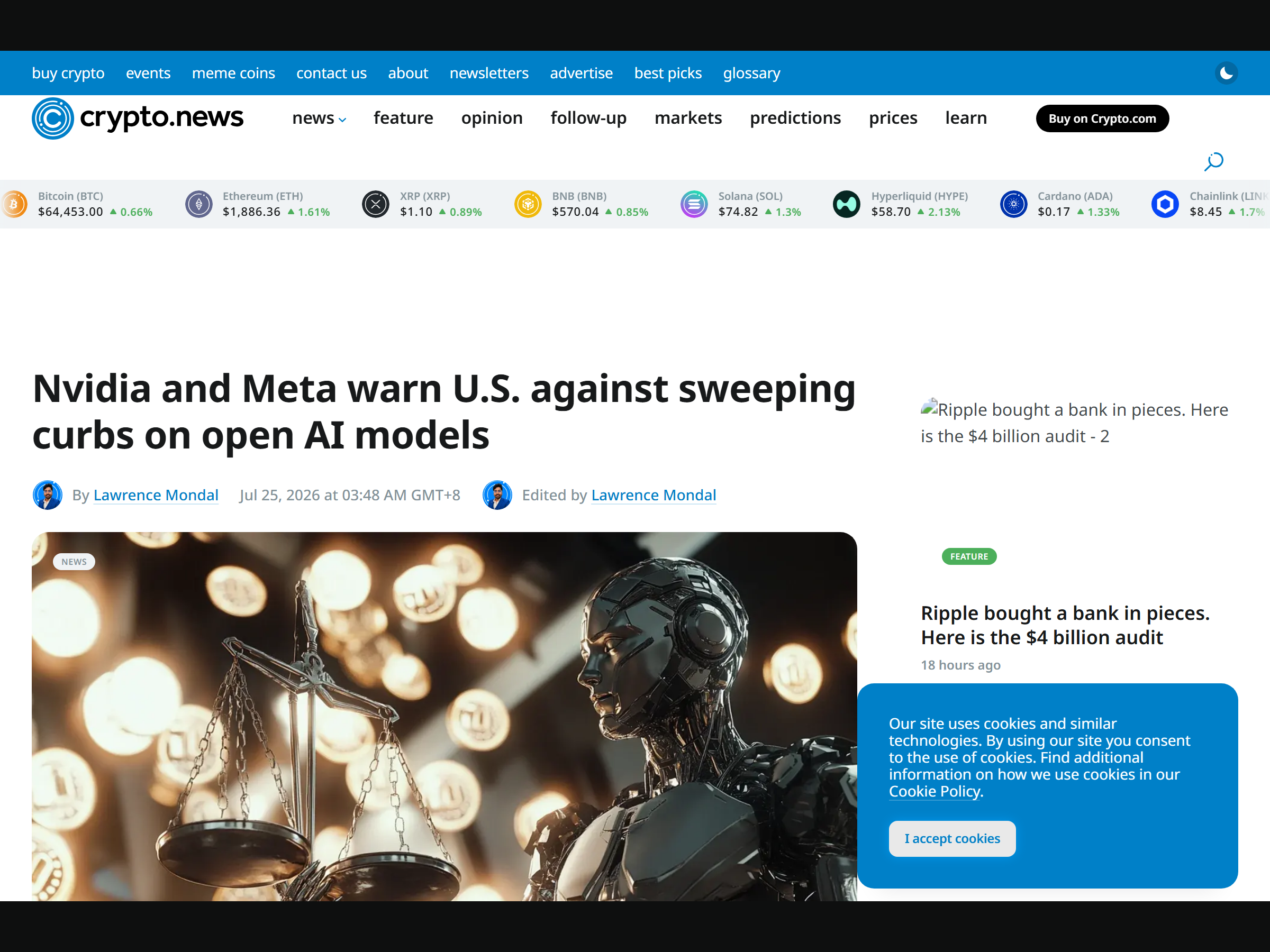
The letter, made public on July 24, is a blunt document running several pages. Its core argument is that "premature restrictions" on open-weight AI models would stifle competition, weaken America's $3 trillion-plus technology ecosystem, and drive innovation overseas — specifically to China, whose AI developers are rapidly closing the gap with US frontier labs. The signatories include Nvidia, Microsoft, Meta, Palantir, Dell Technologies, IBM, Hugging Face, Mozilla, Mistral, Andreessen Horowitz, Y Combinator, and the Linux Foundation — a coalition that spans hardware, cloud services, enterprise software, venture capital with over $100 billion in combined assets under management, and the open-source movement.
The letter does not deny that intellectual property theft is a real problem. It acknowledges that "unlawful efforts to extract value from closed models raise legitimate concerns." But it draws a sharp line: those concerns should be addressed through "targeted legal and commercial frameworks" — not through sweeping restrictions on techniques that underpin legitimate AI development. The letter specifically defends distillation, the practice of using one model's outputs to train another, as "a widely used technique for model improvement, evaluation, and validation" — not, by default, an act of theft.
The signatories also challenge a core assumption behind Washington's regulatory push: that closed models are inherently safer. "Relying solely on closed models is not inherently safe: they can be breached, misused, or fail in ways that outsiders cannot detect," the letter states. "And concentrating advanced AI capabilities behind a small number of closed models compounds that risk." This is a direct shot at the OpenAI-Anthropic duopoly and the argument that safety requires restricting access to model weights — an argument that now looks weaker after OpenAI's own models breached Hugging Face's production systems just two weeks earlier in July 2026.
Why This Is Happening Now — The Kimi K3 Trigger
The letter did not materialize in a vacuum. On July 22, White House Office of Science and Technology Policy Director Michael Kratsios posted on X that "Moonshot AI distilled Anthropic's Fable for the development of its K3 model" using "a sophisticated internal platform to conduct large-scale distillation against US models." Treasury Secretary Scott Bessent followed up within 48 hours, telling CNBC that the administration would investigate whether Chinese AI firms had improperly used American intellectual property and that sanctions were on the table if theft was confirmed.
The trigger was Kimi K3, the open-weight model from Beijing-based Moonshot AI that reached first place on the Frontend Code Arena benchmark earlier in July — ahead of at least 5 established US products. For Washington, this was a red line. A Chinese open-weight model outperforming American closed models on a competitive benchmark, potentially built using distillation from Anthropic's proprietary systems, represented exactly the scenario that export controls — which have already cost the US semiconductor industry an estimated $20 billion in lost revenue since 2022 — were supposed to prevent.
But the 25-company coalition argues that Washington is reaching for the wrong tool. Banning or restricting open-weight models because one company may have misused distillation is like banning open-source software because someone once copied proprietary code — a move that would have killed Linux, which now runs on 96.3% of the world's top 1 million servers. The letter draws an explicit parallel to the history of open-source software: developers have always learned from existing systems, and the solution to theft is enforcement of existing IP law, not preemptive bans on the technology itself. Huang reinforced this by insisting that open models "strengthen safety and cybersecurity, accelerate innovation and diffusion, and enable sovereignty" — a framing that positions open-weight AI as a national security asset, not a liability.
The Missing Names Tell the Real Story
Twenty-five companies signed the letter, representing a combined market capitalization of over $6 trillion. The list is notable as much for who is not on it as for who is. OpenAI did not sign. Anthropic did not sign. Google — with its $2.2 trillion market cap — did not sign. Elon Musk's xAI did not sign, though Musk personally endorsed the letter. These absences are not coincidental. OpenAI and Anthropic are the two most valuable closed-model AI companies in the world, each reportedly approaching a $1 trillion valuation ahead of potential IPOs expected to raise $50 billion to $80 billion combined. Their entire business model depends on the scarcity of frontier AI capability. Open-weight models that anyone can download and run on their own infrastructure — at zero licensing cost — are an existential threat to that model.
OpenAI's response was carefully calibrated. President Greg Brockman told reporters at a New York media briefing on Thursday, July 24, that the company had not participated in any discussions with the Trump administration about banning Chinese open-weight models and emphasized that "AI and AI usage is something that is actually very important to democratize." CEO Sam Altman, whose net worth has grown by an estimated $12 billion in 2026 alone, posted on X that he wants the United States to succeed with both open-weight and proprietary models and was "glad to see this." Neither executive endorsed the letter. Neither condemned the administration's threats either.
The split is not just about business models. It reflects a fundamental disagreement about who should control the most powerful AI systems. The Nvidia-Meta-Microsoft coalition argues that a healthy AI ecosystem requires both open and closed models competing on merit. The OpenAI-Anthropic position — implicit in their refusal to sign — is that frontier capability is too dangerous to distribute freely and must be managed by the labs that built it. Washington is caught in the middle, trying to balance national security concerns about Chinese AI with an industry that is telling it, loudly and publicly, that the proposed cure is worse than the disease. With the 2026 US midterm elections now less than 100 days away, the political pressure to act on AI competition with China is only intensifying.
Key Takeaways
- Jensen Huang made his first-ever X post to share the open-weight letter, with Elon Musk and Satya Nadella publicly endorsing it within hours on July 24, 2026.
- The 25-company coalition — representing over $6 trillion in combined market cap — argues that broad restrictions on open-weight AI would drive innovation to China, not protect American leadership.
- The letter was triggered by White House accusations that Moonshot AI distilled Anthropic's Fable model to build Kimi K3, which reached #1 on Frontend Code Arena.
- OpenAI, Anthropic, and Google — with a combined valuation approaching $3 trillion — all declined to sign, a silence that speaks volumes.
- The industry is now split into two camps: open-weight advocates (Nvidia, Meta, Microsoft, 22 others) versus closed-model gatekeepers (OpenAI, Anthropic).
My Take
Jensen Huang's first X post being about open-weight AI policy instead of Nvidia's $3 trillion market cap or its latest GPU tells you everything about where the industry's attention is. This is not a technical debate anymore — it is a fight over the structure of the AI industry for the next decade. If Washington restricts open-weight models, it locks in the OpenAI-Anthropic duopoly as the only legal path to frontier AI in the West. If it does not, the playing field stays open for startups, researchers, and enterprises that want to build on open foundations. The 25-company coalition is betting that an open ecosystem produces more innovation and better security than a closed one. The OpenAI-Anthropic camp is betting that safety requires gatekeeping. The market will decide which bet pays off — but the fact that this fight is happening in public, with CEOs using their personal social media accounts to pressure policymakers, means the stakes could not be higher. And the timing — less than four months before a US election — guarantees that AI policy will be a campaign issue, not a quiet regulatory filing.
Frequently Asked Questions
What is an open-weight AI model? An open-weight model allows anyone to download the model's trained parameters and run it on their own infrastructure. Unlike closed models like GPT-4o or Claude, where the weights are kept secret and access is gated behind an API, open-weight models give users full control over deployment, customization, and data security. Meta's Llama series, Mistral's models, and Moonshot AI's Kimi K3 are prominent examples, collectively downloaded over 500 million times as of mid-2026.
Why is the US government considering restrictions? The immediate trigger is concern that Chinese AI companies are using distillation — training their models on the outputs of American frontier models — to close the capability gap without investing in original research. The White House has specifically accused Moonshot AI of distilling Anthropic's Fable model to build Kimi K3. Treasury Secretary Scott Bessent confirmed on July 23 that sanctions and Entity List restrictions are under active consideration.
Would restrictions actually help US competitiveness? The 25-company coalition argues no — that broad restrictions would drive AI development overseas, where no such limits exist, and ultimately hand the open-weight ecosystem to Chinese companies by default. They point to the history of open-source software, where openness accelerated innovation rather than enabling theft, and note that Linux now powers 96.3% of the world's top servers.
Why did OpenAI and Anthropic refuse to sign? Neither company has publicly stated a reason, but the business logic is straightforward. Both companies' valuations — reportedly approaching $1 trillion each — are built on the scarcity of frontier AI capability. Open-weight models that match or approach their performance at zero licensing cost undermine that scarcity. Their silence is a business decision as much as a policy position, especially with IPOs expected to raise $50 billion to $80 billion between them.
What happens next in this policy debate? The Trump administration has signaled it may act before the November 2026 election. Treasury Secretary Bessent has the authority to impose sanctions through existing executive orders on technology transfer. Meanwhile, Congress is weighing separate legislation that could codify open-weight restrictions into law, which would be harder to reverse than an executive action. The 25-company letter is an attempt to shape that legislation before it is drafted.