How to Make Money Editing Podcasts With Cleanvoice
Category: Monetization Guide
You can make money editing podcasts for creators with Cleanvoice, the AI audio tool that strips filler words, dead air, and background noise in minutes. Podcasters pay $50 to $150 per finished episode while your only real cost is about $1 to $2 per 30-minute file. Cleanvoice is used by more than 15,000 podcasters and 30-plus brands, and it handles both audio and video podcast files.
Tool at a Glance: What Cleanvoice Actually Does
Cleanvoice is a web app that auto-edits recorded audio. Upload a WAV, MP3, or MP4 and it removes filler words like "um," "uh," "you know," and "like" in more than 20 languages, trims long silences, cleans mouth sounds and breaths, and pulls out background hiss and room hum. It then levels volume across speakers so the file sounds studio-recorded.
Two extras turn it into a paid service. The transcription and summary feature produces show notes, chapter markers, and a short recap you can hand to the client as a bonus deliverable. The timeline export gives markers of every cut, so a human editor can fine-tune in Audacity or Adobe Audition if needed. Cleanvoice is GDPR-compliant, ISO 27001 certified, and processes audio in the EU, which matters when pitching business clients.
The free trial gives 30 minutes of processing, enough to clean one short segment and prove the result before you pay.
The Monetization Idea: Podcast Cleanup as a Service
The offer is "send me your raw recording, get back a publish-ready episode." Most podcasters hate the cleanup tax, the two to three hours per 40-minute episode spent hunting "ums" and dead air. You remove that tax with a few clicks and charge for the saved time.
A second angle is a monthly retainer for shows that publish weekly: a flat $150 to $400 fee covers every episode's cleanup plus show notes. A third is bundling Cleanvoice with light mixing for video podcasters who need the audio track cleaned while staying synced to picture. Solo creators typically pay $50 to $80 per episode; business and agency shows pay $120 to $150.
Part-time, a focused editor earns $500 to $2,000 a month handling 10 to 25 episodes. Because processing a 30-minute file costs roughly $1, margin stays high even at the low end of pricing.
Step-by-Step: From Sign-Up to Your First Paid Client
- Use the 30-minute free trial to clean a sample episode and save the raw-versus-cleaned clip as your demo.
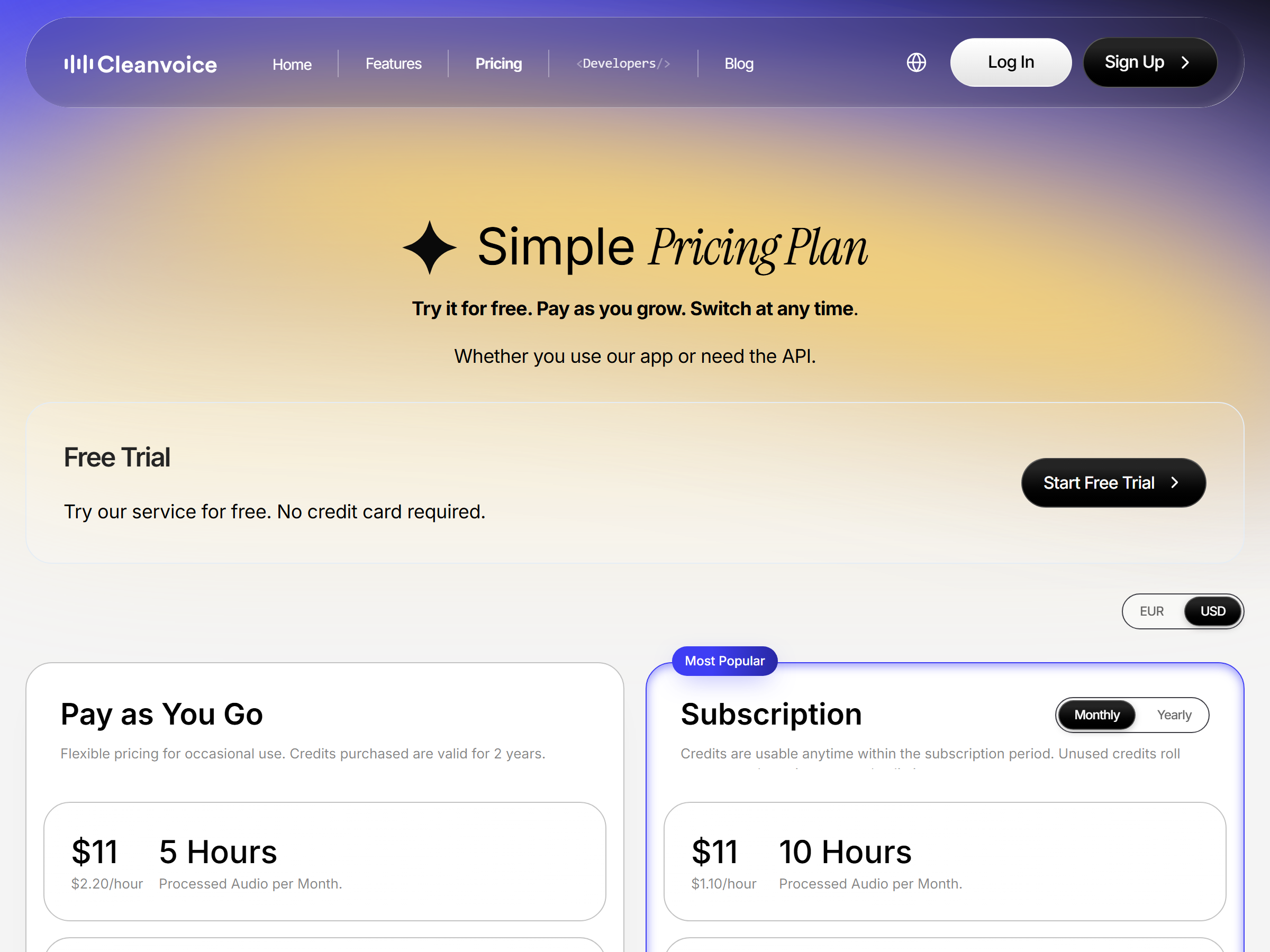
- Subscribe to the Starter plan at $11 a month for 10 processing hours; upgrade to $30 for 30 hours as clients pile up.
- Define one package: cleanup plus show notes for $65 per episode, with a $250 monthly retainer option.
- Post a gig on Fiverr and a service listing on Upwork targeting podcast editing.
- Cold-email 15 small podcasts whose episodes clearly need cleanup, offering one free episode.
- Convert free episodes into paying retainers by showing the time they save each week.
Your first-month spend is $11 plus maybe a domain. The bottleneck is outreach and trust, not the software, because Cleanvoice does the actual editing in five to fifteen minutes per file.
Pricing: Which Cleanvoice Plan You Need
| Plan | Monthly cost | Audio hours | Best for |
|---|---|---|---|
| Free trial | $0 | 0.5 hr | Demo and testing |
| Starter | $11 | 10/mo | First clients, about 20 episodes |
| Standard | $30 | 30/mo | Weekly shows, agencies |
| Pro | $90 | 100/mo | High-volume production |
Starter at $11 covers roughly 20 half-hour episodes, enough for a solo editor's first month. Choose Standard at $30 once you run weekly retainers. Unused subscription hours roll over up to three times your plan limit, so slow months do not waste credits.
Client Management and Quality Control
Be clear about what Cleanvoice is not. It cleans audio; it does not restructure an episode, fix content, or replace real editing. Tell clients you deliver a polished raw-to-clean pass plus show notes, and charge separately for anything beyond that. Always keep the 7-day file window in mind, download and deliver cleaned files before Cleanvoice deletes them.
Deliver a before-and-after clip with every job; podcasters convert fastest when they hear the "um" removal. Store client files locally the moment processing finishes, since the platform only keeps originals and edits for seven days.
Pro Tips and Pitfalls to Avoid
- Lead with the time saved, not the price, because creators care about getting their evening back.
- Use the timeline export when a client wants manual tweaks; it makes handoffs to Audacity painless.
- Do not promise full production if you only run cleanup; scope creep will eat your margin.
- Avoid the pay-as-you-go tier early; at $2.20 an hour it costs more than the $11 subscription for regular work.
The usual mistake is underpricing against Descript, which bundles cleanup with full editing at $24 a month. Your edge is specialization and speed, so sell the "done in 15 minutes" angle rather than competing on a feature checklist.
Realistic Expectations: Who This Is For
This fits someone who listens to podcasts and can judge clean audio. It is a poor fit if you want fully passive income, because every job is a client relationship with deadlines. You also need basic comfort with audio formats and a local backup habit, since Cleanvoice's storage window is short.
My Take / The Bottom Line
My take: Cleanvoice is the most defensible podcast side hustle on this list, because cleanup is the chore every creator dreads and the tool removes it almost completely. The catch is that you sell reliability and fast turnaround, not magic; clients stay when you consistently hand back a clean file the same day. Run it as a small editing agency with one automation and $500 to $2,000 a month is realistic. Run it as a race-to-the-bottom Fiverr gig and the $11 software fee will be your only profit.
For the full feature list and pricing, check Cleanvoice on aifreetool.site before you start.
FAQ
Is the Cleanvoice free trial enough to land clients?
Barely. The 30-minute trial cleans one short segment, which is enough for a demo clip but not a full episode. Most sellers subscribe to the $11 Starter plan immediately so they can deliver real samples without watermarks or limits.
Can Cleanvoice edit video podcasts too?
Yes. It processes the audio track of MP4 and similar video files, cleaning sound while keeping it synced to the picture. That makes it useful for YouTube and Spotify Video podcasters, not just audio shows.
What happens to client files after processing?
Cleanvoice stores originals and edits for seven days, then deletes them. Download and back up every delivered file locally the moment processing finishes, and keep your own copies for client revisions.
Do I need audio engineering skills to sell this?
No deep skills, but you need a good ear and basic tool knowledge. Cleanvoice handles the edits; you judge quality, write show notes from the transcript, and manage delivery. Real engineering only matters if a client asks for manual fixes via the timeline export.