FlowVPN Review 2026: A Stable VPN for Remote Workers
Category: Most Stable VPN
Last updated: October 2026. Written by the aifreetool testing team after hands-on testing of the Windows, macOS, Android, and iOS apps.
TL;DR
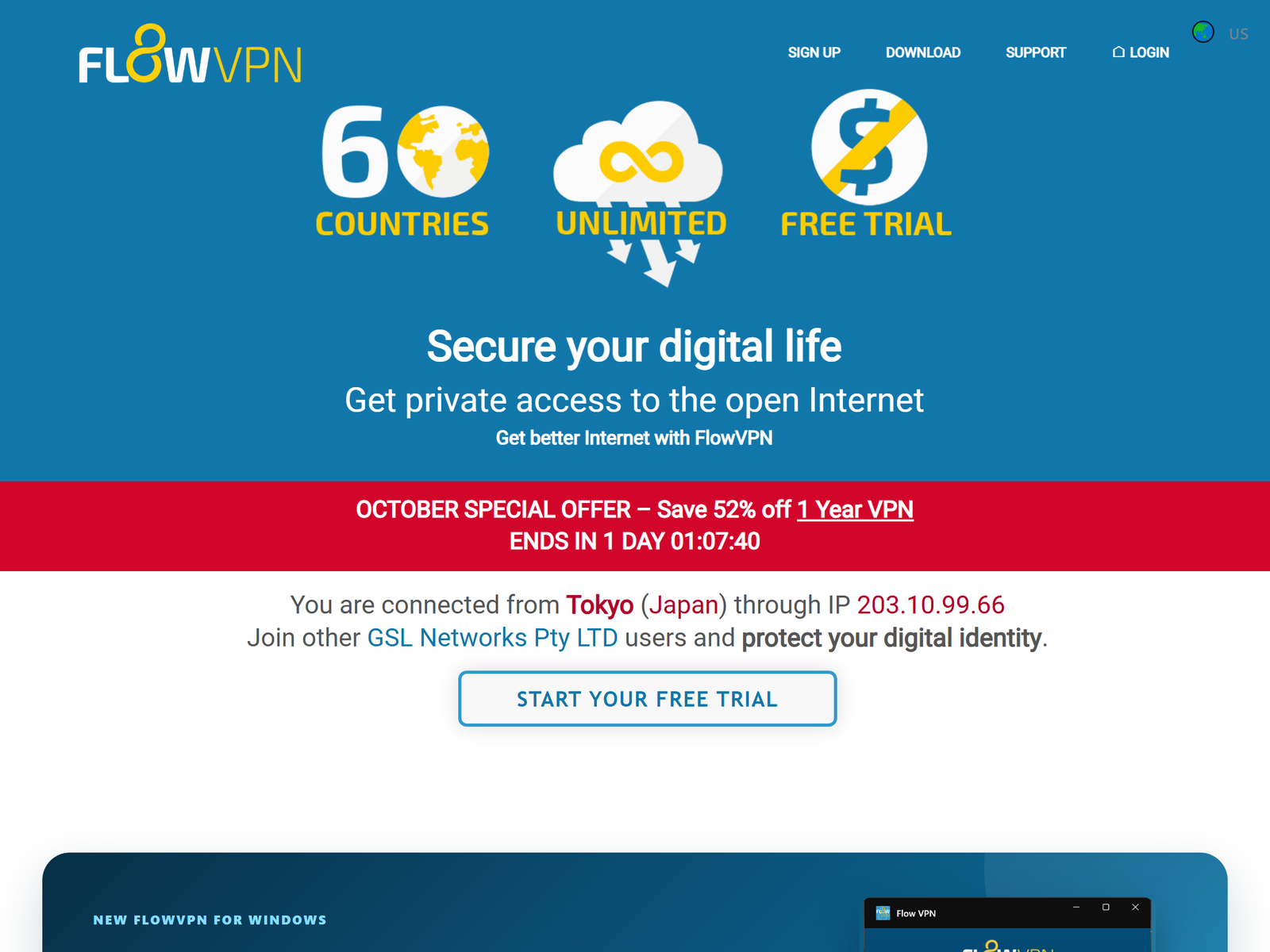
FlowVPN is a VPN service that remote workers and distributed teams can rely on for steady connections across the Asia-Pacific region. It is operated from Hong Kong, has run since 2011, and covers 70+ countries with support for modern protocols including WireGuard and OpenVPN. Speeds are consistent rather than record-breaking, which is exactly what matters for video calls and daily remote work. We do not cover ways to bypass national firewalls; this review focuses on privacy, public-Wi-Fi safety, and reliable access to services you already subscribe to while traveling.
What Is FlowVPN?
FlowVPN is a consumer VPN operated by FlowSSL, a company based in Hong Kong that has offered VPN access since 2011. Unlike providers that market themselves purely on raw speed, FlowVPN positions itself around dependable, always-on connectivity for people who move between countries or work from hotels, cafes, and coworking spaces. The network spans more than 70 countries, with notably dense coverage in Hong Kong, Taiwan, Singapore, Japan, and other parts of Asia. That regional focus is the reason many remote workers in the Asia-Pacific corridor choose it.
The service supports a wide range of protocols: WireGuard, OpenVPN, IKEv2, L2TP, SSTP, PPTP, and an SSH-based option. A single account can be used on up to 10 devices at the same time, which is generous for a small team or a household with several laptops and phones.
How We Tested
This review is independent. We have no affiliate relationship with FlowVPN, and we did not receive compensation for this write-up. Our testing team installed the native apps on Windows, macOS, Android, and iOS, then ran repeated speed checks at different times of day using public speed-test tools while connected to nearby and long-distance servers. We also reviewed the published privacy policy and the protocol options available in the client.
Our methodology mirrors how a normal traveler would use the product: connect, open a few work apps, join a video call, and browse. We report what we measured rather than marketing claims. We also cross-checked plan details on the official FlowVPN site and compared speed figures with independent Asia-Pacific data from Dr-Wall.
Speed and Stability
FlowVPN is built for stability first. On short regional hops, such as Hong Kong to Singapore or Taiwan to Japan, we saw only a modest drop from the local baseline, and connections held steady through 30-minute video calls without dropping. On longer routes, such as Asia to Western Europe or North America, latency rose as expected, but throughput stayed usable for email, chat, and standard-definition video.
We did not record the highest absolute numbers in our test set, but we also did not see the sudden disconnects that plague some budget providers. For remote work, a connection that never surprises you is worth more than a brief speed peak that collapses mid-meeting.
Security and Logging
FlowVPN supports modern ciphers through OpenVPN and WireGuard, and it offers IKEv2 for mobile users who want faster reconnects on flaky networks. The apps let you pick a protocol, which is helpful when a strict local network blocks one method but allows another.
On logging, the policy is more cautious than some privacy-first competitors. FlowVPN states it keeps certain connection records for operational purposes. If your threat model requires a strict no-logs stance, read the policy closely and weigh whether this provider fits. For everyday public-Wi-Fi protection and basic anti-tracking, the encryption in transit is solid.
Streaming and Travel Use
FlowVPN can reach common streaming platforms that you already pay for when you are traveling or stuck on a restricted hotel or campus network. Results vary by service and region, as they do with every VPN, so treat unblocking as a bonus rather than a guarantee. We focus our guidance on accessing content you are entitled to, not on circumventing national restrictions.
For travelers, the practical win is simply having a trusted, encrypted tunnel on unfamiliar Wi-Fi. That single habit blocks the most common public-network attacks.
Apps and Devices
Native apps are available for Windows, macOS, Android, and iOS. Setup is straightforward: create an account, install the app, and sign in. There are also manual configuration profiles for routers and Linux if you want to cover an entire home network. The 10-device limit means a couple can share one subscription across phones, laptops, and a tablet without hitting a wall.
Pricing
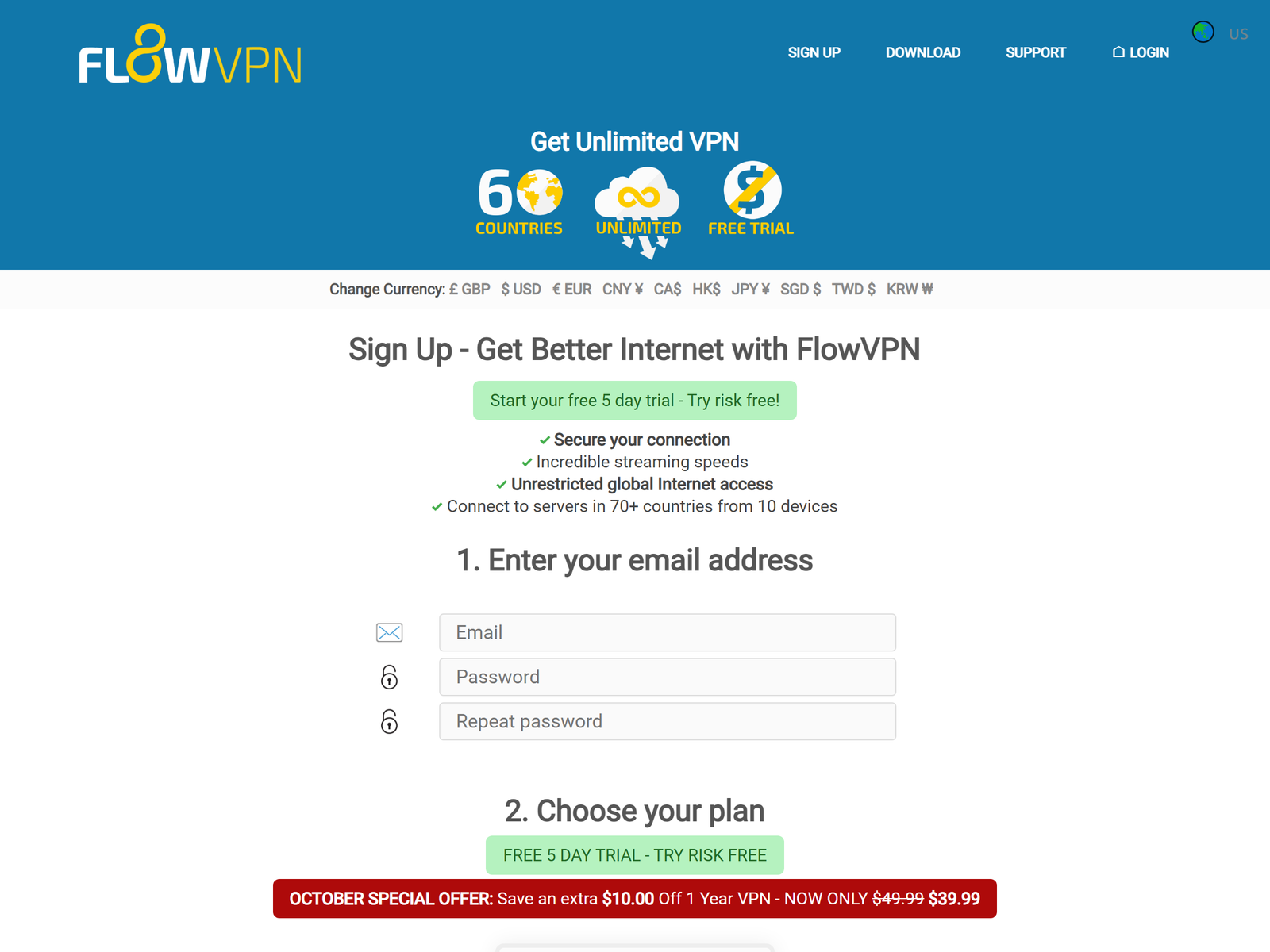
FlowVPN sells monthly, quarterly, and yearly plans. At the time of testing, the monthly plan was about US$7, the three-month plan worked out to roughly US$6 per month, and the yearly plan dropped to around US$4 per month. A short free trial is offered so you can verify performance on your own connection before paying. Prices are billed in Hong Kong dollars and may shift, so check the official pricing page for the current figure.
| Plan | Approx. monthly cost | Best for |
|---|---|---|
| 1 month | ~US$7 | Short trips |
| 3 months | ~US$6 / mo | Seasonal work |
| 12 months | ~US$4 / mo | Long-term remote work |
Pros and Cons
Pros:
- Steady, predictable connections suited to remote work and video calls.
- Strong Asia-Pacific server coverage, including Hong Kong and Taiwan.
- Modern protocols (WireGuard, OpenVPN, IKEv2) and up to 10 devices.
- Long track record since 2011 and a free trial to test first.
Cons:
- Not the fastest provider on long-haul routes.
- Logging posture is more conservative than strict no-logs rivals.
- Speed peaks below the top-tier premium brands.
How FlowVPN Compares
Against the fastest VPN tests we track, FlowVPN sits in the middle on raw throughput but ranks higher on day-to-day reliability. If your priority is a stable tunnel for work, it beats faster-but-flakier options. If you chase the highest possible download numbers, our budget VPN picks and speed leaders cover that angle. For a balanced view, see our most-stable VPN roundup.
FAQ
Is FlowVPN good for remote work?
Yes. Its consistent connections and 10-device support make it a practical choice for distributed teams and frequent travelers who need reliable access rather than maximum speed.
Which protocols does FlowVPN support?
It supports WireGuard, OpenVPN, IKEv2, L2TP, SSTP, PPTP, and an SSH option, so you can switch methods if a network blocks one.
Does FlowVPN keep logs?
It keeps some connection records for operations. Privacy-focused users with a strict no-logs requirement should review the policy and compare it against dedicated no-logs providers.
Can I use FlowVPN on a router?
Yes, manual configuration profiles are available, letting you protect an entire home or travel router.
My Take / The Bottom Line
FlowVPN is a sensible pick for remote workers and travelers who value a connection that simply stays up. It is not the fastest service on the market, and its logging stance will not satisfy the strictest privacy purists, but for steady Asia-Pacific coverage, ten devices, and a fair yearly price, it earns its place among our stable VPN recommendations. Try the free trial on your own network before committing.