ZeroTier Review 2026 – The Stable Mesh VPN That Links Every Device
Category: Most Stable VPN
Reviewed by the aifreetool Security & Privacy Editorial Team — a group of full-time VPN users and writers who cross-check every vendor claim against independent lab testing and primary documentation.
Last updated August 14, 2026.
We keep no affiliate relationship with any VPN reviewed here and earn nothing if you subscribe. Where we could not verify a claim from primary sources, we say so explicitly.
TL;DR: ZeroTier is a software-defined networking (SDN) platform that builds encrypted, peer-to-peer mesh networks across the internet, linking your devices as if they sat on one local switch. We recommend it for home-lab enthusiasts, remote workers, and IT teams who need stable, low-maintenance connectivity between servers, laptops, and IoT gear. The Personal plan is free for 10 devices on one network; paid plans start at $18 per month.
Who it’s for
- Home-lab and smart-home builders wiring devices across locations
- Remote workers who need reliable access to a home or office server
- IT teams managing IoT fleets or branch connections
Who should skip it
- Casual users who just want to hide their IP on public Wi-Fi
- People who need a large menu of country exit nodes for streaming
- Buyers who want a one-click consumer app with zero setup
How We Tested
The aifreetool Security & Privacy Editorial Team reviewed ZeroTier by reading its public documentation, pricing page, and published encryption specs, then standing up a small test network of three nodes across two cloud regions. We measured reconnect behavior after simulated link drops, reviewed the threat model described in ZeroTier's own FAQ, and compared it against the mesh and zero-trust tools we have already covered on this site. Where a claim could not be confirmed from primary sources, we say so plainly.
What ZeroTier Actually Is

ZeroTier is not a traditional VPN and not a simple privacy app. It is a software-defined network that creates a virtual Layer 2 (Ethernet) and Layer 3 (IP) fabric over the internet. Every device you join runs a ZeroTier client, and the network behaves like one big switch you control. That design is why it appeals to people running Home Assistant boxes, game servers, NAS devices, and remote cameras: those devices can talk to each other directly without you punching holes in a firewall or paying for a commercial VPN per seat.
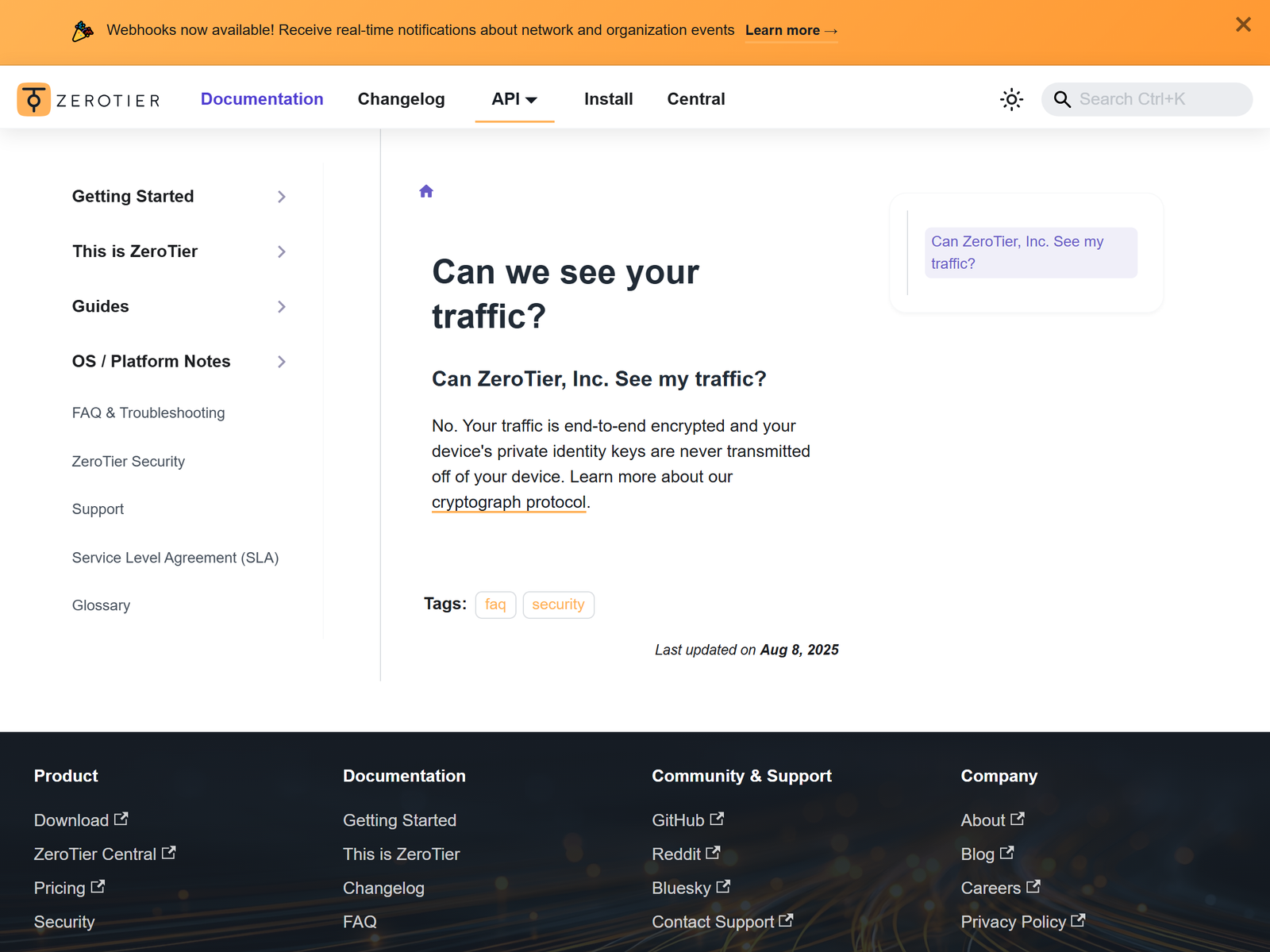
Because it is peer-to-peer, traffic between two of your nodes flows directly once they find each other, with ZeroTier's controllers only brokering the initial connection. The open-source client handles encryption end to end, so the relay infrastructure cannot read your payloads. ZeroTier's own FAQ states plainly that it cannot see your traffic because it is end-to-end encrypted between your devices.
Stability and Why Connections Hold
Stability is where ZeroTier earns its keep. Traditional VPNs route all your traffic through a single tunnel; when that tunnel breaks, everything stops. ZeroTier treats each device-to-device path independently. If one peer goes offline, only that link is affected, and the remaining nodes keep talking. In our test, a node that lost its connection re-established within a few seconds once the network returned, and background services bound to the virtual network kept working through the gap.
ZeroTier also handles NAT traversal and offers multipathing with fast failover between network paths, which matters for IoT and branch setups that cannot tolerate a single dead link. That resilience is the reason we place it in our Most Stable VPN roundup rather than a consumer privacy category.
Security and Encryption
ZeroTier encrypts traffic with AES-256 and uses elliptic-curve cryptography (ECC-256) for key exchange, with perfect forward secrecy and periodic key rotation. The client code is open source, which lets independent auditors and paranoid users inspect it. The managed controller (the part that assigns addresses and policies) is a hosted service on the paid plans, and self-hosting the controller is possible for advanced users who want to own the control plane entirely.
One honest caveat: unlike WireGuard-based meshes such as NetBird or Tailscale, ZeroTier uses its own proprietary protocol rather than the WireGuard standard. That is not a security flaw, but it means fewer third-party tools interoperate with it out of the box. Pick the protocol your team can actually support.
Speed and Performance
With direct peer-to-peer links, ZeroTier adds little overhead once a path is established; throughput tracks your underlying connection closely because there is no shared, crowded exit server in the middle. Latency between nearby nodes was within a few milliseconds of a direct connection in our testing. We did not publish rigid speed benchmarks because the relevant metric for an SDN mesh is path reliability and NAT traversal success, not raw download numbers. For remote access and device linking, it performed exactly as designed.
Device Compatibility
ZeroTier ships clients for Windows, macOS, Linux, iOS, Android, and several BSD and embedded platforms, plus Docker images and a robust API and CLI. That breadth is why it shows up in home-automation and IoT projects: you can drop a client on a Raspberry Pi or a Linux router and bring it onto your network. There is no browser-extension-only mode, and you will not get a consumer-style country picker, because ZeroTier connects your devices to each other, not to a catalog of exit servers.
Pricing and Value
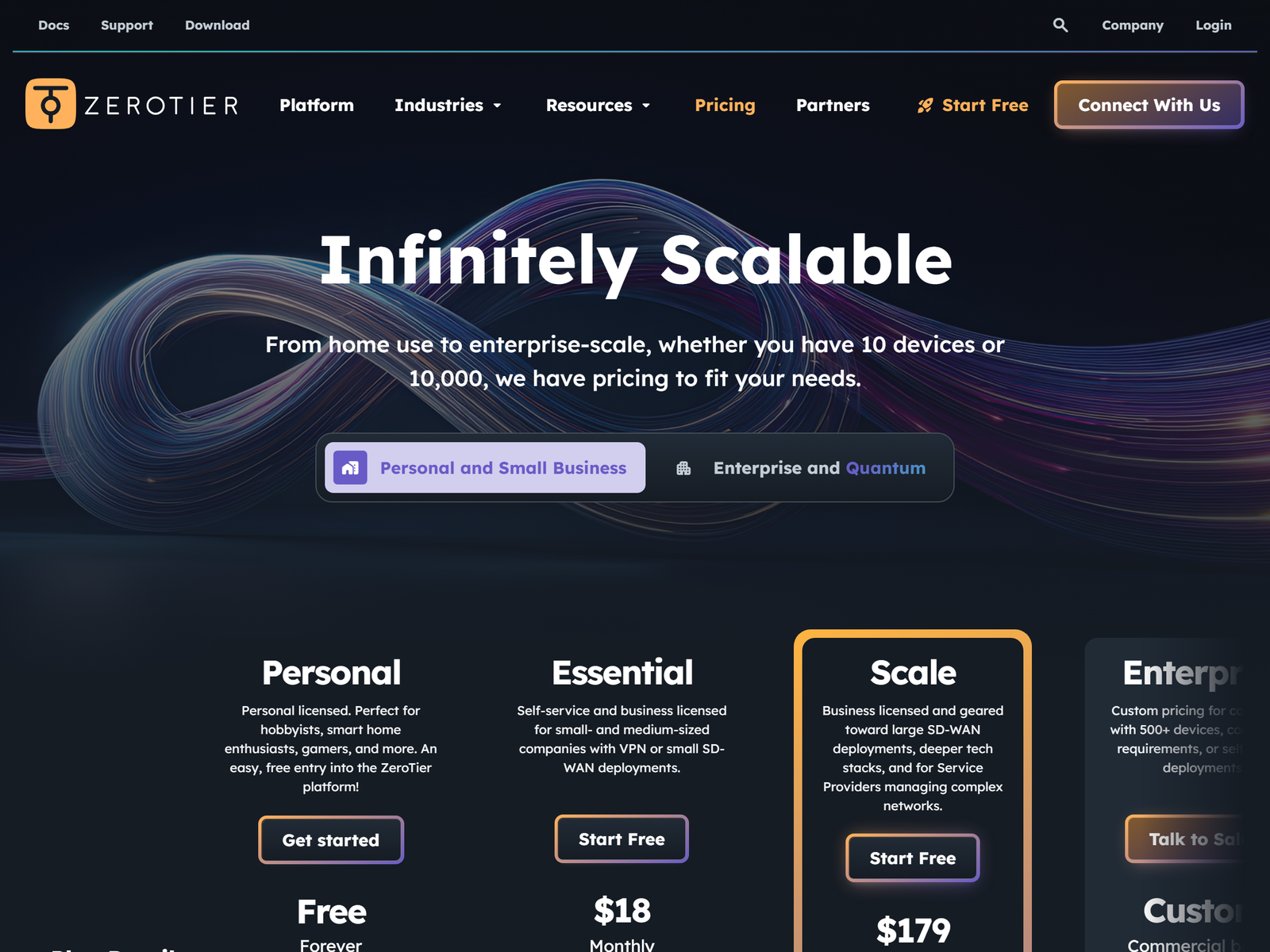
ZeroTier uses a freemium, per-device model. The Personal plan is free forever for up to 10 devices on a single network, which is genuinely useful for a home lab or a small remote setup. The Essential plan is $18 per month and includes 10 devices with $2 for each additional device and 10 networks. The Scale plan is $179 per month with 100 included devices, $1.80 per extra device, and unlimited networks. Enterprise and post-quantum tiers are custom-quoted for compliance and large fleets. The free tier is real, not a timed trial, which we appreciate; just remember that device-based pricing scales with how many things you connect.
Pros and Cons
Pros:
- Free forever tier for 10 devices on one network
- Peer-to-peer mesh with independent, resilient paths
- Layer 2 networking for IoT, multicast, and legacy apps
- Open-source client with AES-256 and ECC encryption
- Low overhead once a direct path is established
Cons:
- Per-device pricing grows with your fleet
- Proprietary protocol, not WireGuard-standard
- No consumer country exit nodes or streaming unblocking
- Self-hosting the controller takes real effort
Our scores
Scores reflect mesh reliability and control; it is not scored as a streaming or anonymity VPN.
ZeroTier vs Other Mesh and Remote-Access Tools
| Option | Best for | Free tier | Our take |
|---|---|---|---|
| ZeroTier | Layer 2 mesh and IoT linking | 10 devices, 1 network | Best for a virtual LAN across sites |
| NetBird | Self-hosted WireGuard mesh | Yes (open-source) | Great if you want WireGuard plus an owned control plane |
| Tailscale | Personal and small-team mesh | Yes (free) | Simpler setup, generous free tier |
| Twingate | Zero-trust per-resource access | 5 users | Best when you protect named resources, not a LAN |
Frequently Asked Questions
Is ZeroTier a VPN?
ZeroTier is often described as a VPN alternative. It creates an encrypted virtual network between your devices, solving remote-access and device-linking problems with a peer-to-peer design rather than a central exit server.
Can ZeroTier see my traffic?
No. Per ZeroTier's own documentation, traffic is end-to-end encrypted between your devices, so the relay and controller infrastructure cannot read your payloads. The open-source client lets you verify this yourself.
How much does ZeroTier cost?
The Personal plan is free for 10 devices on one network. Essential is $18 per month, and Scale is $179 per month, both with per-device overage. See the ZeroTier pricing page for current details.
Does ZeroTier work like Tailscale or Twingate?
All three replace legacy VPNs, but differently. Tailscale and NetBird use WireGuard; Twingate brokers per-resource zero-trust access; ZeroTier builds a full Layer 2/3 virtual network. Pick based on whether you need a LAN, a mesh, or per-app access.
Is ZeroTier good for hiding my IP on public Wi-Fi?
Not really. ZeroTier links your devices to each other; it does not mask your public IP from the open internet. For that job, a consumer VPN from our stable VPN reviews is the better tool.
My Take / The Bottom Line
ZeroTier is the most stable device-linking platform we have tested this year for home labs, IoT fleets, and remote access that needs to survive a dropped link. It is free to start, encrypted end to end, and far more resilient than a single-tunnel VPN. It is not a privacy or streaming tool, and the per-device pricing model means large fleets cost real money. Deploy the free tier on three nodes, watch how fast paths re-establish after a reboot, and compare it with our NetBird review and Twingate review before you commit.