Google Lost Its Two Most Important AI Leaders in One Day. Here Is What That Really Means.
Category: Industry Trends
Reviewed by the aifreetool Editorial Team — a group of full-time AI-tool researchers and writers who verify every product claim against primary sources and independent testing.
Last updated August 12, 2026.
We keep no affiliate relationship with the products covered here and earn nothing if you click through. Where a claim could not be verified, we say so.
On August 5, 2026, Alphabet announced that Demis Hassabis would step down as CEO of Google DeepMind and Jeff Dean, the company's chief scientist and 27-year veteran, would leave to start a new company. The news hit Alphabet shares immediately. They closed down 4 percent, wiping roughly $180 billion off the company's market capitalization in a single session. The Google AI brain drain is not a new story, but losing Hassabis and Dean on the same day, while Gemini 3.5 Pro sits months behind its original June launch target, marks a turning point that investors and competitors are still digesting.
What Actually Happened at Google DeepMind
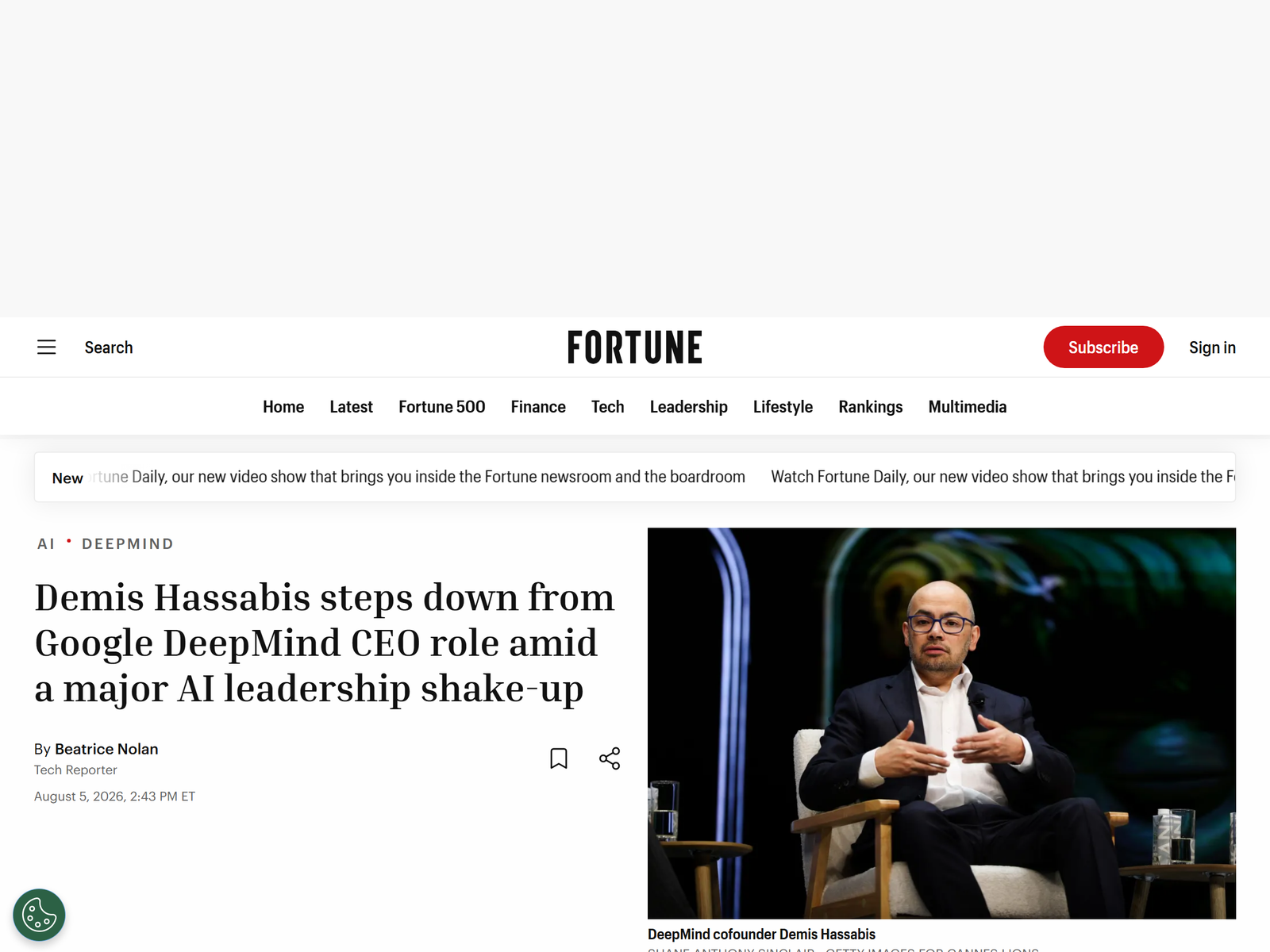
Hassabis transitions from CEO of Google DeepMind to chairman of the unit and Alphabet's newly created chief scientist role. In a memo to staff, he wrote that AGI is close at hand and that getting the next steps right is critical for humanity. He will focus on long-term AGI strategy, global AI governance, including a proposal for a FINRA-style self-regulatory body for AI, and Isomorphic Labs, Alphabet's drug discovery subsidiary.
Koray Kavukcuoglu, DeepMind's CTO and Alphabet's chief AI architect, takes over daily operations as senior vice president of Google DeepMind. Notably, he reports directly to CEO Sundar Pichai rather than holding a standalone CEO title. This means DeepMind is now embedded deeper into Google's product organization rather than operating as a semi-autonomous unit. The structural message is clear: research prestige is being subordinated to shipping speed.
Jeff Dean's departure is the bigger signal. He is leaving with Sanjay Ghemawat, Oriol Vinyals, and Quoc Le, four of Google's most decorated AI and systems engineers, to found Discovery Loop, a public benefit corporation focused on automating machine learning, science, and engineering research. Alphabet is a founding investor and will supply cloud compute. In an interview with The New York Times, Dean said operating outside a public company gives the team room to make decisions that are not necessarily in a company's purest financial interests.
The Context: Why This Matters Now
The leadership shakeup lands at a difficult moment for Google. Gemini 3.5 Pro, the flagship model, was originally targeted for a June 2026 launch. As of early August, it remains unreleased. Reuters reported that investor and industry concerns are growing that Google is falling behind Anthropic and OpenAI, both of which have been shipping faster. Two weeks before the announcement, Google posted quarterly revenue of $119.8 billion with cloud business up 82 percent, but free cash flow turned negative for the first time in the company's history as capital expenditure guidance was raised to $195 to $205 billion.
The talent outflow has been steady throughout 2026. Noam Shazeer, a Gemini co-lead, left for OpenAI. John Jumper, who shared the 2024 Nobel Prize in Chemistry with Hassabis for the AlphaFold work, departed for Anthropic. Jeremy Nixon, a former Google Brain researcher who now runs the AI research institute Infinity, told reporters that if Discovery Loop attracts Google's best researchers, it would be an unprecedented talent crisis.
Google is also reportedly in talks to bring in AI coding startup Mechanize's team and technology, a move seen as an attempt to shore up its agentic coding capabilities. This is an area where Anthropic's Claude Code and OpenAI's Codex have established strong positions. For developers evaluating AI coding tools, a comparison of available options is available at https://aifreetool.site/tool-category/ai-programming-development/
What Discovery Loop Tells Us About Where AI Research Is Going
Jeff Dean described his vision at Y Combinator's Startup School on July 25, 2026, ten days before the public announcement. He talked about building an automated scientific method. Systems that propose experiments, write the code to run them, execute and evaluate results, then feed those results into the next iteration. Run thousands of such loops in parallel, and the pace of discovery in biology, chip design, and AI model research itself could accelerate dramatically.
That vision explains why Dean left Google rather than building it internally. In his Times interview, he was explicit: operating outside a public company removes the pressure to prioritize quarterly earnings over long-horizon research. Discovery Loop is structured as a public benefit corporation, which legally binds it to consider social impact alongside financial returns. Alphabet's backing as founding investor and compute provider keeps the work connected to Google without forcing it through the same product and revenue filters.
This is a structural bet that the most valuable AI research in the next decade will happen at the intersection of automation and scientific discovery, and that it requires an organizational form that traditional big tech cannot provide. If Dean is right, Discovery Loop could become the template for how frontier AI talent exits large corporations without entirely abandoning their resources.
Key Takeaways
- Demis Hassabis stepped down as Google DeepMind CEO on August 5, 2026, becoming chairman and Alphabet chief scientist focused on AGI strategy and AI governance.
- Jeff Dean left Google after 27 years to co-found Discovery Loop with Sanjay Ghemawat, Oriol Vinyals, and Quoc Le, a public benefit corporation backed by Alphabet as founding investor.
- Alphabet shares fell 4 percent on the news, erasing approximately $180 billion in market value in a single trading session.
- Koray Kavukcuoglu takes over as SVP of Google DeepMind, reporting directly to Pichai. The standalone CEO title is gone, embedding DeepMind deeper into Google's product organization.
- Gemini 3.5 Pro remains unreleased, months behind its original June 2026 target, while Anthropic and OpenAI continue shipping faster.
My Take: Google Is Trading Research Depth for Product Speed
The conventional read on this shakeup is negative. Google is losing its best people. That is true, but it misses the strategic logic. By moving Hassabis to a strategy role and placing Kavukcuoglu, an operational leader who reports directly to Pichai, in charge of daily operations, Google is explicitly prioritizing product execution over research prestige. The standalone CEO title is gone. DeepMind is now a division within Google, not a lab alongside it.
That is probably the right call. Google's problem has never been research quality. It has been shipping speed. Gemini 3.5 Pro's delay is not a research failure. It is a productization failure. Embedding DeepMind deeper into Google's product organization, with a leader who reports to the CEO rather than running a semi-autonomous fiefdom, should tighten the loop between research and deployment.
The risk is that Discovery Loop becomes a magnet for Google's best researchers. Dean, Ghemawat, Vinyals, and Le represent the core of Google's AI infrastructure and Gemini model brain trust. If they recruit aggressively from their former employer, Google could face a sustained talent drain that no reorganization can fix. The next six months will reveal whether Google can retain its research bench while accelerating its product cadence, or whether August 5, 2026, will be remembered as the day the center of gravity in AI research shifted out of Mountain View.
FAQ
Why did Demis Hassabis step down as Google DeepMind CEO?
Hassabis said he wants to focus on AGI strategy, long-term research, and global AI governance. He transitions to chairman of Google DeepMind and Alphabet's chief scientist, while continuing as CEO of Isomorphic Labs. He stated that AGI is close at hand and that shaping its trajectory requires his full attention.
What is Discovery Loop?
Discovery Loop is a public benefit corporation co-founded by Jeff Dean, Sanjay Ghemawat, Oriol Vinyals, and Quoc Le after leaving Google. It focuses on automating machine learning, science, and engineering research. Alphabet is a founding investor and will provide cloud compute.
Who is the new head of Google DeepMind?
Koray Kavukcuoglu, formerly DeepMind's CTO and Alphabet's chief AI architect, takes over daily operations as senior vice president. He reports directly to Alphabet CEO Sundar Pichai and does not hold a standalone CEO title.
How much did Alphabet's stock fall after the announcement?
Alphabet shares closed down approximately 4 percent on August 5, 2026, erasing roughly $180 billion in market capitalization. The stock had been down as much as 5 percent during intraday trading.
Is Gemini 3.5 Pro delayed?
Yes. Gemini 3.5 Pro was originally targeted for a June 2026 launch but remains unreleased as of early August. The delay has fueled investor concerns that Google is falling behind Anthropic and OpenAI in the frontier model race.