OpenAI Atlas Browser Shut Down in 2026: Why the Agent Won
Category: Industry Trends
By the AI Free Tool Editorial Team | Last updated: August 10, 2026
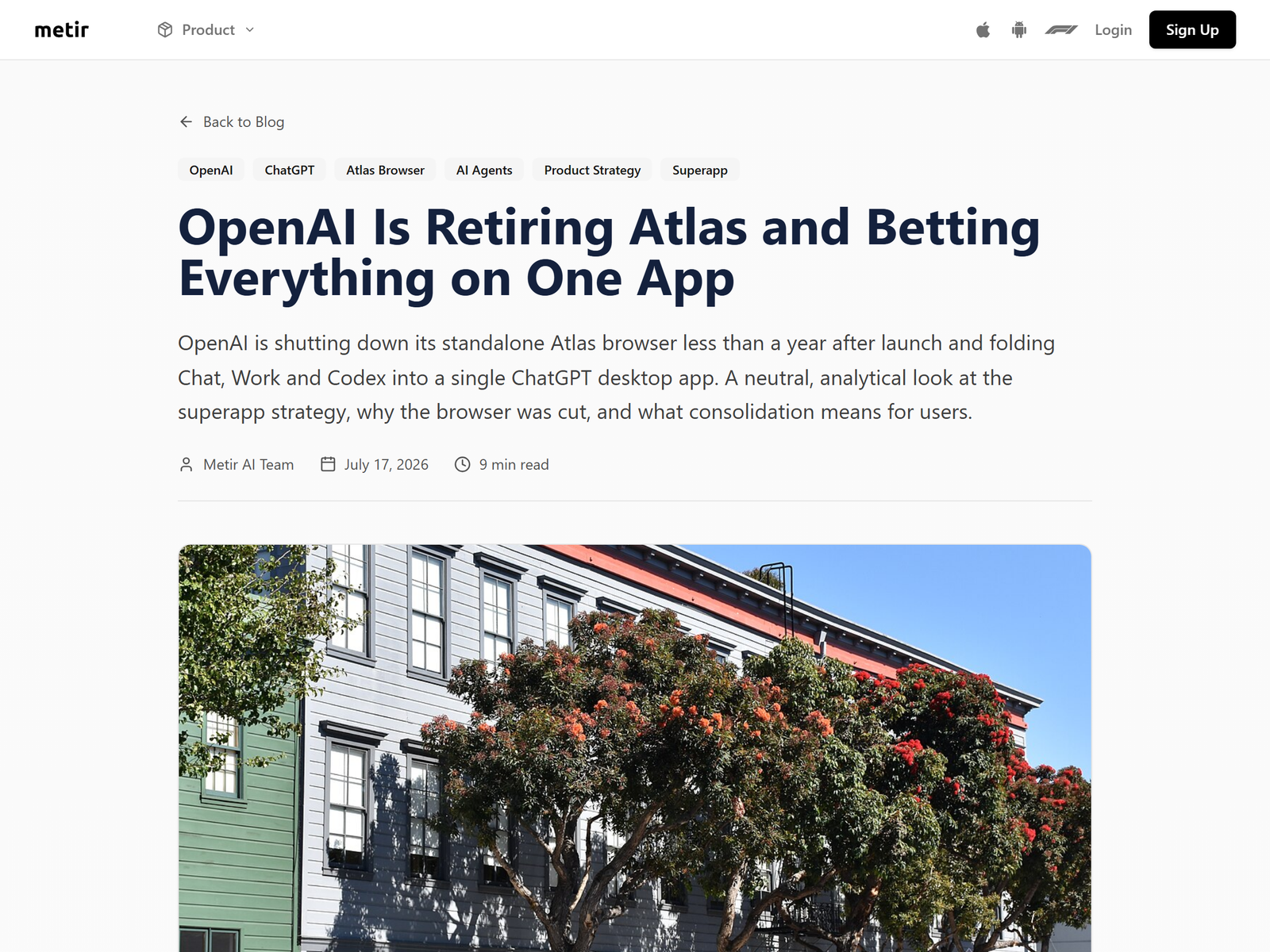
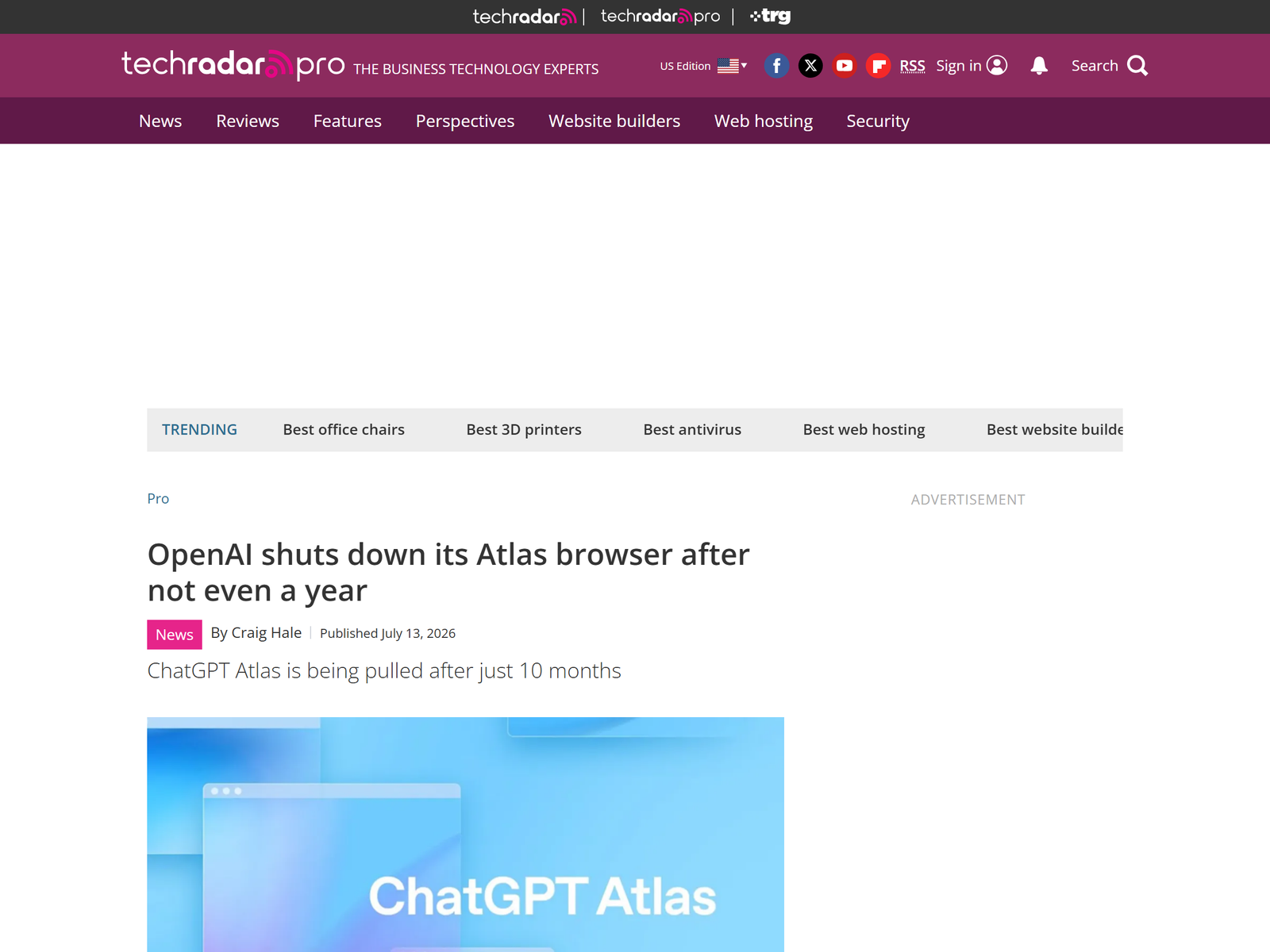
OpenAI shut down ChatGPT Atlas on August 9, 2026, killing a standalone AI browser that launched barely ten months earlier. The company framed it as consolidation. The real story is that the browser was the wrong container for agentic AI, and OpenAI figured that out faster than its competitors.
TL;DR: OpenAI killed its standalone Atlas browser after 293 days and folded agentic browsing into a unified ChatGPT desktop app. Chrome's 68% market share, security maintenance costs, and the superapp strategy made a standalone browser unsustainable. The agentic capability survives; the browser product does not.
The Rise and Fall of ChatGPT Atlas
Atlas arrived on October 21, 2025 as a dedicated agentic browser built on Google Chromium with ChatGPT wired directly into it. The pitch was simple: instead of toggling between a chat window and a browser, the AI lived inside the browser and could navigate sites, fill forms, and complete tasks on the user's behalf. It sounded like the future of web browsing.
It lasted 293 days. On July 9, 2026, OpenAI announced a 30-day wind-down, and on August 9 the browser stopped receiving security updates and ceased functioning. Bookmarks, open tabs, and browsing history did not transfer automatically. Users had to export everything manually before the deadline, as documented by Notebookcheck's migration guide.
The timing was not accidental. OpenAI launched a unified ChatGPT desktop app the same week, folding Chat, Work, and Codex into a single client. Chief Revenue Officer Denise Dresser had telegraphed the move back in April 2026 when she said the company was done pursuing side quests and fragmented interfaces. Atlas was the side quest.
Why Standalone AI Browsers Cannot Win
Chrome holds roughly 68% of global browser market share. That number has barely moved despite multiple AI browser launches from Arc, Edge with Copilot, and now Atlas. The reason is structural: a browser is not just an app. It is the operating system for everything people do online. Switching browsers means migrating passwords, extensions, bookmarks, muscle memory, and years of accumulated workflow. Almost no one does that for an AI feature.
OpenAI recognized this faster than its critics expected. Rather than fighting Chrome for market share, the company took its agentic browsing capabilities and distributed them across three surfaces where users already are: the new ChatGPT desktop app with a built-in browser, a Chrome extension and sidebar for users who stay on Chrome, and Codex for developer workflows that need logged-in website access. The capability survived. The standalone product did not.
Security was the other factor. Browsers see every page a user opens and every password they type. OpenAI was unusually blunt about the risk, warning that a discontinued browser without ongoing security maintenance becomes a liability. Disguised ad blockers had already been caught reading along in ChatGPT and Gemini chats. Microsoft Copilot had been tricked by websites injecting hidden commands. The attack surface of a browser is enormous, and maintaining it requires the kind of continuous security investment that only Google and Mozilla can sustain at scale. Digital Trends noted that OpenAI explicitly warned holdouts to move before the deadline.
Key Takeaways
- Browser-as-product is dead; agent-as-feature won. OpenAI is folding agentic browsing into the ChatGPT desktop app, Chrome extension, and Codex rather than maintaining a standalone browser.
- Chrome's 68% share is a moat. No AI company can displace Google's browser distribution advantage, and OpenAI stopped trying after ten months.
- Security maintenance killed Atlas faster than competition. A browser without continuous security updates is a liability, and OpenAI could not justify the cost for a product with marginal adoption.
- The superapp strategy is real. Chat, Work, and Codex unified into one desktop client signals OpenAI is building toward a single application that does everything.
What This Means for the AI Browser Wars
The Atlas shutdown is not a defeat for AI-powered browsing. It is a course correction. Agentic browsing, the ability for an AI to navigate websites, log in, fill forms, and complete transactions, is central to where OpenAI is heading. The company just concluded that the browser was the wrong delivery vehicle.
The new ChatGPT desktop app includes a built-in browser with multiple tabs, downloads, and account logins. ChatGPT Work, launched alongside the consolidation, bridges generative and agentic AI by running longer tasks across local and cloud environments. Custom instruction limits jumped from 1,500 to 5,000 characters. The App Directory was replaced with a Plugin Directory. Every signal points toward one application doing everything rather than a suite of specialized tools, as Metirai's analysis detailed.
For competitors still building standalone AI browsers, the Atlas shutdown is a warning. The browser market does not reward features. It rewards distribution, habit, and security investment. Google has all three. An AI layer bolted on top of Chrome, via extension or sidebar, reaches more users at a fraction of the maintenance cost.
My Take: The Bottom Line
OpenAI killed Atlas because it was competing for the wrong thing. The company does not need to own the browser. It needs to own the agent that uses the browser. By distributing agentic browsing across the desktop app, Chrome extension, and Codex, OpenAI gets the capability into the hands of users who never would have switched browsers in the first place. That is a better use of engineering resources than maintaining a Chromium fork that fewer than 1% of users would adopt.
The broader lesson for the AI industry is that standalone products built around a single AI feature have a short shelf life. The winning shape is the superapp, one application that handles chat, coding, research, and browsing in a unified interface. OpenAI is not the first company to figure this out, but it is the first to act on it decisively by killing a flagship product inside a year. Best for users who want AI everywhere without switching apps. Trade-off: more concentration of power in one application, and less room for specialized competitors.
Frequently Asked Questions
What was ChatGPT Atlas?
ChatGPT Atlas was OpenAI's standalone AI web browser, launched October 21, 2025 and built on Google Chromium with ChatGPT and agentic browsing capabilities integrated directly into the browser interface.
Why did OpenAI shut down Atlas?
OpenAI determined that a standalone browser was the wrong container for agentic AI. The company is consolidating browsing capabilities into the unified ChatGPT desktop app, Chrome extension, and Codex rather than maintaining a separate browser that required continuous security updates.
What happens to Atlas users' data?
Bookmarks, open tabs, and browsing history do not transfer automatically. Users must export bookmarks as HTML files and import them into another browser. ChatGPT conversation history is stored with the user's account and is unaffected by the Atlas shutdown.
Will agentic browsing still work after Atlas?
Yes. OpenAI is moving agentic browsing features into the new ChatGPT desktop app, which supports multiple tabs, downloads, account logins, and agent-led browsing. Chrome users can access similar features through the ChatGPT extension or sidebar.
Is this related to ChatGPT Work?
Yes. ChatGPT Work launched alongside the Atlas shutdown as part of the same consolidation strategy. Work enables longer-running agentic tasks across local and cloud environments, bridging generative and agentic AI in a single application.
This analysis is based on OpenAI's official announcements, press coverage from TechRadar, Dataconomy, Notebookcheck, and Metirai, and publicly available product documentation. For more AI industry coverage, browse our Industry Trends section, or explore curated AI tools on aifreetool.site.