SpaceX Just Bet Its Entire AI Future on NVIDIA. The Q2 Numbers Show How Much That Costs.
Category: Industry Trends
Reviewed by the aifreetool Editorial Team — a group of full-time AI-tool researchers and writers who verify every product claim against primary sources and independent testing.
Last updated August 12, 2026.
We keep no affiliate relationship with the products covered here and earn nothing if you click through. Where a claim could not be verified, we say so.
On August 4, 2026, SpaceX published its first quarterly earnings report as a public company and announced something that reshapes the AI infrastructure landscape: the company will exclusively use NVIDIA GPUs for all artificial intelligence computing. The partnership includes building Starmind AI1, a satellite designed to perform AI workloads in low Earth orbit using NVIDIA Vera Rubin GPUs and Vera CPUs.
The announcement arrived alongside financials that stunned Wall Street. SpaceX posted $7.8 billion in Q2 2026 revenue, up 92 percent year-over-year, but spent $18.4 billion in capital expenditures, with $15.8 billion going to AI infrastructure alone. The stock dropped 7.5 percent in after-hours trading.
The Starmind AI1 Satellite: AI Compute in Orbit
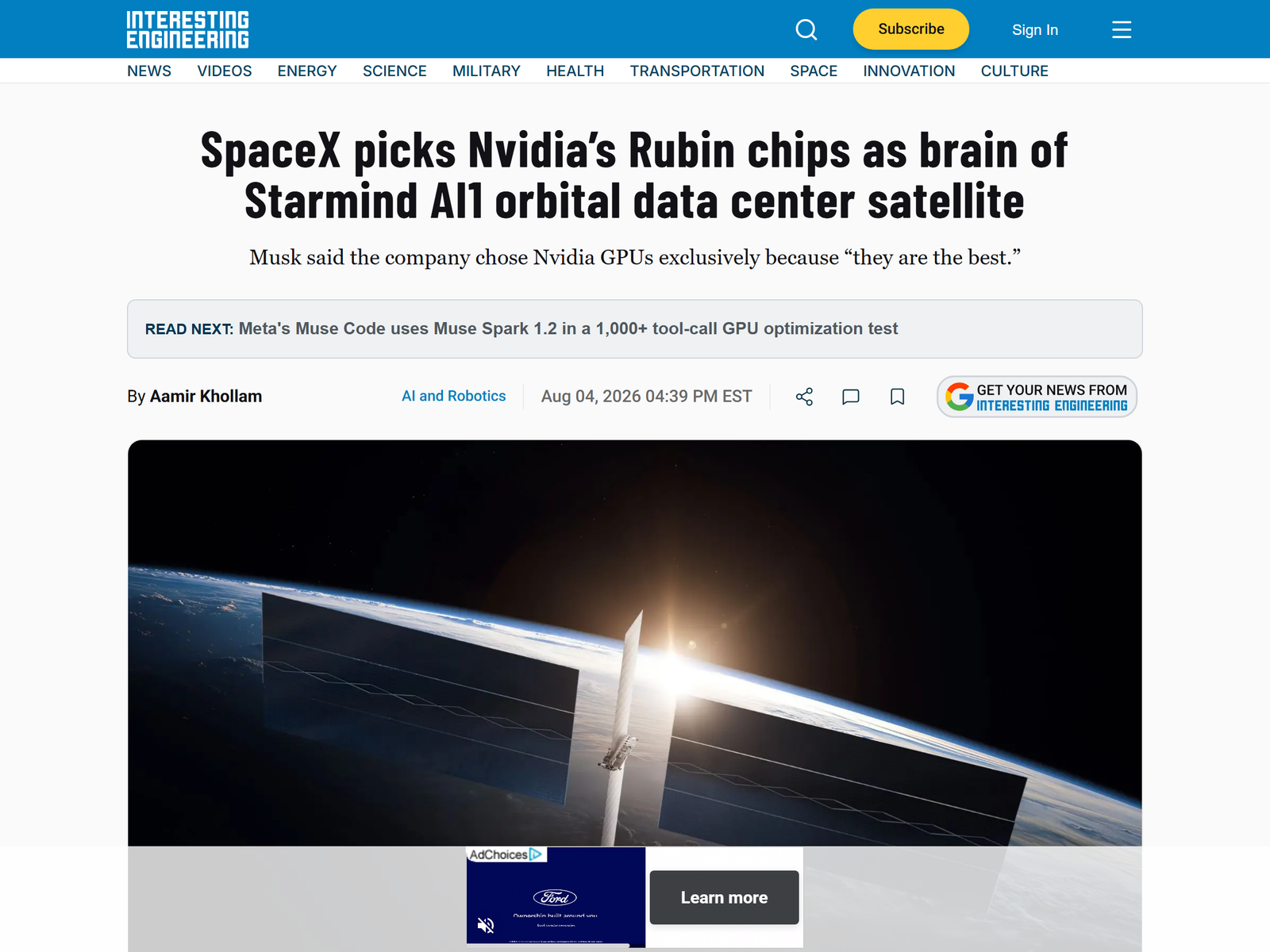
The Starmind AI1 satellite is the most unconventional part of this partnership. Each satellite carries NVIDIA Rubin GPUs and Vera CPUs, delivering what SpaceX describes as datacenter-class compute in low Earth orbit. The satellite measures roughly 30 meters tall with a 75-meter wingspan when fully deployed. Peak power consumption hits 250 kilowatts, with an average draw of 175 kilowatts. A 160-square-meter deployable liquid cooling radiator handles thermal management.
NVIDIA's Space-1 Vera Rubin module, designed specifically for orbital environments, integrates four Rubin GPUs with two Vera CPUs. The company claims it delivers up to 25 times the AI processing performance of an H100 GPU. Commercial shipments of the space-grade module are expected to begin later in 2026.
SpaceX has filed with the FCC to deploy as many as one million orbital data center satellites between 311 and 1,243 miles above Earth. The constellation would use petabit-scale optical laser links for inter-satellite communication. For context, roughly 15,000 active satellites currently orbit Earth. Prototype testing for Starmind AI1 is scheduled for early 2027, with mass production potentially beginning later that year.
Q2 2026 Financials: Revenue Soared, Capex Soared Higher
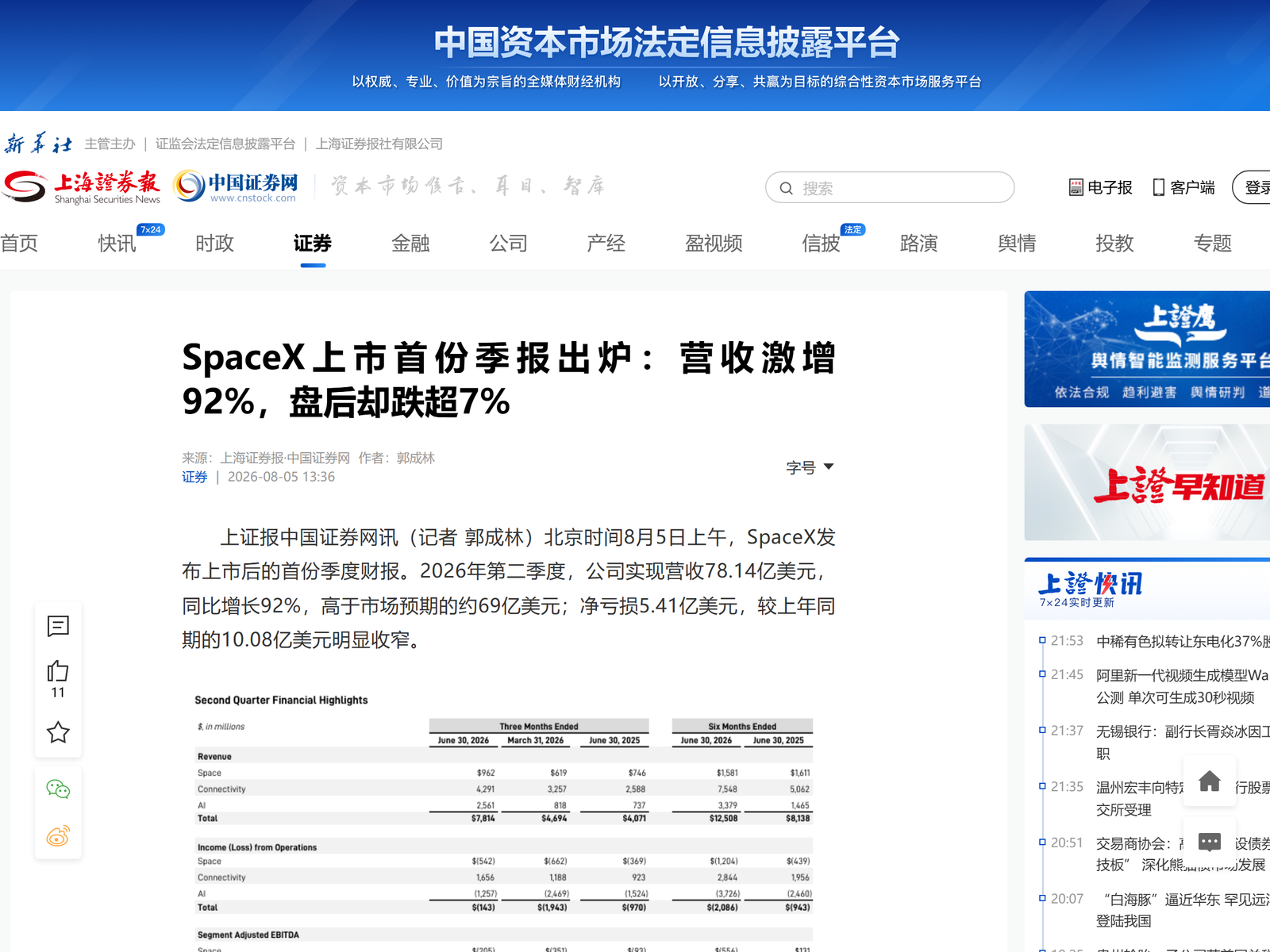
SpaceX's first public earnings report tells a story of aggressive expansion. Total revenue reached $7.814 billion, up from $4.071 billion in Q2 2025, beating analyst estimates of approximately $6.9 billion. The connectivity segment, driven by Starlink, generated $4.291 billion, up 66 percent year-over-year, with 12 million subscribers doubling from the prior year. Starlink delivered $1.656 billion in operating profit at a 38.6 percent margin.
The AI segment produced $2.561 billion in revenue, up 247 percent year-over-year from $737 million, and achieved its first positive segment Adjusted EBITDA of $1.146 billion. However, AI still posted an operating loss of $1.257 billion. The space segment contributed $962 million in revenue but lost $542 million operationally, with Starship R&D spending exceeding $10.76 billion cumulatively.
The headline number that spooked investors was capital expenditure. Q2 2026 capex hit $18.369 billion, compared to $2.825 billion in Q2 2025, a 550 percent increase. Of that, $15.828 billion went to AI compute infrastructure, primarily the Colossus data center in Memphis, Tennessee. CFO Bret Johnsen indicated that capex would remain at similar levels for the next several quarters. SpaceX ended the quarter with $100 billion in cash and $47.5 billion in backlog.
The NVIDIA Exclusivity Decision
Elon Musk stated on the earnings call that SpaceX chose NVIDIA exclusively because their GPUs are the best. The Vera Rubin architecture, specifically the NVL72 rack system codenamed Kyber, will deploy in both ground data centers and orbital satellites. Musk revealed that the same satellite design would be adapted for ground facilities, minus the solar panels and radiators, to improve data center efficiency.
The compute capacity targets are staggering. SpaceX ended Q2 with 1.4 gigawatts of nameplate compute draw. Musk projected exceeding 2 gigawatts by end of 2026, and targeting 10 to 20 gigawatts by end of 2027. For perspective, that would represent one of the largest concentrated AI compute deployments on the planet.
SpaceX also closed a $60 billion acquisition of Cursor, the AI coding platform, during the quarter, and released Grok 4.5 in July 2026. The company signed $14.1 billion in cloud services agreements, leasing AI compute capacity to Google, Anthropic, and other customers.
Key Takeaways
- Exclusive NVIDIA partnership: SpaceX commits to Vera Rubin GPUs for all AI compute, ground and orbital.
- $18.4B Q2 capex with $15.8B for AI infrastructure, up 550 percent year-over-year, triggered a 7.5 percent stock decline.
- Starmind AI1 satellite: 250kW peak power, 75m wingspan, Space-1 module delivering 25x H100 performance, prototype testing in early 2027.
- 10-20GW compute target by end of 2027, up from 1.4GW today, potentially the largest concentrated AI deployment globally.
- $100B cash position and $47.5B backlog provide runway, but lockup expiry of 912 million shares adds near-term selling pressure.
My Take: The Scale Is Real, the Risk Is Realer
SpaceX is executing the most aggressive AI infrastructure buildout in history, and the numbers prove it. A 247 percent year-over-year AI revenue increase to $2.56 billion is not trivial. Neither is spending $15.8 billion in a single quarter on AI capex. The question investors are asking is whether the revenue trajectory can catch up to the spending curve before the cash burn becomes unsustainable.
The orbital data center vision is genuinely novel. Sun-synchronous orbit provides consistent solar power without grid dependence, and space offers superior thermal conditions. But launching hundreds of thousands of GPU-laden satellites faces engineering challenges that make terrestrial data centers look straightforward. The FCC has not issued final approval for the full constellation.
The NVIDIA exclusivity is a double-edged sword. It guarantees access to the best available silicon and deepens a partnership that includes joint product development. It also concentrates supply chain risk in a single vendor at a time when GPU allocation is already constrained across the industry. For more coverage of AI infrastructure trends and tools, visit aifreetool.site.
Frequently Asked Questions
What is the Starmind AI1 satellite?
Starmind AI1 is a satellite designed by SpaceX and NVIDIA to perform AI computing in low Earth orbit. It carries NVIDIA Vera Rubin GPUs and Vera CPUs, with 250 kilowatts of peak power and a 160-square-meter liquid cooling radiator. Prototype testing begins in early 2027.
How much did SpaceX spend on AI infrastructure in Q2 2026?
SpaceX spent $15.828 billion on AI compute infrastructure in Q2 2026, out of $18.369 billion total capital expenditure. This represents an 86 percent allocation to AI, primarily funding the Colossus data center in Memphis, Tennessee.
Why did SpaceX stock drop after the earnings report?
The stock fell 7.5 percent in after-hours trading because capital expenditure of $18.4 billion far exceeded analyst estimates of approximately $13.2 billion. Investors also faced lockup expiry of 912 million shares, adding selling pressure. The stock has declined over 20 percent from its IPO price.
How much AI compute capacity does SpaceX have?
As of end of Q2 2026, SpaceX has 1.4 gigawatts of nameplate compute draw. The company targets over 2 gigawatts by end of 2026 and 10 to 20 gigawatts by end of 2027.
What does the NVIDIA exclusivity mean for SpaceX?
SpaceX will use only NVIDIA GPUs for all AI computing, both in ground data centers and orbital satellites. The partnership includes joint development of the Starmind AI1 compute payload using NVIDIA Vera Rubin NVL72 rack systems.