Anthropic Just Made MCP Stateless. That Changes How AI Agents Talk to Everything.
Category: Tech Deep Dives
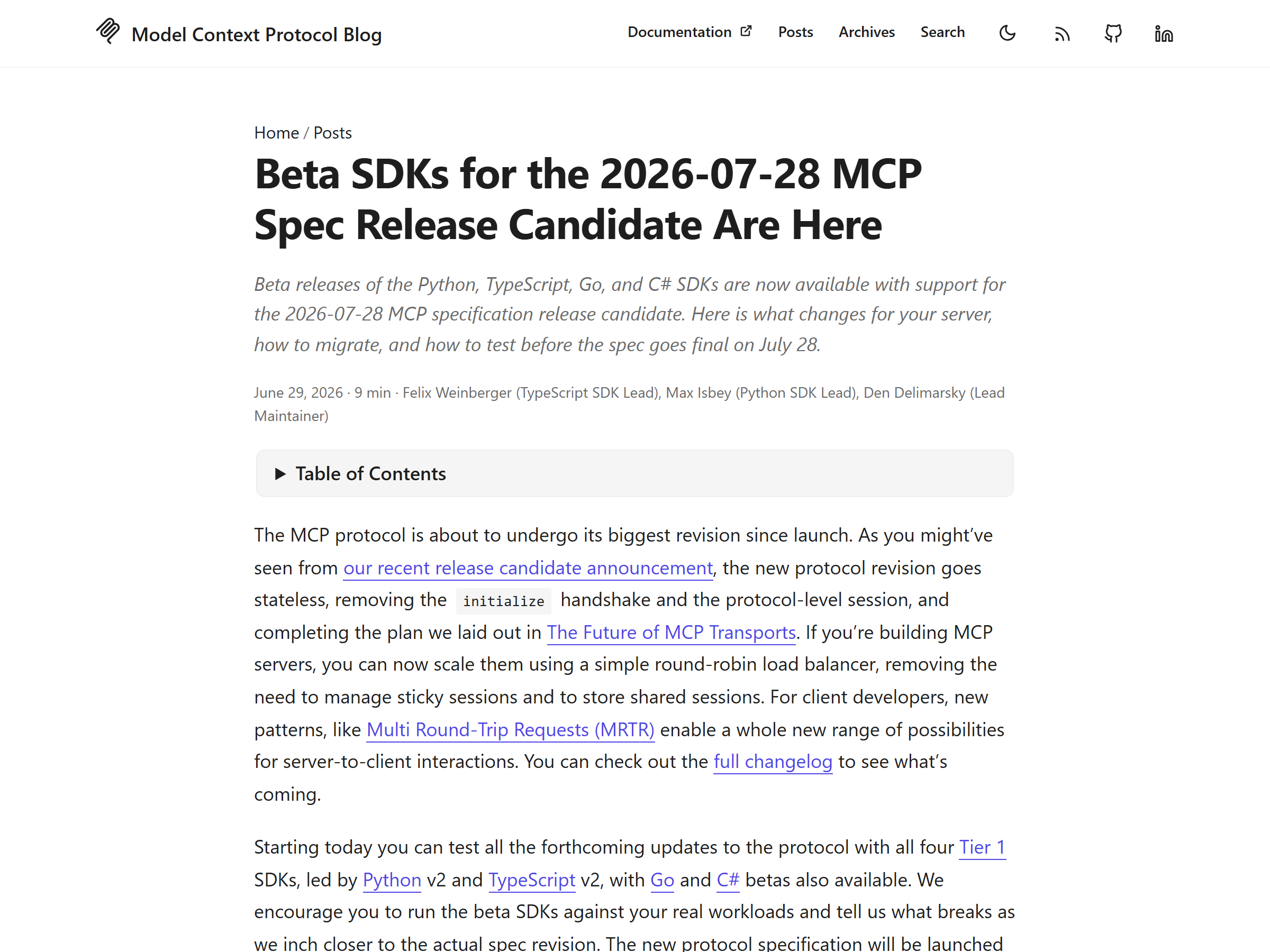
On July 28, 2026, Anthropic published the MCP stateless specification, officially labeled 2026-07-28. The company calls it the biggest revision of the Model Context Protocol since launch, and for once the marketing language is not an exaggeration. The protocol's core has moved from persistent sessions to independent request-response interactions, with richer features shifted into optional extensions. For anyone building agents that need to call tools, databases, or enterprise systems, this is the moment the protocol graduates from promising experiment to production infrastructure that connects to everything.
Why Stateful MCP Was a Production Headache
The original MCP design, released in November 2024, required a client to open a session with a server before making tool calls. An initialize handshake exchanged a session identifier, and subsequent requests were pinned to that same server instance. In practice, that meant horizontal scaling required sticky sessions, shared session stores, and often deep packet inspection at the gateway. Serverless and edge deployments, which spin instances up and down on demand, were structurally awkward fits. Restarting a server mid-session could break client state.
By early 2026, MCP had become popular enough that these constraints were no longer theoretical. Anthropic reported more than 400 million monthly SDK downloads and over 950 servers in the Claude app store. Figma, Zoom, and a growing list of enterprise vendors had backed the protocol. The original session model was starting to look like a prototype that had been pressed into production service. The 2026-07-28 revision is the rewrite that fixes that.
What Changed in the 2026-07-28 Spec
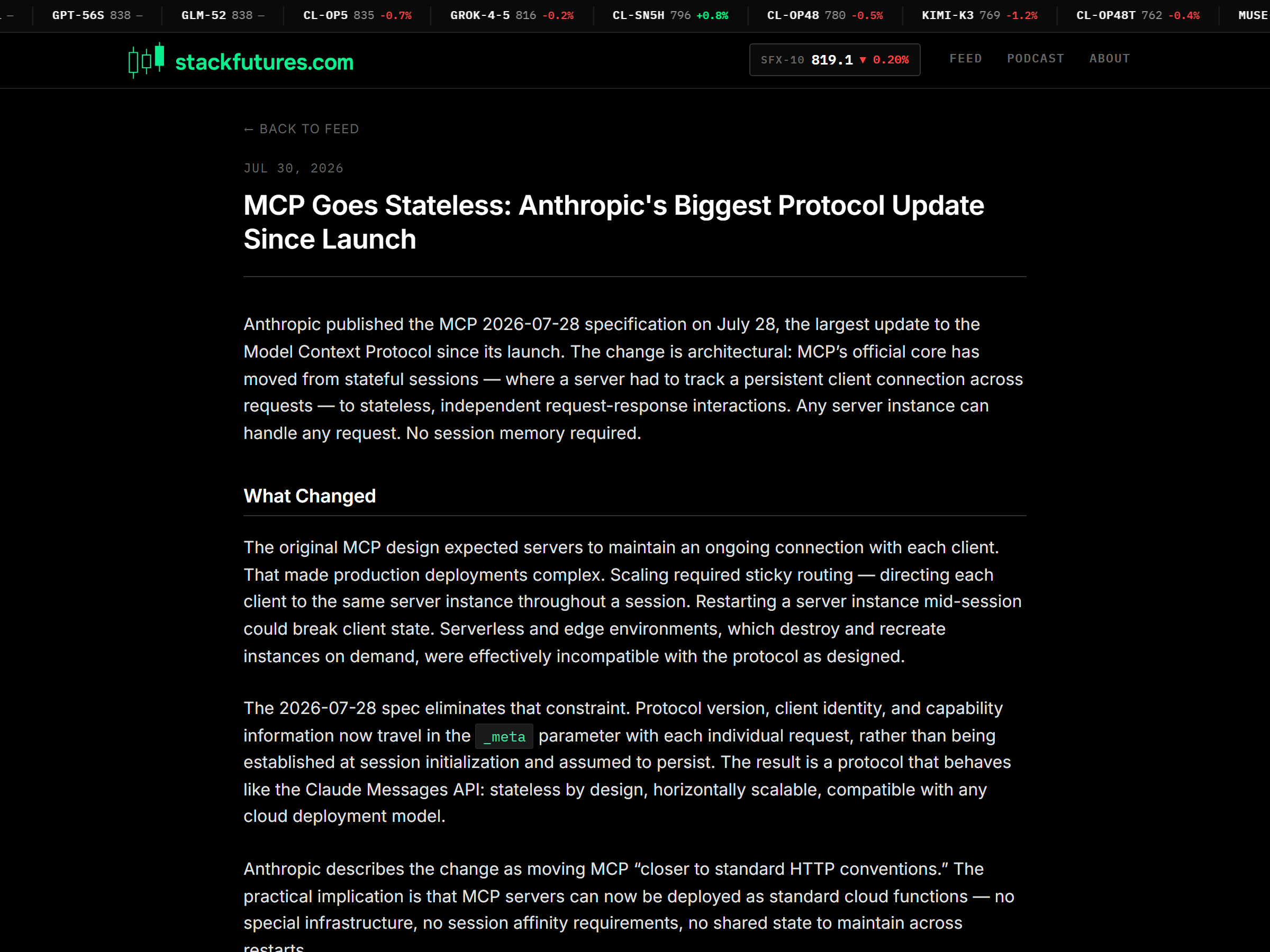
The headline change is a stateless core. Protocol version, client identity, and capability information now travel as metadata on each individual request. Any server instance can handle any request. There is no initialization handshake, no session header, and no requirement that the same instance process a sequence of calls. For operators, this means standard load balancers work without sticky routing, serverless functions can handle MCP traffic without losing state, and rolling deployments no longer need to drain long-lived connections.
The revision also introduces a formal extensions framework. Extensions are identified by reverse-DNS IDs, negotiated through a capabilities map, and versioned independently of the core specification. That lets the protocol add interactive interfaces and long-running tasks without bloating the base protocol that every server must implement.
Finally, the auth layer was hardened. Six specification enhancement proposals bring MCP closer to how OAuth 2.0 and OpenID Connect actually work in production. Clients must now validate the iss parameter on authorization responses, and desktop or CLI clients declare their application_type during Dynamic Client Registration to avoid being misclassified as web clients. The Enterprise-Managed Authorization extension, which lets organizations centrally manage access to MCP servers, is now stable and supported by Anthropic, Microsoft, and Okta.
The New Extensions: Apps, Tasks, and Enterprise Auth
Three additions stand out for practical adoption. MCP Apps lets servers deliver interactive HTML interfaces that the host renders inside a sandboxed iframe. UI actions flow through the same audit path as direct tool calls, which matters for compliance and debugging. Tasks reshapes long-running work around the stateless model: a server returns a task handle, and the client drives progress with tasks/get, tasks/update, and tasks/cancel. The previous experimental Tasks API is not forward-compatible, so teams that shipped against it will need to migrate.
The third addition, Enterprise-Managed Authorization, addresses the consent-fatigue problem that has slowed enterprise rollouts. Instead of prompting individual users every time they connect a new MCP server, organizations can centrally authorize access. End users get single sign-on across connected servers. This is the piece that makes MCP palatable to IT departments that otherwise would block dozens of unvetted tool connections.
What This Means for Developers
For developers already running MCP servers, the migration is not automatic. Python and TypeScript SDK v2 betas are available, Go and C# betas are also out, and stable v1.x branches will continue receiving critical fixes for at least six months. Servers that match on the old -32002 error code need to update to the JSON-RPC standard -32602. Anyone using the experimental 2025-11-25 Tasks API needs to move to the new extension model before the next release cycle.
The bigger picture is that MCP is now architecturally aligned with ordinary HTTP infrastructure. That alignment removes the main objection from platform teams that wanted to adopt the protocol but could not justify custom session management. It also positions MCP as a credible common language for tool use across providers, even though OpenAI's Realtime API and Google's Agent-to-Agent protocol address adjacent problems with their own designs.
Key Takeaways
- The 2026-07-28 MCP spec moves the protocol core from stateful sessions to stateless request-response interactions. Any server instance can handle any request.
- This removes the need for sticky sessions and shared session stores, making serverless, edge, and standard load-balanced deployments practical.
- Richer features move into optional extensions: MCP Apps for interactive UI, Tasks for long-running work, and Enterprise-Managed Authorization for centralized access control.
- Auth hardening aligns MCP with real-world OAuth 2.0 and OIDC deployments, including
issvalidation and desktop client registration fixes. - Migration work is required, but v1.x SDKs will receive security updates for at least six months.
FAQ
What is MCP?
MCP, or Model Context Protocol, is an open standard that lets AI models connect to external data sources, tools, and enterprise systems through a common interface.
What does "stateless" mean in this update?
It means each request carries all the information a server needs to process it. There is no persistent session or handshake, so any server instance can answer any request.
Do I need to migrate my existing MCP server immediately?
No. Existing clients and servers keep working, and stable v1.x SDKs will continue receiving security fixes for at least six months. Migration is opt-in.
What are MCP Apps?
MCP Apps let servers provide interactive HTML interfaces that hosts render in sandboxed iframes, with user actions audited like tool calls.
Which companies support the new Enterprise-Managed Authorization extension?
Anthropic, Microsoft, and Okta have publicly backed the Enterprise-Managed Authorization extension.
My Take / The Bottom Line
The stateless rewrite is the right call at the right time. MCP was at risk of becoming an Anthropic-flavored convenience rather than a true cross-industry standard, largely because production deployment was harder than it needed to be. Stateless HTTP is the default assumption of every modern platform team, so aligning MCP with that model removes the largest barrier to adoption. The extensions framework is equally important: it keeps the core small while letting the protocol grow in directions the maintainers cannot predict.
For builders, the message is to start designing your tool servers as stateless from the beginning, even if you are still on the v1 SDK. If you are choosing an agent stack today, MCP just became a safer bet than it was a month ago. Readers can explore related tools on aifreetool.site, including Claude Code on aifreetool.site for terminal-native agent workflows and OpenClaw on aifreetool.site for an open-source local-first agent framework. The protocol matters, but the harness you wrap around it matters just as much.