Microsoft's First Cybersecurity AI Model Outperforms Anthropic and OpenAI at Half the Cost
Category: Tech Deep Dives
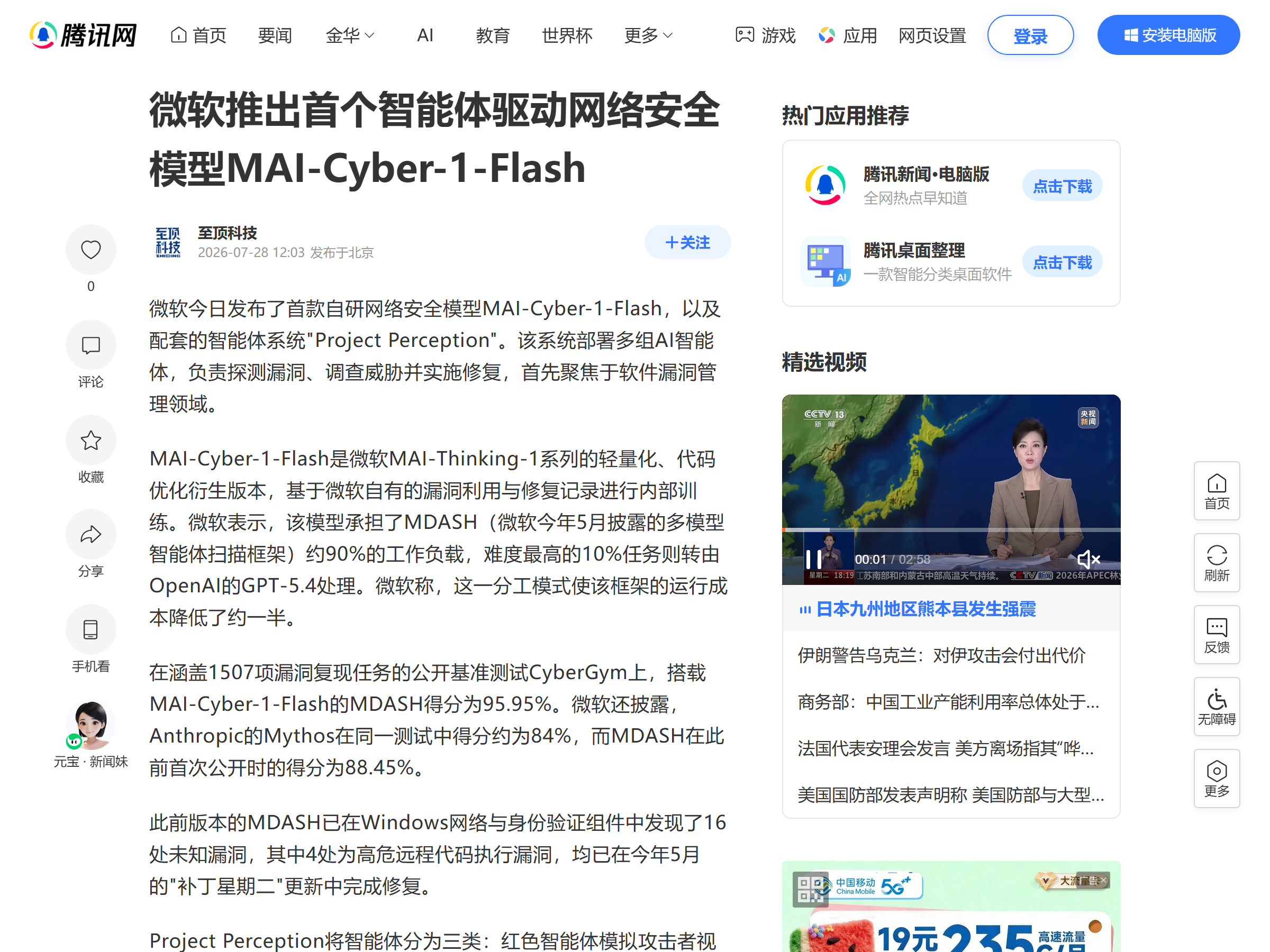
On July 27, Microsoft CEO Satya Nadella posted something unusual to X: a cybersecurity benchmark score. Not a product announcement wrapped in corporate-speak — just a number. 95.95%. That is the CyberGym score for MAI-Cyber-1-Flash, Microsoft's first purpose-built cybersecurity AI model, and it is higher than anything Anthropic's Mythos (83.8%) or OpenAI's GPT-5.6 Sol (83.6%) managed on the same test. But the number that matters more to security teams running on tight budgets is this: Microsoft says the new system does the job at roughly half the cost of its previous configuration.
MAI-Cyber-1-Flash is not a general-purpose model tweaked for security. It is a compact, code-heavy model derived from Microsoft's in-house MAI-Thinking-1 lineage, trained on what Microsoft claims is decades of real-world security data — trillions of daily signals across identity, endpoint, cloud, and network. It is deployed inside MDASH, a multi-agent vulnerability identification and remediation platform that has been running inside Microsoft's own security operations since May 2026. The model handles roughly 90% of MDASH tasks, while the remaining 10% of exceptionally hard cases are routed to GPT-5.4. The result: enterprise-grade vulnerability detection at a price point that does not require a board meeting to approve.
The Numbers Behind the Benchmark
CyberGym is a public benchmark of 1,507 real-world vulnerability reproduction tasks. It is the closest thing the security industry has to a standardized test for AI-powered vulnerability detection. Here is how the top models stack up:
- Microsoft MDASH + MAI-Cyber-1-Flash: 95.95%
- Microsoft MDASH (May 2026, GPT-based): 88.45%
- GPT-5.5 Cyber: 85.6%
- Anthropic Claude Mythos 5: 83.8%
- OpenAI GPT-5.6 Sol: 83.6%
The 95.95% score represents a 7.5 percentage point improvement over Microsoft's own previous MDASH configuration. Before the MAI-Cyber-1-Flash integration, MDASH had already found 16 previously unknown vulnerabilities in Windows networking and authentication components, four of which were critical remote code execution flaws. Those were patched in Microsoft's May 2026 Patch Tuesday. The new model raises the ceiling on what automated scanning can catch.
Cost is where the story gets interesting for security buyers. Microsoft's previous MDASH stack ran GPT-5.4, GPT-5.4 Mini, and GPT-5.3 Codex simultaneously — an expensive menu of frontier models. By slotting MAI-Cyber-1-Flash into the 90% of tasks it can handle natively and reserving GPT-5.4 for the hardest 10%, Microsoft claims a roughly 50% cost reduction. For enterprise security teams running continuous scanning across massive codebases, that is not a rounding error — it is the difference between adopting AI-powered security and sticking with manual review.
How the Hybrid Architecture Actually Works
MAI-Cyber-1-Flash is not a standalone product. It is one component of MDASH, which orchestrates over 100 specialized AI agents through a five-stage pipeline: Prepare (building a pre-repository knowledge base with threat models, call graphs, and CVE histories), Scan (codebase discovery and vulnerability identification), Validate (bug triage, false-positive filtering, and duplicate collapse), Prove (proof-of-concept generation to reproduce the bug), and Patch (fix suggestion and correctness validation).
The critical design decision was the 90/10 task split. Microsoft recognized early that most vulnerability scanning tasks — pattern matching, known CVE variant detection, basic code flow analysis — do not require the full reasoning power of a frontier model. A smaller, security-specialized model trained on actual exploit data and remediation histories can handle the bulk of the work faster and cheaper. The 10% that requires deeper reasoning — novel attack vectors, complex multi-step exploit chains — still gets routed to GPT-5.4. The system dynamically decides which model handles each task based on complexity scoring.
The training data is Microsoft's deepest competitive advantage here. The company processes over 100 trillion security signals daily through its Defender, Sentinel, and Azure security products. It has an unmatched historical record of real exploits, attack chains, and successful remediations across the largest security estate on the planet. No other AI lab — not Anthropic, not OpenAI, not Google — has access to that volume of labeled security data. That data advantage is what makes the model's benchmark scores credible rather than cherry-picked.
Project Perception and the Agentic Security Shift
Alongside MAI-Cyber-1-Flash, Microsoft launched Project Perception — an agentic security system that deploys three categories of AI agents: red agents that simulate attacker behavior and probe for weaknesses, blue agents that analyze signals and prioritize threats, and green agents that write and deploy fixes. The system is designed for continuous operation — it does not wait for a scheduled scan. It monitors, detects, and responds in a loop.
Human approval is still required for high-impact operations. Microsoft's enterprise security VP David Weston told reporters that the company needs to "earn that trust" before granting agents higher autonomy. But the direction is clear: security operations are moving from human-driven, tool-assisted workflows to agent-driven, human-supervised ones. The speed advantage matters because attackers are also using AI. As Weston put it: "We cannot let attackers monopolize the efficiency gains."
The competitive landscape is heating up fast. Anthropic previewed Mythos in April. Google launched Gemini 3.5 Flash Cyber last week. Cisco has its own security model in development. Microsoft's play is to integrate MAI-Cyber-1-Flash into its existing security product ecosystem — Defender, Sentinel, MDASH — where it already has enterprise distribution. The model is gated: only verified defenders get access, and it runs in sandboxed environments with no internet access, role-based controls, tenant isolation, and full audit logging.
What This Means for the Security Industry
The emergence of security-specific AI models changes the economics of vulnerability management in three ways. First, it makes continuous, automated scanning affordable for organizations that previously could only afford periodic manual penetration tests. Second, it shifts the defender's job from finding vulnerabilities to reviewing and verifying AI findings — a quality-control role rather than a discovery role. Third, it intensifies the arms race: as defenders get better AI tools, attackers get them too, which means the baseline for adequate security keeps rising.
Microsoft's pricing uses a custom "security compute unit" metric rather than raw token counts, which means enterprises will need to model their costs carefully. But for organizations already running Microsoft security products, the integration path is straightforward — MAI-Cyber-1-Flash becomes another capability inside tools they already use, not a separate procurement decision.
The public preview of MAI-Cyber-1-Flash opens August 3, 2026. By then, Google and Anthropic will likely have updated their own security offerings. The winner in this category will not be the company with the best benchmark score — it will be the one whose model integrates most seamlessly into the security workflows enterprises actually run every day.
Key Takeaways
- Microsoft's MAI-Cyber-1-Flash scored 95.95% on the CyberGym vulnerability detection benchmark, beating Anthropic Mythos (83.8%) and OpenAI GPT-5.6 Sol (83.6%) by over 12 percentage points.
- The model handles 90% of MDASH security tasks, with the hardest 10% routed to GPT-5.4, achieving roughly 50% cost reduction versus the previous all-GPT configuration.
- Project Perception introduces red, blue, and green AI agent teams for continuous threat monitoring, detection, and remediation — with human approval required for high-impact actions.
- Microsoft's training data advantage — 100 trillion daily security signals from Defender, Sentinel, and Azure — is a moat no other AI lab can replicate.
- Public preview opens August 3, available only to verified defenders through MDASH.
FAQ
What is MAI-Cyber-1-Flash?
MAI-Cyber-1-Flash is Microsoft's first purpose-built cybersecurity AI model. It is a compact, code-specialized model derived from the MAI-Thinking-1 lineage, trained on real-world exploit and remediation data, and integrated into Microsoft's MDASH vulnerability scanning platform.
How does it compare to Anthropic Mythos and OpenAI GPT-5.6 Sol?
On the CyberGym benchmark of 1,507 vulnerability reproduction tasks, MAI-Cyber-1-Flash scored 95.95%. Anthropic Claude Mythos 5 scored 83.8%, and OpenAI GPT-5.6 Sol scored 83.6%. The model also costs roughly 50% less to run than Microsoft's previous GPT-based MDASH configuration.
Can anyone use MAI-Cyber-1-Flash?
No. The model is gated and available only to verified defenders through the MDASH platform. It runs in sandboxed environments with no internet access, role-based controls, tenant isolation, and full audit logging. Public preview opens August 3, 2026.
What is Project Perception?
Project Perception is Microsoft's new agentic security system that deploys teams of AI agents for continuous security monitoring. Red agents simulate attackers, blue agents analyze threats, and green agents write and deploy fixes. It currently focuses on software vulnerability management and will expand to additional security workflows.
How does the 90/10 task split work?
MDASH dynamically routes security tasks based on complexity. MAI-Cyber-1-Flash handles the 90% of tasks that involve pattern matching, known CVE variant detection, and basic code flow analysis. The remaining 10% of complex tasks — novel attack vectors and multi-step exploit chains — are routed to GPT-5.4 for deeper reasoning.
My Take
Microsoft is playing a different game than Anthropic or Google in AI security. Those companies are building security models and hoping enterprises will adopt them. Microsoft already has the enterprises — Defender, Sentinel, and Azure security products are embedded in most Fortune 500 environments. MAI-Cyber-1-Flash does not need to win a procurement battle; it just needs to be better than what those customers are currently using. That is a much lower bar. The real question is whether the model's benchmark performance holds up against real-world attack diversity — and whether security teams trust an AI to find vulnerabilities they are legally obligated to disclose. That trust will take years to build, not months.
For more AI tools and industry coverage, check out our AI Models category.