NVIDIA and SK Group Just Committed $500 Billion to AI Infrastructure. Here Is What That Actually Buys.
Category: Tech Deep Dives
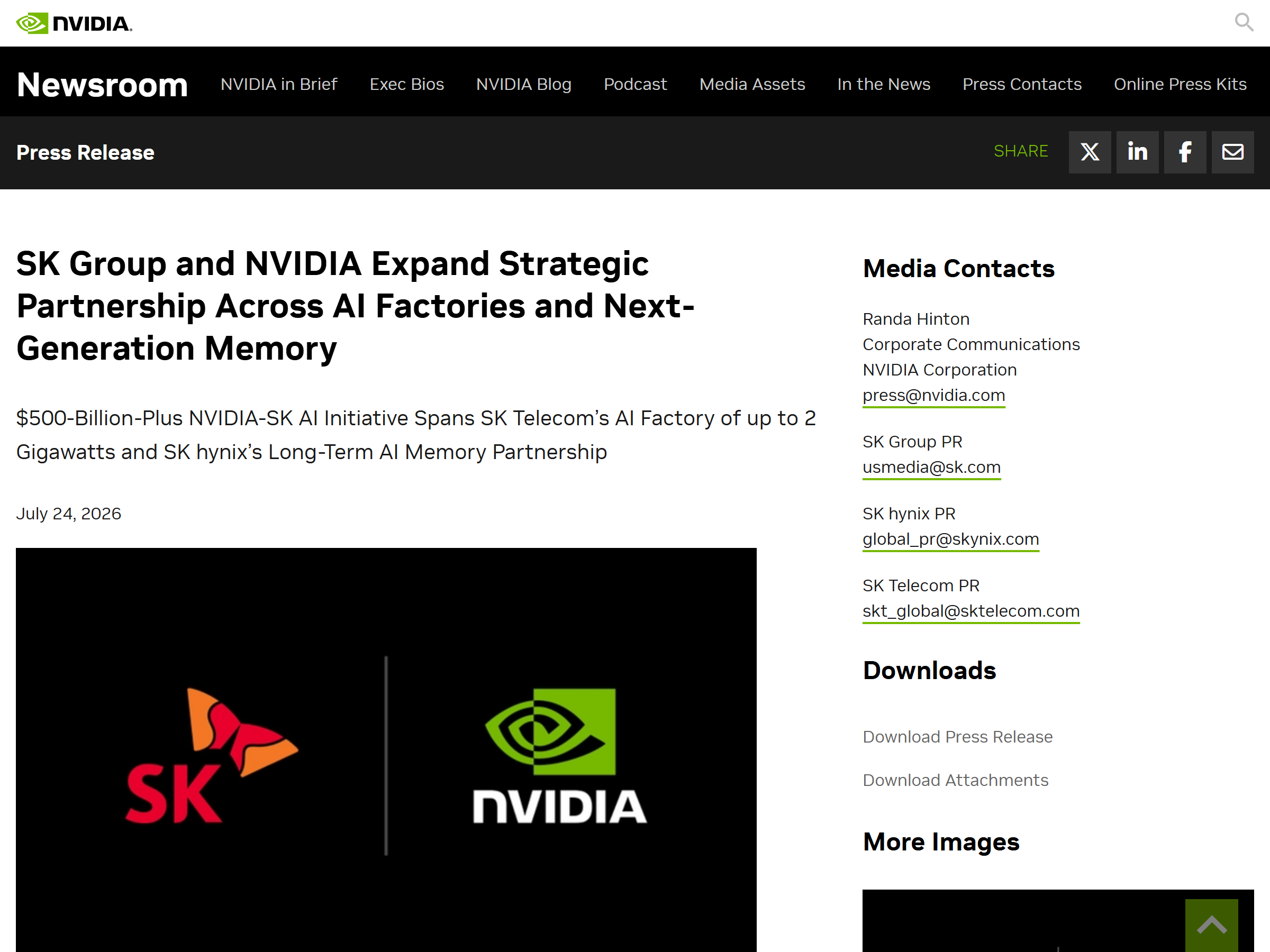
On July 24, NVIDIA and South Korea's SK Group announced a partnership valued at more than $500 billion, making it one of the largest single AI infrastructure commitments ever disclosed. The NVIDIA SK Group AI partnership spans AI factory construction, next-generation memory co-development, and a 2-gigawatt data center in South Korea — a scope that reshapes how the global AI supply chain is structured.
The deal was signed at an AI Summit in San Francisco and formalized through letters of intent. It builds on agreements struck in June 2026 between NVIDIA, SK Telecom, and SK hynix, but the dollar figure and operational scope are new. For context, $500 billion exceeds the annual GDP of countries like New Zealand or Peru. Here is what that money actually covers.
What the $500 Billion Actually Covers
The partnership rests on two pillars, and both are essential to understanding why the price tag is so high.
The first is infrastructure. SK Telecom will build a 2-gigawatt AI data center in South Korea powered by NVIDIA's Vera Rubin accelerated computing platform and SK hynix HBM4 memory. Two gigawatts is enough electricity to supply roughly 1.5 million homes — or about 10% of all data center capacity currently operating in the United States. The first facility is scheduled to come online in 2027, built on NVIDIA's DSX full-stack AI factory architecture.
The second is memory. SK hynix and NVIDIA established a long-term partnership to secure and co-develop next-generation AI memory, including high-bandwidth memory (HBM). SK hynix will supply HBM4 for NVIDIA's Vera Rubin chips and co-develop future memory generations optimized for AI training, agentic AI workloads, and physical AI applications. This is not a standard purchase agreement — it is a joint development pact that gives NVIDIA guaranteed access to the most scarce component in AI chip manufacturing.
A separate but related agreement involves NVIDIA, Naver (South Korea's dominant search platform), and Brookfield (the Canadian infrastructure giant) expanding an existing AI data center in South Korea. That deal was announced alongside the SK Group partnership and adds to the country's growing concentration of AI compute.
Vera Rubin and HBM4: The Technical Stack
The deal's technical foundation centers on two NVIDIA technologies that most enterprises have not yet encountered in production: Vera Rubin and the DSX platform.
Vera Rubin is NVIDIA's next-generation CPU-GPU system, which the company claims processes roughly 10 times more tokens per watt than the current Grace Blackwell platform. That efficiency matters because power consumption — not chip availability — is the single biggest constraint on AI data center expansion. A 2-gigawatt facility is enormous precisely because power is the bottleneck. NVIDIA's stated goal with DSX is to deliver 'the lowest token cost at maximum energy efficiency.'
The DSX platform is described as a full-stack AI factory architecture integrating accelerated computing, systems, software, and partner technologies. In practice, this means NVIDIA is not just selling chips to SK Telecom — it is selling an entire operational stack, from silicon up through the software layer that manages inference, training, and orchestration. Customers who adopt DSX become deeply embedded in NVIDIA's ecosystem.
HBM4 is the memory component, and it is the most supply-constrained element in AI chip manufacturing. Only three companies produce high-bandwidth memory globally: SK hynix, Samsung, and Micron. By signing a long-term co-development agreement with SK hynix, NVIDIA locks down the component most likely to bottleneck its own chip production. This is vertical integration by contract rather than by acquisition — and it gives SK hynix a guaranteed revenue stream while giving NVIDIA priority access to scarce supply.
Why South Korea, and Why Now
The choice of South Korea is not incidental. Three structural advantages make it an ideal location for a $500 billion AI infrastructure bet.
First, SK hynix and Samsung — two of the world's three HBM manufacturers — are both headquartered there. Building AI data centers next to the memory factories creates a vertically integrated supply chain that few countries can match. Logistics complexity drops, and co-development cycles shorten when engineers are in the same time zone.
Second, South Korea has world-class network and industrial infrastructure. SK Telecom operates one of the most advanced 5G networks globally, and SK Group spans semiconductors, energy, and telecommunications under a single corporate umbrella with over 175 affiliate companies and 100,000 employees worldwide. That breadth means the conglomerate can handle everything from chip design to power plant construction internally.
Third, there is a geopolitical dimension. NVIDIA has been pursuing a strategy of building AI factory partnerships across Asia — including deals in Japan (the Noetra consortium with 27,500 Rubin GPUs), the UAE, and Saudi Arabia. South Korea adds a democratic ally with advanced semiconductor capabilities to that network. Jensen Huang framed it explicitly: 'South Korea has all the ingredients to become a global AI powerhouse — world-class networks and data centers, leadership in chip technology, and vast industrial scale.'
SK Group Chairman Chey Tae-won framed the ambition from Korea's side: the goal is to transform the country from an AI adopter into 'a global hub that drives AI innovation.' That is a statement about capturing value in the AI supply chain, not just consuming it.
Key Takeaways
- NVIDIA and SK Group signed a $500 billion+ partnership covering AI factory construction, HBM4 memory co-development, and a 2-gigawatt data center in South Korea.
- The 2GW facility — powered by NVIDIA Vera Rubin chips and SK hynix HBM4 — is enough electricity for 1.5 million homes and comes online in 2027.
- NVIDIA's DSX platform means the company sells an entire operational stack, not just chips — deepening customer lock-in across silicon, software, and memory.
- The SK hynix memory agreement secures the most supply-constrained component in AI chip manufacturing, produced by only three companies globally.
- This is part of NVIDIA's broader Asia strategy, with similar AI factory deals in Japan, the UAE, and Saudi Arabia.
FAQ
What is the NVIDIA and SK Group partnership worth?
The partnership is valued at more than $500 billion, announced on July 24, 2026, at an AI Summit in San Francisco. It covers AI factory construction, HBM4 memory co-development, and data center infrastructure in South Korea.
What is Vera Rubin?
Vera Rubin is NVIDIA's next-generation CPU-GPU computing platform, succeeding Grace Blackwell. NVIDIA claims it processes approximately 10 times more tokens per watt than Grace Blackwell, making it significantly more energy-efficient for AI workloads.
How big is a 2-gigawatt AI data center?
Two gigawatts is enough electricity to power approximately 1.5 million homes. For comparison, total U.S. data center capacity is roughly 20–25 gigawatts as of 2026. A single 2GW facility represents a significant fraction of national-scale compute capacity.
Why is HBM4 so important to this deal?
High-bandwidth memory (HBM) is the most supply-constrained component in AI chip manufacturing. Only three companies produce it globally: SK hynix, Samsung, and Micron. Securing a long-term HBM4 supply agreement ensures NVIDIA can manufacture enough AI chips to meet demand through 2027 and beyond.
When will the first SK Telecom AI factory come online?
The first facility is planned for 2027. The partnership was announced in July 2026, with letters of intent signed at the AI Summit in San Francisco.
My Take
The $500 billion headline is designed to grab attention, but the strategic substance is in the memory agreement. Chips can be designed in months and fabricated in existing foundries. HBM supply takes years to scale because it requires specialized fabrication capacity that only three companies control. By signing a long-term co-development pact with SK hynix, NVIDIA is not just buying components — it is locking down the bottleneck of the entire AI hardware supply chain.
For enterprises, the implication is straightforward: NVIDIA's ecosystem is becoming more vertically integrated, not less. The DSX platform means customers buy NVIDIA chips, NVIDIA software, NVIDIA networking, and now NVIDIA-co-developed memory — all from a single stack. That reduces operational complexity but increases vendor dependency. Companies evaluating AI infrastructure should consider diversifying across hardware providers and cloud platforms rather than betting exclusively on one vendor's roadmap. You can find AI infrastructure and cloud tools to compare options on aifreetool.site.
South Korea's bet is equally significant. By combining semiconductor manufacturing, data center capacity, and telecommunications under a coordinated national strategy, the country is positioning itself as an alternative node in the AI supply chain — one that does not run through either the United States or China. If the 2-gigawatt facility comes online as planned in 2027, South Korea will have one of the largest concentrated AI compute capacities outside the United States.