Google's Gemini 3.6 Flash Is Cheaper and Faster. The Problem Is What's Missing.
Category: Tech Deep Dives
Google shipped three new Gemini models on July 21, 2026. The headline model, Gemini 3.6 Flash, uses 17% fewer output tokens than its predecessor, drops the output price from $9 to $7.50 per million tokens, and posts real gains on coding and agent benchmarks. On paper, it is a solid upgrade. In context, it lands the week after Anthropic's Claude Fable 5 hit 80.3% on SWE-Bench Pro and GPT-5.6 Luna took 67% on DeepSWE — both scores Google's new workhorse does not touch. The release is Google betting that the market wants cheaper agents more than it wants smarter ones. That bet is worth watching.
Three Models, One Message: Efficiency Over Peak Performance
Google DeepMind released three models in one go. Gemini 3.6 Flash is the flagship workhorse, positioned as the everyday model for coding, knowledge work, and multimodal tasks. Gemini 3.5 Flash-Lite is the ultra-cheap option, hitting 350 tokens per second for high-volume, latency-sensitive jobs. Gemini 3.5 Flash Cyber is a security-focused model fine-tuned to find and fix vulnerabilities, available only to governments and trusted partners under a pilot program.
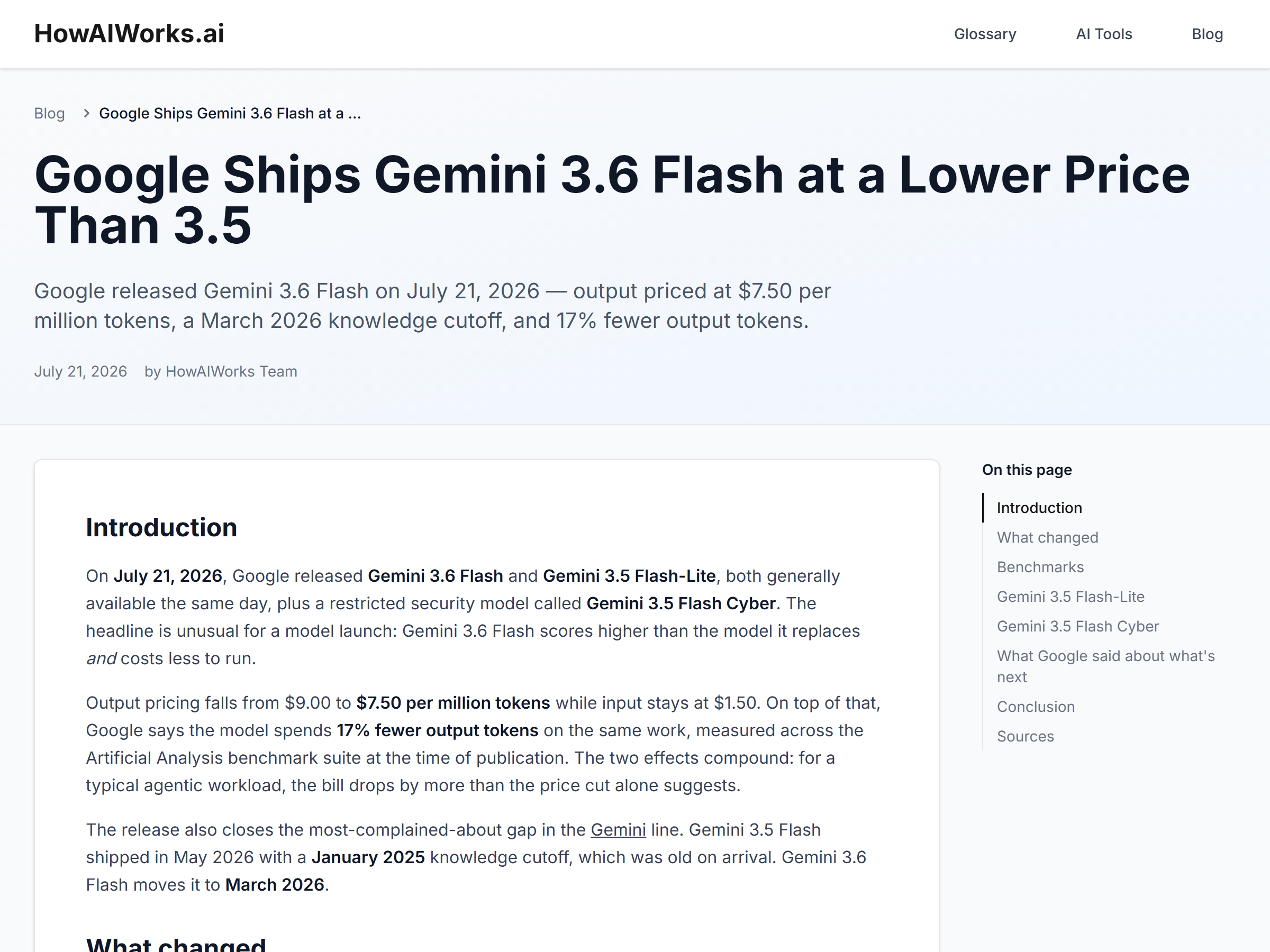
The anchor number across the announcement is token efficiency. On the Artificial Analysis Index, 3.6 Flash consumes 17% fewer output tokens than 3.5 Flash to complete the same tasks. On DeepSWE, a benchmark that tests whether a model can fix real software bugs, the gap widens to 65% — average output dropped from 276,000 tokens to 97,000 per task. That translates to fewer reasoning loops, fewer redundant tool calls, and less of the meandering verbosity that quietly inflates API bills at scale.
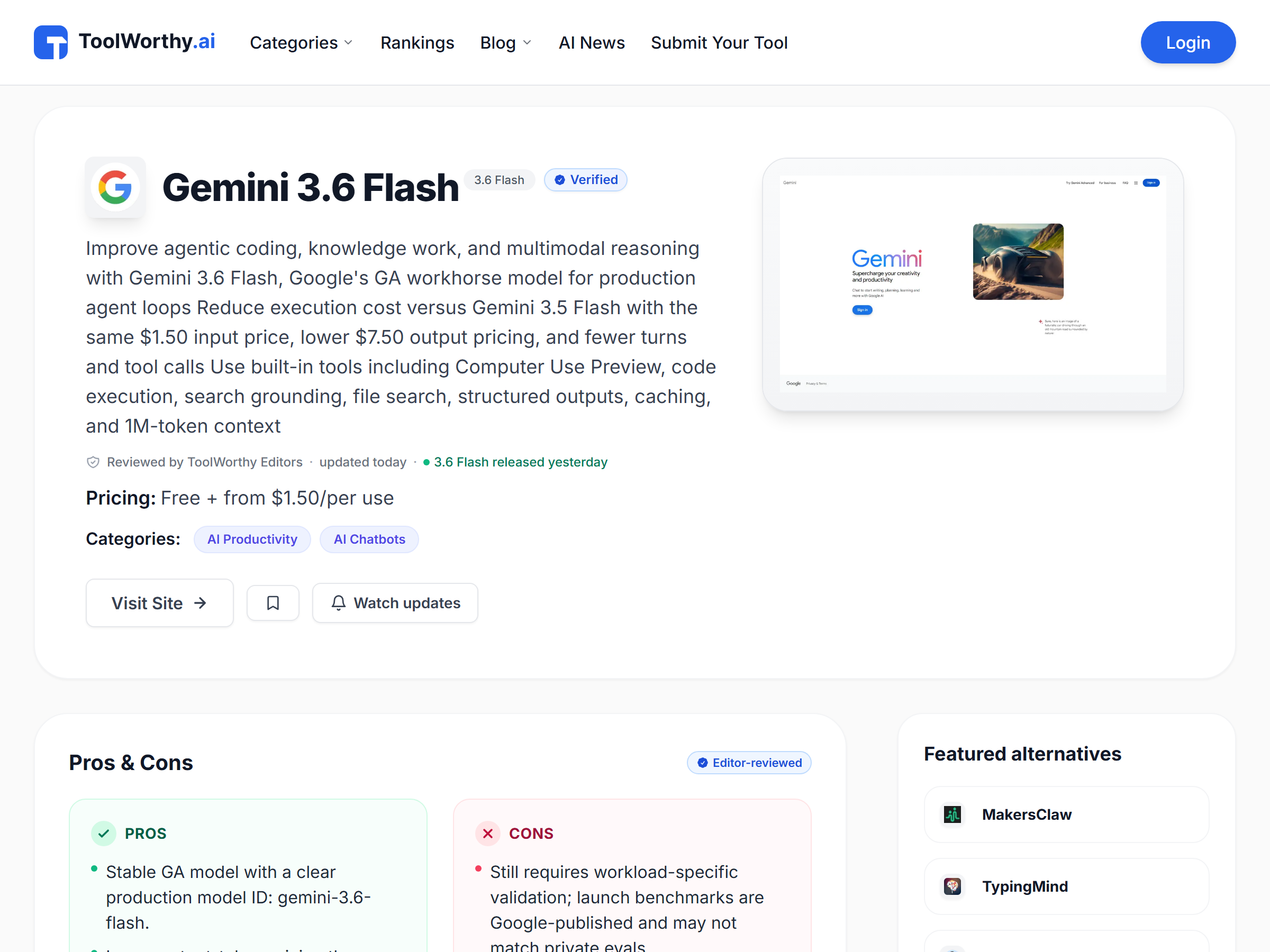
Pricing reflects the efficiency story. Input stays at $1.50 per million tokens. Output drops 16.7% to $7.50. For a support agent processing tens of thousands of queries a month, the compounding effect of fewer tokens and lower per-token pricing is the difference between a line item you notice and one you do not.
The Benchmarks Are Better. The Competition Is Still Ahead.
Google's own comparison table tells the honest story. Gemini 3.6 Flash improves across the board: SWE-Bench Pro from 55.1% to 58.7%, MLE-Bench from 49.7% to 63.9%, OSWorld-Verified from 78.4% to 83.0%, and long-context retrieval at 1 million tokens roughly doubling to 54%. Those are genuine gains, particularly the 14-point jump on machine learning research tasks.
But the same table shows GPT-5.6 Luna at 67% on DeepSWE (vs. 49% for 3.6 Flash), Grok 4.5 at 64.7% on SWE-Bench Pro (vs. 58.7%), and Claude Sonnet 5 at 66.9% on MLE-Bench (vs. 63.9%). Claude Fable 5, which Google omitted from the table, scores 80.3% on SWE-Bench Pro — a number no model in Google's comparison set approaches.
The knowledge cutoff moved from January 2025 to March 2026, closing one of the most-complained-about gaps in the Gemini line. The 1 million token context window and 64,000 token output cap remain unchanged. Computer Use, previously a separate model path, is now a built-in client-side tool in both the API and Gemini Enterprise.
The Elephant: No Gemini 3.5 Pro, and What That Signals
The model that did not ship matters more than the ones that did. Google confirmed that Gemini 3.5 Pro, the flagship model expected to compete with Claude Fable 5 and GPT-5.6, "fell short of internal expectations on coding and complex reasoning" and has been delayed. The company also teased that Gemini 4 pretraining has begun, which reads like an admission that 3.5 Pro may never ship in its current form.
This puts Google in an uncomfortable position. Anthropic, OpenAI, xAI, and Moonshot AI have all shipped frontier models in the past month. Google's response is cheaper Flash models, not a smarter Pro model. The market noticed: Alphabet's stock dropped roughly $200 billion in market cap ahead of the announcement, though it is worth noting that earnings were also due the following day.
For developers, the practical question is whether a model that saves money on agentic workloads is enough when competitors offer higher accuracy at higher prices. Google is betting yes. The Flash strategy — deliver 85-90% of frontier performance at a fraction of the cost — worked for Google Cloud's enterprise AI push throughout 2025. The question now is whether the gap between Flash and frontier has widened past that 85-90% comfort zone.
Key Takeaways
- Gemini 3.6 Flash uses 17% fewer output tokens than 3.5 Flash, with up to 65% reduction on complex agentic tasks like DeepSWE.
- Output pricing drops from $9 to $7.50 per million tokens while input holds at $1.50.
- Knowledge cutoff moves from January 2025 to March 2026. Computer Use is now a built-in tool.
- Gemini 3.5 Pro is delayed after missing internal benchmarks. Gemini 4 pretraining has started.
- The model trails Claude Fable 5 (80.3% SWE-Bench Pro), GPT-5.6 Luna (67% DeepSWE), and Grok 4.5 (64.7% SWE-Bench Pro) on key coding benchmarks.
My Take
Google is making the rational play for a company that cannot win the frontier race right now. If you cannot ship the smartest model, ship the cheapest one that is smart enough. For most production workloads — customer support, document processing, internal tooling — 3.6 Flash is more than adequate, and the 17% token reduction compounds into real savings at scale. The risk is that "smart enough" keeps moving. If Claude Fable 5 and GPT-5.6 raise the floor on what developers expect from a workhorse model, Google's efficiency story starts looking less like a strategy and more like a consolation prize.
FAQ
What is the difference between Gemini 3.6 Flash and 3.5 Flash?
3.6 Flash uses about 17% fewer output tokens, costs $7.50 per million output tokens (down from $9), has a March 2026 knowledge cutoff (up from January 2025), and scores higher on coding, machine learning, and computer-use benchmarks. It also includes Computer Use as a built-in tool rather than a separate model path.
When will Gemini 3.5 Pro be released?
Google has not provided a timeline. The company said 3.5 Pro fell short of internal expectations on coding and complex reasoning and remains in testing with partners. Google also confirmed that Gemini 4 pretraining has begun, suggesting 3.5 Pro may be delayed significantly or potentially skipped.
How does Gemini 3.6 Flash compare to Claude Fable 5?
Claude Fable 5 scores 80.3% on SWE-Bench Pro versus 58.7% for 3.6 Flash. However, 3.6 Flash is significantly cheaper — $7.50 per million output tokens versus higher pricing for Anthropic's frontier models. The tradeoff is cost versus capability, and the right choice depends on whether your workload needs frontier intelligence or cost-efficient reliability.
Does Gemini 3.6 Flash support image and video input?
Yes. 3.6 Flash accepts text, image, video, audio, and PDF as input and supports function calling, structured outputs, search grounding, and code execution as built-in tools. It does not support image generation, audio generation, or the Live API.
For developers evaluating AI coding tools, check out our curated list of AI coding assistants to compare alternatives.