FLUX 3 Video Is Here. Native Audio and Lip-Sync Change Everything About AI Video Generation
Category: Tech Deep Dives
Reviewed by the aifreetool Editorial Team — a group of full-time AI-tool researchers and writers who verify every product claim against primary sources and independent testing.
Last updated August 12, 2026.
We keep no affiliate relationship with the products covered here and earn nothing if you click through. Where a claim could not be verified, we say so.
Black Forest Labs released FLUX 3 Video on August 4, 2026, and the model does something no mainstream AI video generator has done well before: it produces clips with synchronized audio, dialogue, and lip movement in a single pass. No separate voiceover step. No post-production dubbing. The video and the sound come out of the same model, aligned frame by frame.
That matters because the gap between a pretty AI clip and usable footage has always been the audio. A generated character looks convincing, then opens their mouth, and the voice arrives half a second late. FLUX 3 Video targets exactly that gap, and the early benchmark numbers suggest it works.
What FLUX 3 Video Actually Does
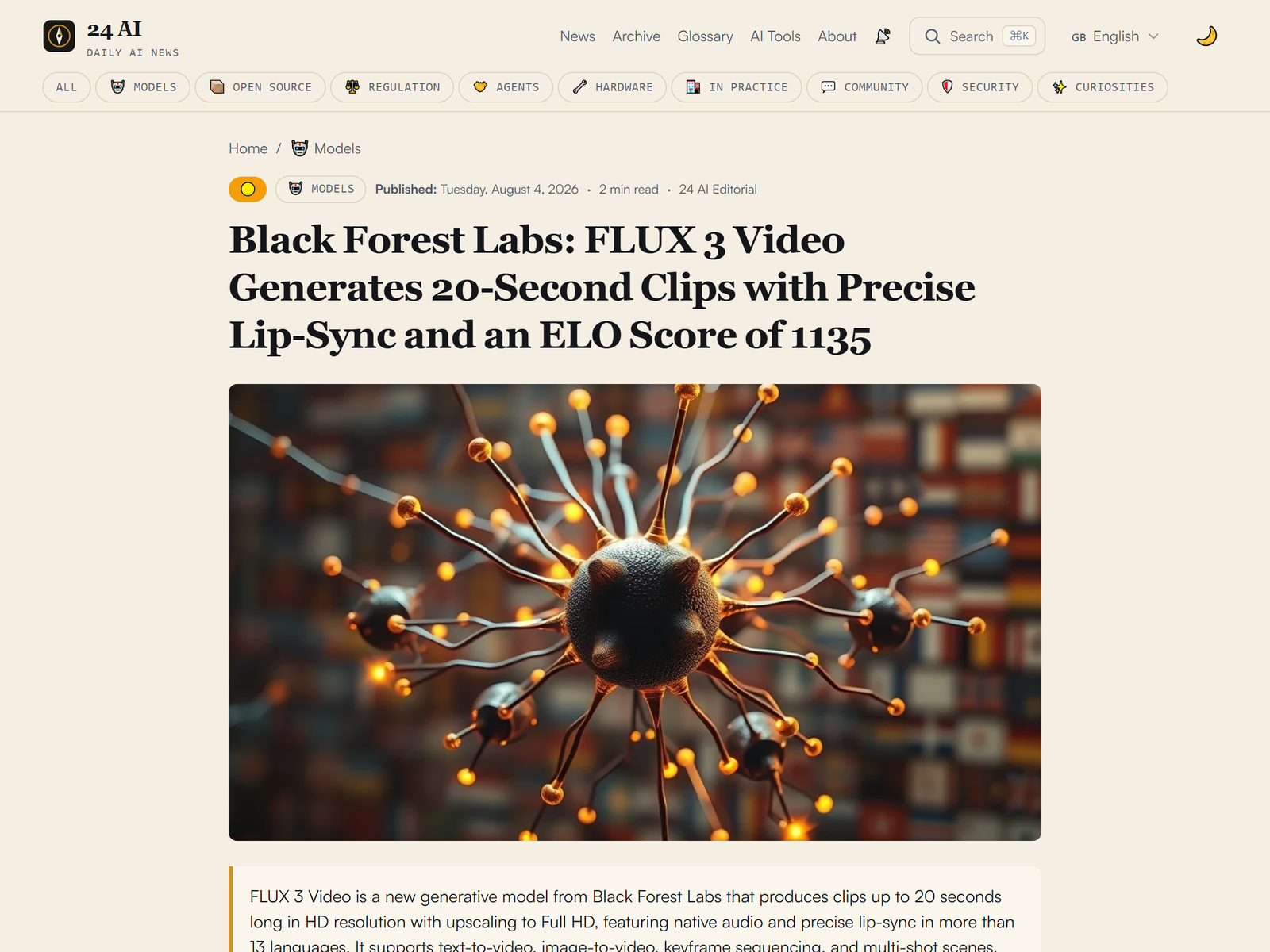
The model generates clips up to 20 seconds long in HD resolution, with upscaling to Full HD (1080p). Each clip ships with natively generated audio, including dialogue, sound effects, and ambient sound. Lip-sync is automatic, aligning mouth movements to spoken words across more than 13 languages, including English, Chinese, Spanish, French, German, and Japanese.
FLUX 3 Video supports five generation modes. Text-to-video turns a prompt into footage. Image-to-video animates a still frame. Keyframe sequencing interpolates between user-supplied frames. Video continuation extends existing clips in steps of up to 4 seconds. Multi-shot generation stitches several shots into one coherent scene with transitions between them. That last mode is where most competitors fall apart, producing jarring cuts that break immersion.
The underlying architecture trains images, video, and audio jointly in one system. Black Forest Labs calls this approach Self-Flow, a self-supervised flow-matching framework that combines representation learning with generation. The premise is that sound, motion, and visual structure are different observations of the same physical world, and a model exposed to all three together learns stronger relationships between them.
Benchmark Scores and Competitive Positioning
On the ELO benchmark for text-to-video, FLUX 3 Video scores 1135 points, surpassing every existing top model on the market. In the image-to-video category, it scores 1051, tying with Seedance 2.0 and beating every other tested model. The gap between the two categories tells an interesting story: FLUX 3 Video excels particularly at generating video from text alone, where competition has traditionally been weaker.
The models it surpasses include ByteDance Seedance 2.0, MiniMax H3, and Google Gemini Omni Flash. That is a competitive field. Black Forest Labs also announced a future open-weight variant called FLUX 3 Dev, whose parameters will be publicly available for local deployment, continuing the pattern from earlier FLUX generations that combined closed API access with open research releases.
Pricing: Draft Mode Changes the Economics
Black Forest Labs prices FLUX 3 Video by the second of output, and the structure rewards iteration. Draft mode, limited to HD, costs $0.06 per second for text-to-video or image-to-video, and $0.12 per second for video-to-video. At 20 seconds, a draft clip costs $1.20. That is cheap enough for a creator to generate dozens of variations before committing to a final render.
Regular HD quality runs $0.17 per second for text or image-to-video, and $0.41 per second for video-to-video. Full HD costs $0.29 per second for text or image-to-video, and $0.53 per second for video-to-video. All prices include audio generation at no extra charge. For comparison, a 10-second Full HD text-to-video clip costs $2.90, which undercuts most competitors offering comparable quality.
Key Takeaways
- Native audio is the breakthrough: FLUX 3 Video generates video and synchronized audio, including lip-sync dialogue in 13+ languages, from a single model.
- Benchmark leader: ELO score of 1135 for text-to-video, beating Seedance 2.0, MiniMax H3, and Gemini Omni Flash.
- Draft mode at $0.06/second makes rapid prototyping economically viable for individual creators.
- Open-weight variant FLUX 3 Dev is coming, continuing Black Forest Labs' pattern of combining commercial API access with public research releases.
- Five generation modes cover the full production pipeline from text prompts to multi-shot scenes with transitions.
Safety, Open Weights, and What Comes Next
Before release, Black Forest Labs contracted Cinder, an independent content moderation specialist, to assess misuse risks including non-consensual intimate imagery (NCII) and CSAM content. The safety review is publicly documented, which is more than most video generation providers offer.
The broader FLUX 3 family is rolling out in stages. Video launched first on August 4, 2026, following an early access phase that began July 23. Image generation and action-prediction components are planned for subsequent releases. The open-weight FLUX 3 Dev variant does not have a confirmed date yet, but Black Forest Labs has committed to releasing it.
For creators and studios evaluating AI video tools, FLUX 3 Video deserves a spot on the shortlist. You can explore more AI video generation tools and compare options at aifreetool.site, where we track the latest models and their capabilities.
My Take: The Audio Gap Is Closing Fast
The real story here is not the ELO score. It is that Black Forest Labs identified the single biggest weakness in AI video generation, the disconnect between visuals and sound, and built a model architecture that addresses it directly. Self-Flow's joint training across modalities is the right bet. Video without synchronized audio is a demo. Video with synchronized audio is a product.
The pricing structure is equally smart. Draft mode at $0.06 per second lets creators fail cheaply, which is how creative workflows actually work. You iterate twenty times, find the right shot, then pay for quality. That is a fundamentally different proposition from competitors that charge full price for every generation.
The open-weight commitment matters too. If FLUX 3 Dev delivers on its promise, local deployment becomes possible for studios with the hardware, which puts pressure on every closed competitor to justify their API pricing. The video generation market in 2026 is crowded, but Black Forest Labs just raised the bar on what "complete" means.
Frequently Asked Questions
How long are FLUX 3 Video clips and at what resolution?
Clips run up to 20 seconds. They are generated in HD and can be upscaled to Full HD (1080p). Native audio and lip-sync are included at no additional cost.
What languages does FLUX 3 Video support for dialogue?
The model supports lip-synced dialogue in more than 13 languages, including English, Chinese, Spanish, French, German, and Japanese, without requiring separate dubbing.
How does FLUX 3 Video compare to Seedance 2.0 and MiniMax H3?
FLUX 3 Video scores 1135 on the ELO text-to-video benchmark, surpassing both. In image-to-video, it scores 1051, tying with Seedance 2.0 and beating MiniMax H3. The key differentiator is native audio generation, which competitors do not offer in a single model.
What is the cheapest way to use FLUX 3 Video?
Draft mode costs $0.06 per second for HD text-to-video or image-to-video. A 20-second draft clip costs $1.20. Full HD text-to-video costs $0.29 per second, or $5.80 for a 20-second clip.
Will FLUX 3 Video have open weights?
Yes. Black Forest Labs announced FLUX 3 Dev, an open-weight variant whose parameters will be publicly available for local deployment. A release date has not been confirmed.