Qualcomm AWS $60B AI Chip Deal 2026 Review: LPDDR vs HBM
Category: Tech Deep Dives
This analysis was written by the aifreetool Editorial Team — a group of full-time AI-industry researchers and writers who verify every claim against primary sources. Last updated September 9, 2026. We keep no affiliate relationship with the companies covered here.
TL;DR: This review of the Qualcomm AWS $60B AI chip deal covers the agreement announced September 8, 2026 — up to $60 billion in potential revenue over 10 years, backed by 25 million share warrants at $161.26 each. Qualcomm's Dragonfly ASICs use LPDDR memory instead of HBM, betting that inference workloads reward capacity over peak bandwidth. Revenue starts in December 2026, and Amazon has already committed to an initial $9 billion purchase.
The Deal Structure: Warrants, Not Just Orders
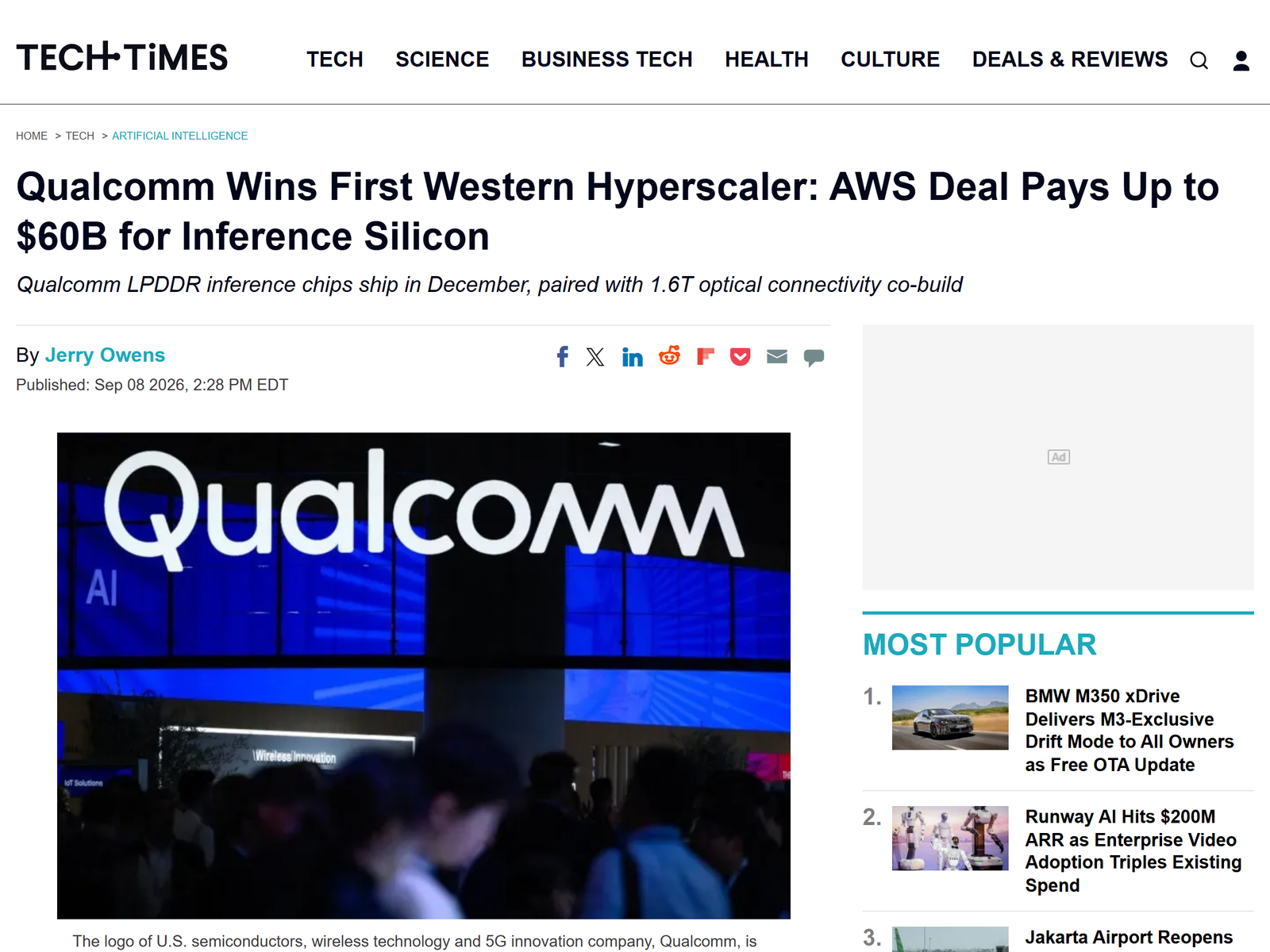
This is not a forward-looking promise. Qualcomm filed an SEC Form 8-K on September 8, 2026, disclosing a multi-generational co-development agreement with Amazon Web Services. The structure is a purchase-for-equity arrangement: Qualcomm issued Amazon up to 25 million common share warrants at $161.26 per share — a 4.4% discount to the closing price before announcement. The warrants vest in stages tied to Amazon's actual purchases of Qualcomm data center products, with a 10-year term running through September 2036.
Amazon has already secured 15% of the warrants (approximately 3.75 million shares) by committing to an initial purchase of roughly $9 billion in Qualcomm chips. Qualcomm CFO Akash Palkhiwala confirmed at the Goldman Sachs Communacopia and Technology Conference that chips are already in production, with revenue recognition beginning in Qualcomm's fiscal Q1 2027 — the December 2026 quarter. QCOM shares surged up to 9.5% in Tuesday's session, marking the stock's first positive return for the year.
Why LPDDR Beats HBM for Inference
The architectural choice that separates Qualcomm from every other inference competitor is memory type. NVIDIA's flagship B200 carries approximately 180 GB of HBM3e per card. Qualcomm's AI200 supports up to 768 GB of LPDDR per card — more than four times the capacity. HBM delivers dramatically higher peak memory bandwidth, which is why it dominates training workloads where massive parallel matrix operations happen simultaneously.
But inference — specifically the decode phase where a model generates one token at a time — is not bandwidth-bound in the same way. It is memory-capacity-bound: the bottleneck is whether the entire model can stay resident on the card to avoid expensive data transfers while serving users. Qualcomm's bet: decode workloads reward capacity over peak bandwidth, and LPDDR delivers sufficient bandwidth at a fraction of HBM's cost per gigabyte.
| Specification | NVIDIA B200 | Qualcomm AI200 |
|---|---|---|
| Memory type | HBM3e | LPDDR |
| Memory capacity per card | ~180 GB | Up to 768 GB |
| Memory bandwidth | ~8 TB/s (peak) | Lower peak, high effective |
| Best for | Training, prefill | Inference decode |
| Cost per GB | High | ~4x lower |
The AI250, Qualcomm's next-generation card expected in calendar 2027, pushes further with a near-memory computing architecture that stacks compute logic physically adjacent to memory. Qualcomm's specifications indicate the AI250 delivers more than 10x higher effective memory bandwidth compared with conventional DRAM configurations at significantly lower power. Palkhiwala described this as High Bandwidth Compute — stacking compute and memory together to deliver extremely high bandwidth that customers see as a perfect solution for certain decode workloads within inference.
The 1.6T Optical Layer and Alphawave
The deal's second track is optical connectivity scaling to 1.6 terabits per second (1.6 Tbps) for intra-cluster networking — the backbone that moves data between racks inside hyperscale data centers. This traces directly to Qualcomm's $2.4 billion acquisition of Alphawave Semi, announced in June 2025 and completed in December 2025. Alphawave specializes in high-speed serializer/deserializer (SerDes) IP — the technology that converts parallel chip-internal data into serial format for ultra-fast external communication. Alphawave's portfolio includes PCIe Gen 6, CXL 3.0, and Ethernet IP rated for 400G, 800G, and 1.6T data rates.
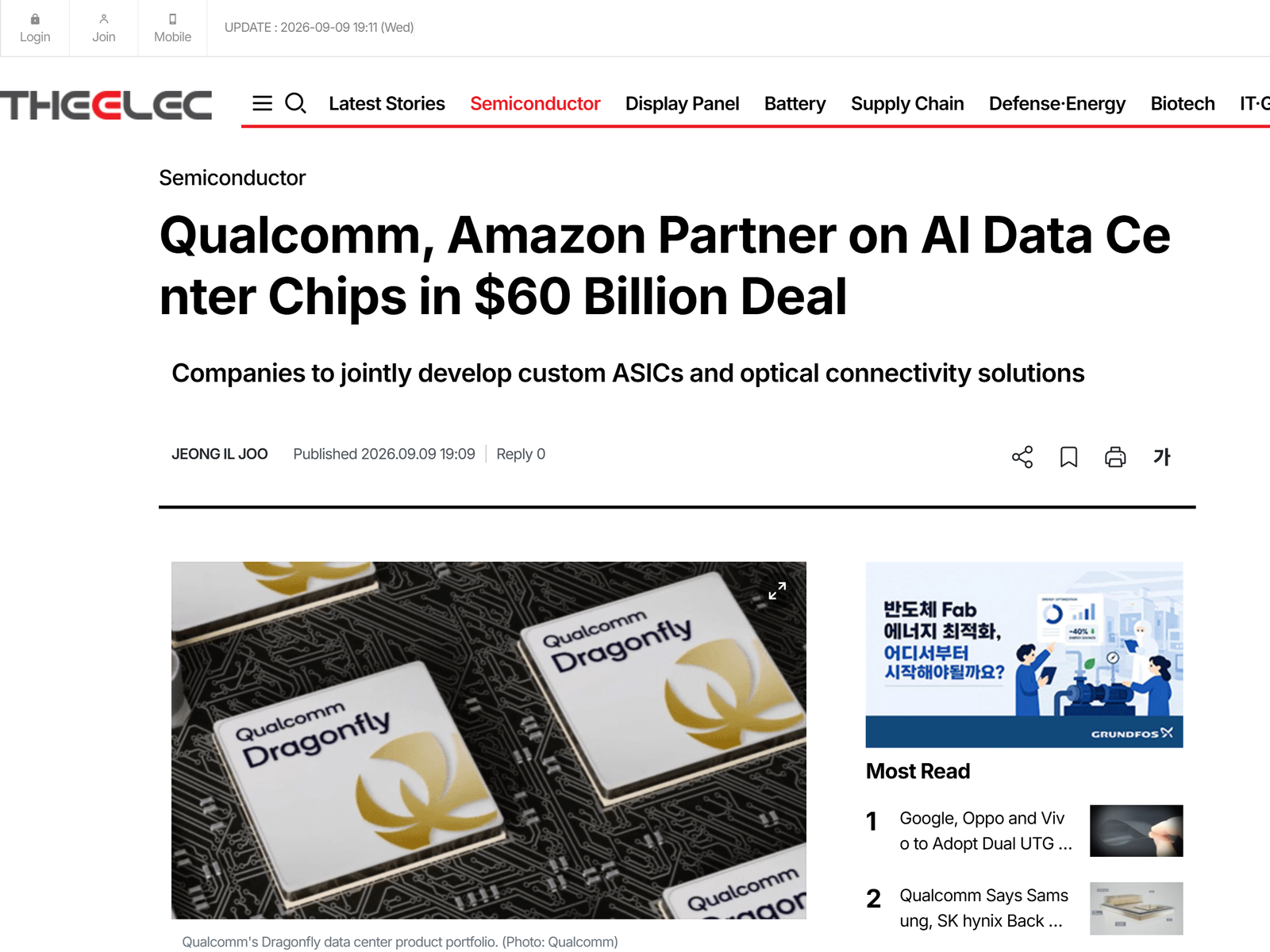
The optical DSP compensates for signal distortion and loss as data travels through fiber, while SerDes chips handle the parallel-to-serial conversion. Together, these components address the network bandwidth bottleneck that emerges as AI clusters scale beyond thousands of GPUs. Qualcomm's Dragonfly portfolio includes the C1000 CPU (designed for agentic AI scenarios, with Meta confirming adoption for 2028 production), the AI300 inference accelerator, and connectivity products.
What This Means for the AI Chip Market
Amazon's chip business generates over $25 billion in annual revenue, including Trainium (AI training and inference) and Graviton (general-purpose cloud compute). Adding Qualcomm as a custom silicon supplier gives AWS a new bargaining chip against NVIDIA's pricing power. Amazon CEO Andy Jassy highlighted the chip business growth in Q2 earnings, signaling continued investment in custom silicon as a strategic priority.
For Qualcomm, this deal validates a multi-year pivot from mobile-only to data center infrastructure. The company previously projected $5 billion in data center revenue for fiscal 2027 and $15 billion by fiscal 2029. The Amazon partnership makes both targets credible. Qualcomm has also secured Microsoft as a customer and Meta for the C1000 CPU. If you work with AI coding and development tools, the inference cost reductions from LPDDR-based chips could eventually flow through to the APIs you use daily. A detailed technical breakdown is available from TechTimes and product portfolio details from The ELEC.
My Take / The Bottom Line
The Qualcomm AWS deal is the first credible challenge to NVIDIA's inference monopoly from a Western hyperscaler. The LPDDR-vs-HBM bet is technically sound: decode workloads are capacity-bound, and 768 GB at a quarter of HBM's cost per gigabyte changes the unit economics of AI serving. But the real story is structural. Amazon now has three silicon paths — NVIDIA for training, Trainium for its own workloads, and Qualcomm for cost-optimized inference. That triangulation erodes NVIDIA's pricing power on the inference side even if training remains uncontested. The 10-year warrant structure means Qualcomm cannot afford to falter on execution — Amazon's warrant vesting is tied to actual purchases, not promises. For developers, the practical implication is clear: inference costs are heading down, and the bottleneck is shifting from raw compute to network bandwidth, which is exactly where Qualcomm's Alphawave acquisition pays off.
FAQ
How much is the Qualcomm AWS deal worth?
Up to $60 billion over 10 years, tied to Amazon's actual purchases of Qualcomm data center chips and connectivity products. Amazon has committed to an initial $9 billion purchase, vesting 15% of the 25 million share warrants immediately.
Why does Qualcomm use LPDDR instead of HBM for AI inference?
Inference decode workloads are memory-capacity-bound, not bandwidth-bound. LPDDR delivers four times the capacity per card (768 GB vs 180 GB on NVIDIA's B200) at roughly a quarter of the cost per gigabyte, making it more cost-effective for serving models to users.
When does Qualcomm start recognizing revenue from the Amazon deal?
December 2026 — Qualcomm's fiscal Q1 2027. Chips are already in production. CFO Palkhiwala confirmed this timeline at the Goldman Sachs Communacopia and Technology Conference on September 8, 2026.
What is the 1.6T optical connectivity in the deal?
A joint development of high-speed optical networking hardware scaling to 1.6 terabits per second, using Qualcomm's SerDes and optical DSP technology from the Alphawave acquisition. It addresses network bandwidth bottlenecks inside large AI data center clusters.
Does this threaten NVIDIA's AI chip dominance?
On inference, yes. On training, not yet. HBM's peak bandwidth remains necessary for training workloads. But Amazon now has three silicon paths (NVIDIA, Trainium, Qualcomm), which erodes NVIDIA's pricing power on the inference side where most production AI spending occurs.