Anthropic Is Building Its Own Claude Chips. Here Is What That Means for the AI Hardware Race.
Category: Tech Deep Dives
Reviewed by the aifreetool Editorial Team — a group of full-time AI-tool researchers and writers who verify every product claim against primary sources and independent testing.
Last updated August 12, 2026.
We keep no affiliate relationship with the products covered here and earn nothing if you click through. Where a claim could not be verified, we say so.
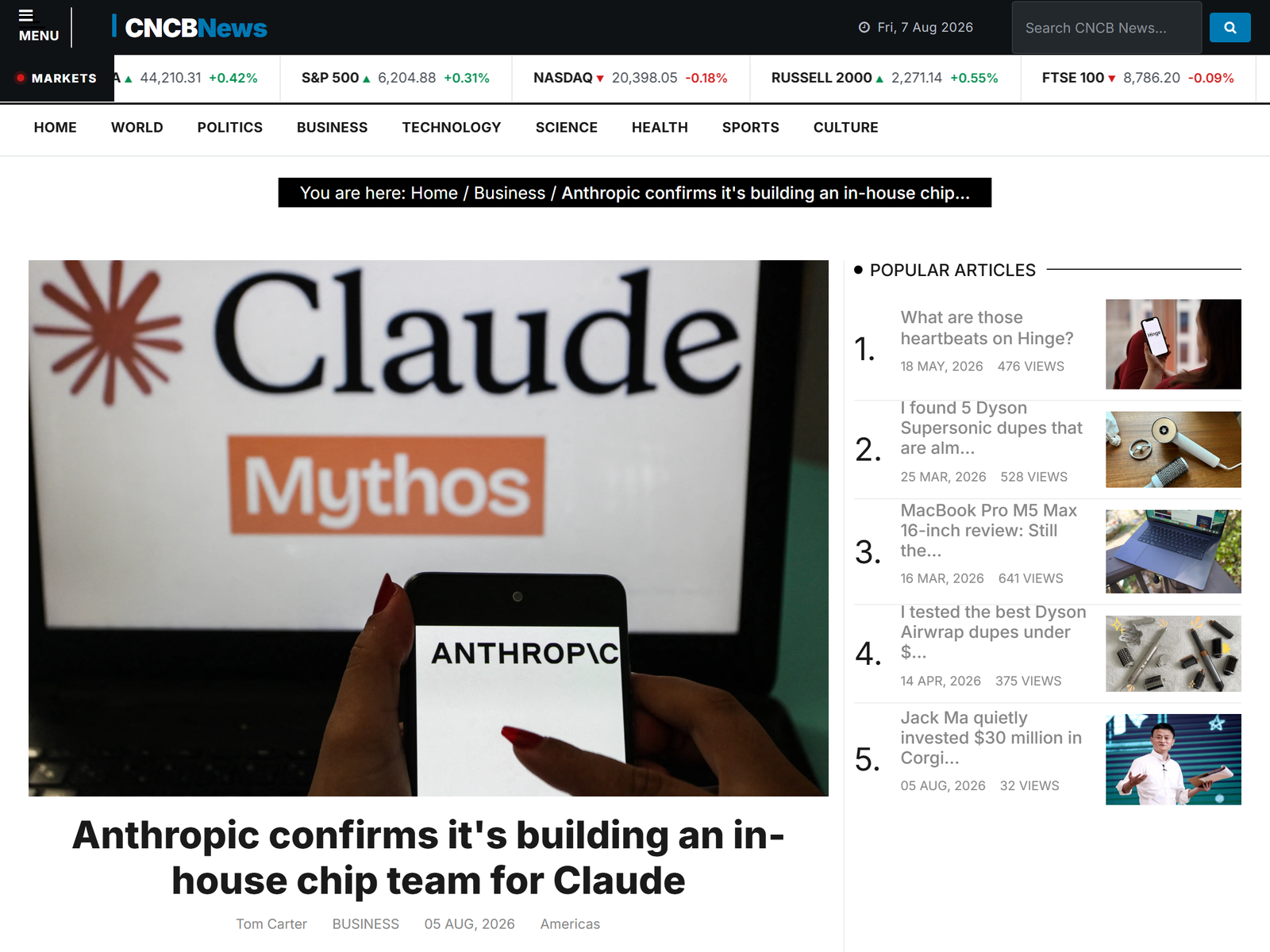
On August 5, 2026, Anthropic confirmed it is building an in-house silicon team to design custom chips for Claude, becoming the second major AI lab in two months to commit to its own semiconductor program. The move follows OpenAI's Jalapeno chip announcement in June and signals that frontier AI companies no longer view compute as something they can exclusively rent from Nvidia, AMD, and cloud providers. For Anthropic, whose run-rate revenue surpassed $30 billion in April and whose customer base of million-dollar-plus accounts doubled to over 1,000 in under two months, the economics of owning a layer of the compute stack have become impossible to ignore.
What Anthropic Actually Announced

The confirmation came through a company statement to Business Insider and a job listing posted on Anthropic's careers page. The AI lab is hiring silicon engineers at a salary range of $320,000 to $485,000, covering the entire chip design pipeline: front-end design, pre-silicon verification, physical design, design-for-test, analog and mixed-signal, technology and foundry, design infrastructure, and packaging with signal and power integrity.
The job description asks for candidates who have "shipped silicon" and can make "consequential calls without a large organization behind them." That language describes a team that expects to tape out a physical chip, not merely evaluate third-party designs. Anthropic's spokesperson said the company would co-design hardware and models so Claude can run faster and more efficiently "at the scale our customers need," while maintaining a "multi-chip approach" in which hardware from AWS, Google, Nvidia, and AMD remains central.
In June 2026, Data Center Dynamics reported that Clive Chan, who had led OpenAI's custom chip program, left to join Anthropic. Chan wrote on X: "I joined Anthropic this week because I was deeply impressed with the team's talent, values, and ambition." His arrival gave Anthropic a leader who had already navigated a chip from concept to tape-out at OpenAI, where the Jalapeno processor went from initial design to manufacturing tape-out in nine months with Broadcom.
Why Every AI Lab Is Going Silicon-First

The strategic logic is straightforward. Anthropic's compute today runs entirely on other companies' silicon. Its April 2026 compute announcement committed the company to multiple gigawatts of next-generation Google TPU capacity coming online starting in 2027, described by CFO Krishna Rao as the company's "most significant compute commitment to date." Amazon was named the primary cloud and training partner through Project Rainier. But none of that capacity is owned outright by Anthropic. It is rented, and rental terms can change.
A custom chip adds a layer Anthropic controls. It lets the company tune the silicon to Claude's specific training and inference patterns rather than adapting Claude to fit general-purpose GPUs. The job listing's emphasis on machine-learning accelerators, high-bandwidth memory subsystems, and on-die interconnect points toward a part optimized for Claude's own architecture, not a general-purpose accelerator.
OpenAI took a similar path with Jalapeno, its inference processor co-designed with Broadcom, unveiled on June 24, 2026. Mistral's CEO has also publicly stated the company is exploring its own chips. Google has built TPUs for over a decade. Meta has its MTIA series. Amazon offers Trainium and Inferentia. The pattern is clear: at a certain scale of AI deployment, renting general-purpose silicon from Nvidia becomes more expensive and less performant than designing a chip that matches your specific workload.
The Broader Chip Landscape: Who Wins, Who Loses
Bank of America Securities noted in a recent research report that Nvidia will likely maintain its dominant position in AI accelerators for the foreseeable future, because its CUDA software ecosystem, developer tools, and broad availability create switching costs that custom ASICs cannot easily overcome. ASICs typically serve specific workloads for specific cloud vendors. Google's TPU serves Gemini. Amazon's Trainium serves Bedrock. And potentially, Anthropic's custom chip would serve Claude.
But the trend line is unmistakable. Every frontier AI lab is now building or co-designing silicon. The question is not whether custom chips will replace Nvidia. They will not. The question is whether the marginal workload that can be moved to cheaper, purpose-built silicon will grow fast enough to dent Nvidia's pricing power. Anthropic's entry into chip design adds another data point suggesting it will.
For smaller AI companies and developers, the implication is practical. If you are building on Claude, the compute economics behind your API calls are about to shift. A custom chip that reduces Anthropic's inference cost by even 20 percent creates room for price reductions, something OpenAI demonstrated when it cut GPT-5.6 Luna's price by 80 percent three weeks after launch. You can explore AI coding tools that may benefit from these cost reductions at https://aifreetool.site/tool-category/ai-programming-development/
Key Takeaways
- Anthropic confirmed on August 5, 2026, that it is building an internal silicon team to design custom chips for Claude, hiring across the full chip design pipeline at $320K to $485K salaries.
- The company hired Clive Chan, who previously led OpenAI's custom chip program, in June 2026, giving it a leader with direct tape-out experience.
- Anthropic's approach differs from OpenAI's: it positions custom silicon as one layer in a multi-chip stack alongside AWS, Google, Nvidia, and AMD, rather than a single-purpose replacement.
- The move is driven by economics: Anthropic's $30B run-rate revenue and 1,000+ million-dollar customers make owning silicon justified versus continued pure rental.
- Samsung has been in talks as a potential manufacturing partner since July 2026, though no agreement has been announced.
My Take: A Multi-Year Bet, Not a Quick Win
Anthropic's chip program is at the beginning, not the end. The company has not named a manufacturing partner, a process node, or a ship date. The Samsung talks remain exploratory. The April TPU expansion means a large share of near-term capacity is already committed to Google and Broadcom silicon. Designing and taping out a chip typically takes 18 to 24 months, and first silicon rarely works perfectly. The job listing's call for engineers who can handle "first-silicon bring-up and debug" acknowledges this reality.
But the strategic direction is correct. Anthropic is racing toward an IPO, and investors will want to see infrastructure cost discipline. A custom chip that lowers inference cost per token by 30 to 50 percent over three years would materially improve gross margins. More importantly, it gives Anthropic leverage in negotiations with Nvidia, Google, and Amazon. Even if the chip never ships at scale, the credible threat of in-house silicon changes the power dynamic.
The real risk is execution. Chip design is unforgiving, and Anthropic is competing for talent against Nvidia, Google, Apple, and OpenAI, all of whom are already further along. Clive Chan's arrival helps, but one person does not make a silicon program. The next 12 months will show whether Anthropic can recruit the 50 to 100 engineers needed to take a chip from spec to silicon.
FAQ
When will Anthropic's custom Claude chip be available?
Anthropic has not announced a timeline. Based on the company's current hiring stage and industry norms for chip design, a first tape-out would likely take 18 to 24 months from team formation, putting earliest availability in late 2027 or 2028.
Will Anthropic stop using Nvidia GPUs?
No. Anthropic explicitly stated it will maintain a multi-chip approach with AWS, Google, Nvidia, and AMD hardware remaining central. The custom chip is an addition to, not a replacement for, its existing compute stack.
How does this compare to OpenAI's Jalapeno chip?
OpenAI's Jalapeno, co-designed with Broadcom and announced June 24, 2026, is a single-purpose inference processor that went from design to tape-out in nine months. Anthropic's approach is positioned as one layer within a multi-vendor stack rather than a standalone replacement, and it is at an earlier stage.
Who is manufacturing Anthropic's chip?
No manufacturing partner has been confirmed. The Information reported in July 2026 that Anthropic held talks with Samsung Electronics, but no agreement has been announced. TSMC, which manufactures the majority of advanced AI chips, is another likely candidate.
Why is Anthropic building its own chip now?
The company's run-rate revenue surpassed $30 billion in April 2026, with over 1,000 customers spending more than $1 million annually. At that scale, even modest improvements in inference cost per token translate to hundreds of millions of dollars in savings, making the upfront investment in chip design economically justified.