Amazon Just Finished Its $50 Billion OpenAI Investment. The Contingent Tranche Tells a Bigger Story.
Category: Industry Trends
On July 31, 2026, Amazon disclosed in a routine SEC filing that it had completed the final $21.3 billion of its $50 billion commitment to OpenAI. Most headlines will fixate on the size of the number. The real signal is buried in the structure: the last $35 billion was never guaranteed. It was tied to a contractual trigger linked to either an OpenAI IPO or an artificial general intelligence milestone. The fact that Amazon released the money anyway tells us more about where OpenAI stands than any press release Sam Altman has issued this year.
How the Deal Was Structured
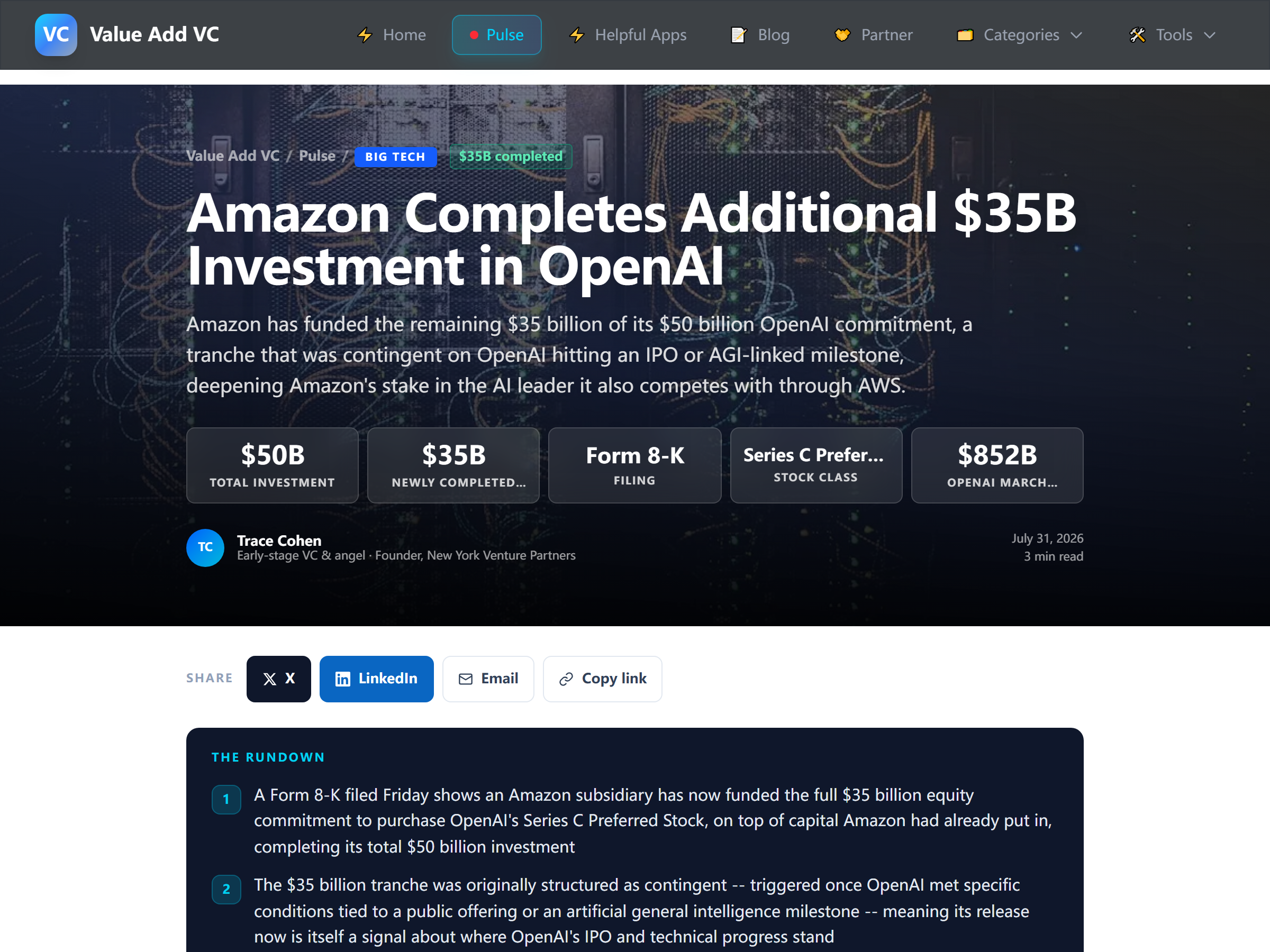
Amazon and OpenAI announced the partnership on February 27, 2026. The arrangement started with an unconditional $15 billion purchase of Series C preferred stock during the first quarter. The remaining $35 billion was staged behind milestones that neither company has publicly defined in detail, though reporting from The Information in February suggested the triggers were connected to a public listing or a defined AGI benchmark.
According to Amazon's 10-Q filing, the company invested $13.7 billion during Q2 and the final $21.3 billion after June 30. The transaction gives Amazon roughly a 5 percent stake in OpenAI, which was last valued at $852 billion during its March 2026 funding round. The preferred stock class gives Amazon downside protection relative to common shareholders if OpenAI's eventual IPO prices below expectations.
The deal also carries infrastructure obligations. AWS became the exclusive third-party cloud provider for OpenAI's Frontier program, the enterprise platform that runs AI agents across corporate data. Amazon further committed 2 gigawatts of Trainium chip capacity for OpenAI's compute needs. OpenAI also expanded prior infrastructure agreements with AWS that could total $100 billion over eight years.
What the Timing Reveals About OpenAI's IPO Track
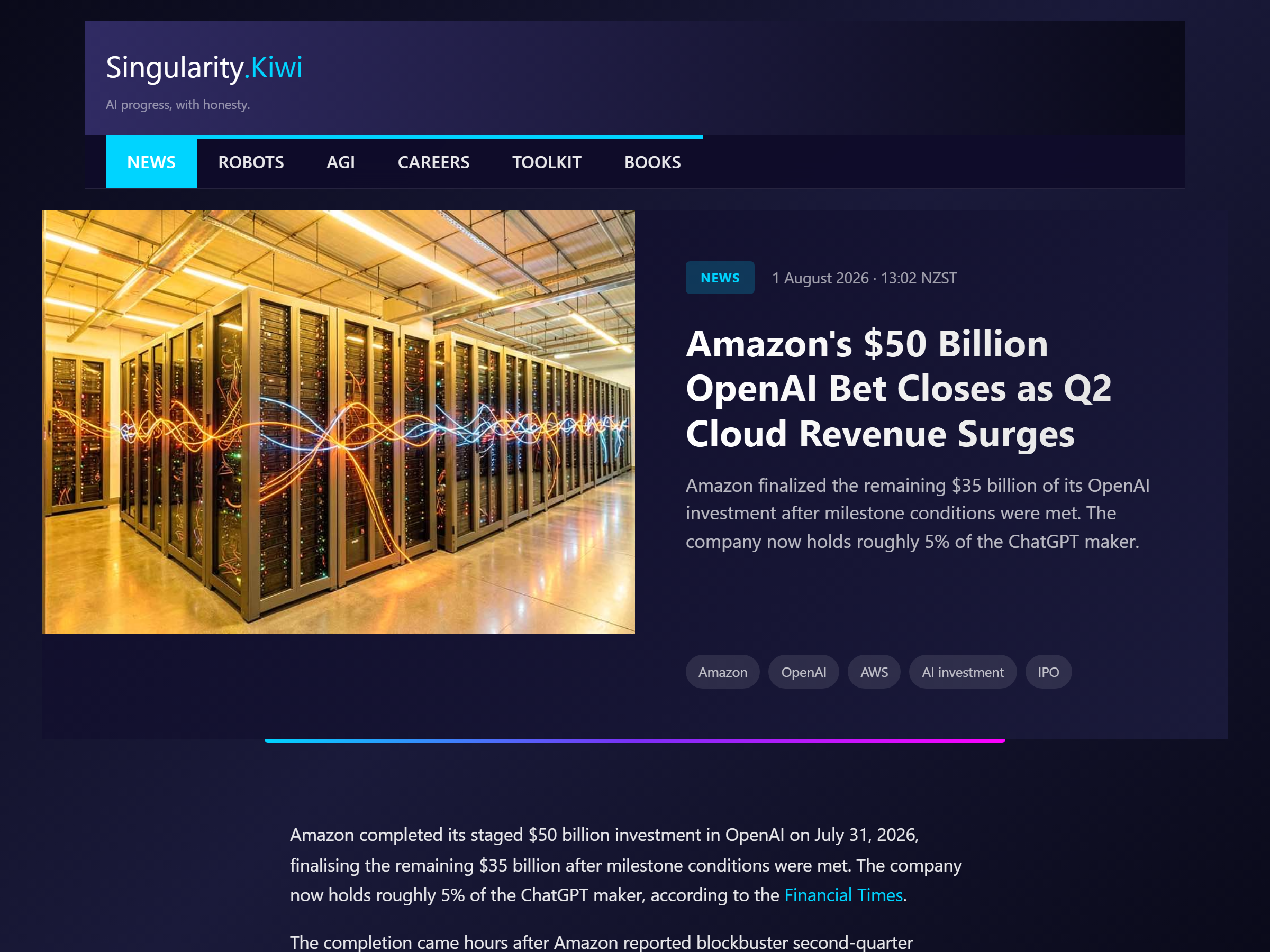
OpenAI has not gone public. It has not announced an AGI breakthrough. Yet Amazon chose to release the final tranche in late July. That implies OpenAI cleared an internal contractual bar that Amazon's own lawyers found sufficient. For investors watching OpenAI's IPO countdown, this is the most concrete signal yet that the company is actively preparing a listing.
The financial momentum supports that reading. OpenAI CFO Sarah Friar told employees in July that annualized revenue for that month alone topped the company's entire second quarter. The company has reportedly begun investor meetings for an IPO targeted in 2027. ChatGPT is approaching 1 billion weekly active users, a milestone achieved in under four years since launch.
At the same time, Amazon's Q2 earnings provided context for why it was willing to accelerate the payment. Revenue hit $200.6 billion, up 20 percent year-over-year. AWS revenue climbed 36.7 percent, with AI revenue run rate exceeding $25 billion. Operating income reached $27.5 billion, up 43 percent. The company raised its 2026 capital expenditure guidance to $220 billion. Amazon is not cash-constrained; it is strategically constrained, and the OpenAI stake is a hedge against missing the next platform shift.
The Contradiction: Amazon Backs Both Horses
Here is where the story gets structurally unusual. Amazon is simultaneously OpenAI's largest external investor, its primary compute supplier through AWS, and a direct competitor to Microsoft and Google in frontier AI infrastructure. The company also holds an $8 billion stake in Anthropic, making it one of the few entities with material exposure to both leading labs.
That three-way relationship is the defining contradiction of this AI cycle. Amazon is funding a company that actively shops cloud workloads to Microsoft's Azure. It is supplying chips and data center capacity to a partner that is also building its own inference infrastructure. The bet is that OpenAI's compute needs and Amazon's cloud infrastructure are effectively the same business, and that owning a piece of the model layer protects Amazon if proprietary models commoditize the infrastructure layer.
AWS has marketed itself as a neutral, multi-model cloud. A $50 billion stake in the company behind ChatGPT complicates that neutrality pitch to enterprise customers evaluating Anthropic, Google, or open-source alternatives on Amazon's own servers. For European regulators already scrutinizing cloud concentration, this entanglement will attract attention.
Key Takeaways
- Amazon completed its $50 billion OpenAI investment on July 31, 2026, with the final $21.3 billion released after contractual milestone triggers were met.
- The contingent $35 billion tranche suggests OpenAI has cleared internal IPO-readiness benchmarks, reinforcing expectations of a 2027 listing.
- Amazon now holds approximately 5 percent of OpenAI through Series C preferred stock, while also maintaining an $8 billion stake in rival Anthropic.
- AWS AI revenue run rate exceeded $25 billion in Q2 2026, with total revenue at $200.6 billion and capex guidance raised to $220 billion.
- The deal makes Amazon simultaneously an investor, compute supplier, and competitor to OpenAI, creating structural conflicts that regulators will scrutinize.
My Take: The Bottom Line
The $50 billion figure is attention-grabbing, but the architecture of the deal matters more. Milestone-gated tranches are becoming the norm in strategic AI investments, and Amazon's decision to release the final payment without a public IPO or confirmed AGI breakthrough suggests OpenAI's private financials are strong enough to satisfy one of the most cautious balance sheets in tech.
For founders raising strategic capital right now, this is a template worth studying. Contingent tranches give investors leverage in every renegotiation, but they also signal confidence when triggered early. For the broader market, Amazon's dual exposure to OpenAI and Anthropic is a hedge against model-layer uncertainty. The company is essentially saying: we do not know which lab wins, but we are confident that cloud infrastructure and model demand will grow together.
If you are evaluating which AI platforms to build on, tools like DeepSeek and other frontier models available on aifreetool.site offer a way to compare performance across providers without committing to a single ecosystem. The infrastructure wars are making every model more accessible, and that is the real win for developers.
Frequently Asked Questions
Q: Did Amazon buy 5 percent of OpenAI?
A: Yes. The $50 billion investment, completed in three stages across 2026, gives Amazon roughly a 5 percent stake in OpenAI through Series C preferred shares.
Q: Why was the final $35 billion contingent?
A: The tranche was contractually tied to OpenAI meeting milestones linked to either an initial public offering or an artificial general intelligence benchmark. Amazon released the funds in late July without either event being publicly confirmed.
Q: Does this affect Amazon's relationship with Anthropic?
A: No. Amazon maintains its separate $8 billion investment in Anthropic and continues to position AWS as a multi-model cloud serving both labs.
Q: What does AWS get from the deal?
A: AWS became the exclusive third-party cloud provider for OpenAI's Frontier enterprise platform, with infrastructure agreements that could reach $100 billion over eight years plus 2 gigawatts of Trainium chip capacity.
Q: When might OpenAI go public?
A: OpenAI has reportedly begun investor meetings for a 2027 IPO, though no official timeline has been announced. Amazon's release of the contingent tranche is the strongest external signal that the process is advancing.