Why 95% of Enterprise AI Projects Were Delayed in 2026
Category: Tech Deep Dives
This analysis was written by the aifreetool Editorial Team — a group of full-time AI-industry researchers and writers who verify every claim against primary sources. Last updated August 20, 2026. We keep no affiliate relationship with the companies covered here.
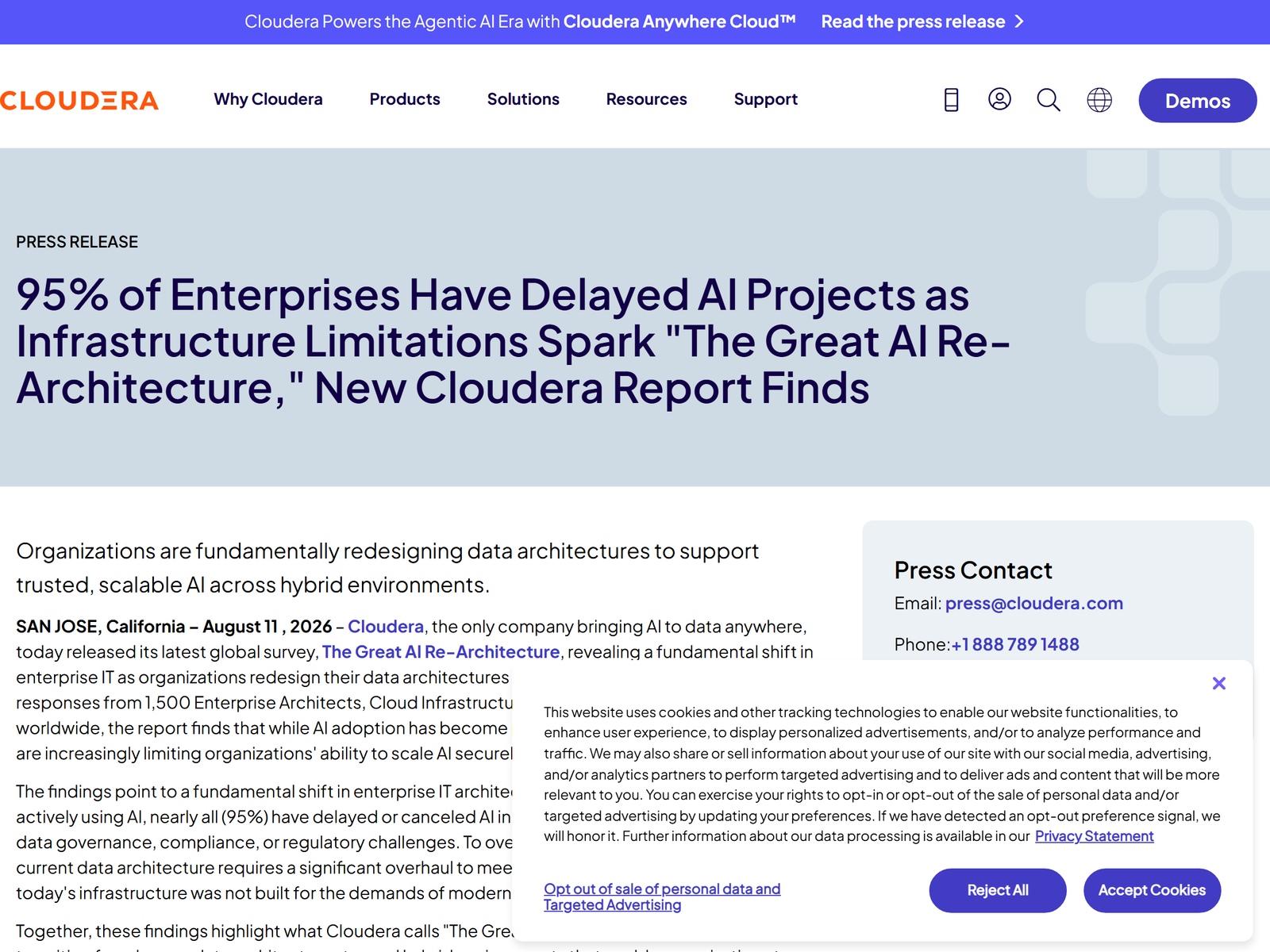
Quick answer: A Cloudera survey of 1,500 enterprise architects published August 11, 2026 found that 95% of organizations have delayed or cancelled AI projects in the past year due to data governance, compliance, and infrastructure limitations. 72% say their current data architecture needs a significant overhaul. The bottleneck for enterprise AI projects is not model capability — it is the plumbing underneath.
Enterprise AI projects are failing not because the models are not smart enough, but because the infrastructure underneath them was never built for this. That is the central finding of Cloudera's "The Great AI Re-Architecture" report, published August 11, 2026, based on responses from 1,500 Enterprise Architects, Cloud Infrastructure Leads, and Data Architects worldwide. While 77% of organizations are actively using AI, nearly all of them — 95% — have delayed or cancelled AI initiatives over the past 12 months. The reasons are not about algorithms. They are about data governance, compliance, regulatory challenges, and infrastructure that was designed for analytics, not for AI at scale.
The Numbers That Define the Problem
The report paints a picture of an industry that has sprinted past pilot projects and hit a wall. Here are the key data points:
- 95% of organizations delayed or cancelled AI initiatives in the past year due to data governance, compliance, or regulatory challenges
- 72% say their current data architecture requires a significant overhaul to meet future AI requirements
- 84% reported increased infrastructure costs driven by AI workloads
- 75% say AI integrations have changed their data storage and architecture practices
- 73% say AI has made data governance more complex
- 55% delayed or cancelled more than six AI projects in the past 12 months
- 97% move data between environments at least monthly
- 66% moved AI workloads from public cloud back to private cloud or on-premises in the past year
Sergio Gago, CTO of Cloudera, framed it bluntly: "Many enterprises are discovering that the architectures built for traditional analytics weren't designed for the scale, governance, and flexibility AI demands today." The 55% who cancelled six or more projects are not running experiments that failed — they are running production initiatives that their infrastructure cannot support. For tools that help bridge the AI deployment gap, visit aifreetool.site or explore AI development tools.
Why Enterprises Are Moving AI Workloads Back On-Premises
The most counterintuitive finding is that 66% of organizations have moved AI workloads from public cloud back to private cloud or on-premises infrastructure in the past year. This reverses a decade of cloud-first orthodoxy. The reasons are practical: data residency requirements, regulatory compliance, cost control, and the simple fact that moving large datasets between environments every month — as 97% of organizations do — is expensive and slow.
The shift toward hybrid architecture is accelerating. One-quarter of respondents (25%) say they plan to prioritize a hybrid-first architecture over the next two years. This is not a rejection of cloud — it is a recognition that AI workloads have different requirements than the web applications that drove the original cloud migration. AI needs data locality, consistent governance across environments, and the ability to run inference close to where data is generated.
Inference Spending Has Overtaken Training
Separate Gartner data released August 10, 2026 confirms what the Cloudera survey implies: AI is moving from the lab to production. Global spending on AI-optimized infrastructure as a service will nearly double by end of 2026 to reach $42 billion, driven by agentic AI and inference workloads. Critically, inference spending is projected to hit $23.3 billion this year — officially surpassing the $19 billion spent on model training.
This is a watershed moment. For years, AI infrastructure investment was dominated by a handful of frontier model providers building training clusters. Now enterprises are deploying AI in production, which requires continuous inference rather than periodic training cycles. Hardeep Singh, Senior Principal Analyst at Gartner, put it directly: "The fact that inference spending will exceed training spending in 2026 indicates that AI adoption is becoming more mainstream and production-oriented." Gartner forecasts the infrastructure-as-a-service market will reach $66 billion by 2027. Meanwhile, Forrester projects global technology spending will grow to $5.6 trillion in 2026, up from $5.2 trillion in 2025, driven by AI demand.
The Governance Gap Is the Real Risk
The Cloudera report lands at a moment when AI governance has shifted from best practice to legal obligation. The EU AI Act's high-risk provisions became enforceable on August 2, 2026, with non-compliance fines reaching 15 million euros or 3% of global annual revenue. The timing is not coincidental. Organizations that have been delaying AI projects due to governance concerns now face those same concerns as enforceable law.
The governance challenge is compounded by distributed data. With 97% of organizations moving data between environments at least monthly, maintaining consistent governance across cloud, private cloud, on-premises, and edge environments has become a foundational requirement. The companies that solve this problem — consistent policy enforcement, data lineage tracking, and audit trails across hybrid environments — will be the ones that can actually deploy AI at scale without regulatory exposure. Cisco's rollout of personal AI agents to approximately 90,000 employees is the largest internal agent deployment disclosed to date, and it uses on-premises infrastructure for control — exactly the pattern the Cloudera survey describes.
FAQ
Why are enterprises delaying AI projects?
According to the Cloudera survey, 95% of organizations have delayed or cancelled AI initiatives due to data governance, compliance, or regulatory challenges. The primary bottleneck is not model capability but infrastructure — 72% say their current data architecture requires significant overhaul, and 84% report increased infrastructure costs from AI workloads.
What is the Great AI Re-Architecture?
It is Cloudera's term for the mass transition from legacy data architectures toward hybrid environments that can support AI at scale. The shift involves redesigning data storage, governance, and deployment models to handle the volume, velocity, and governance requirements that AI workloads demand — requirements that traditional analytics-era architectures were never designed for.
Are companies moving AI away from the cloud?
Partially. 66% of surveyed organizations moved AI workloads from public cloud back to private cloud or on-premises in the past year, driven by data residency requirements, cost control, and regulatory compliance. The trend is toward hybrid architectures rather than a wholesale retreat from cloud — 25% plan to prioritize hybrid-first architecture over the next two years.
Is inference spending really bigger than training spending?
Yes, in 2026. Gartner projects global inference spending at $23.3 billion versus $19 billion for training. This crossover signals that AI has moved from research and development into production deployment, where trained models generate responses, recommendations, and decisions continuously rather than periodically.
My Take / The Bottom Line
The narrative that AI adoption is limited by model capability is wrong. The models are good enough for most enterprise use cases. What is failing is everything underneath: data architectures designed for batch analytics, governance frameworks built for human decision-making, and infrastructure that cannot handle the continuous, real-time demands of AI inference at scale.
The companies that will win the next phase of enterprise AI are not the ones with the best models — those are commoditizing. They are the ones that solve the plumbing: hybrid data architectures, consistent governance across environments, and infrastructure that can run inference close to where data lives. The 66% moving workloads back on-premises are not retreating from cloud — they are recognizing that AI workloads have fundamentally different requirements than the web applications that drove the original cloud migration.
Best for: enterprise leaders who need to understand that the next AI investment should be in data infrastructure, not just model licenses. The trade-off is that infrastructure investment is slower, less visible, and harder to justify to a board than a flashy AI pilot — but it is the difference between AI that works in production and AI that stays stuck in pilot forever.
If you want to explore AI tools that are ready for production use today, browse the directory at aifreetool.site.