How Broadcom's $1 Trillion Anthropic Bet in 2026 Reshapes AI Chips
Category: Tech Deep Dives
This analysis was written by the aifreetool Editorial Team — a group of full-time AI-industry researchers and writers who verify every claim against primary sources. Last updated August 21, 2026. We keep no affiliate relationship with the companies covered here.
Quick answer: Broadcom's Anthropic bet is a proposed debt facility that could reach $1 trillion to secure AI chips and data center capacity. If it closes, it would be one of the largest corporate financings ever and proof that compute access, not just model talent, is now the main bottleneck for frontier AI.
The Scale of the Proposed Broadcom-Anthropic Deal

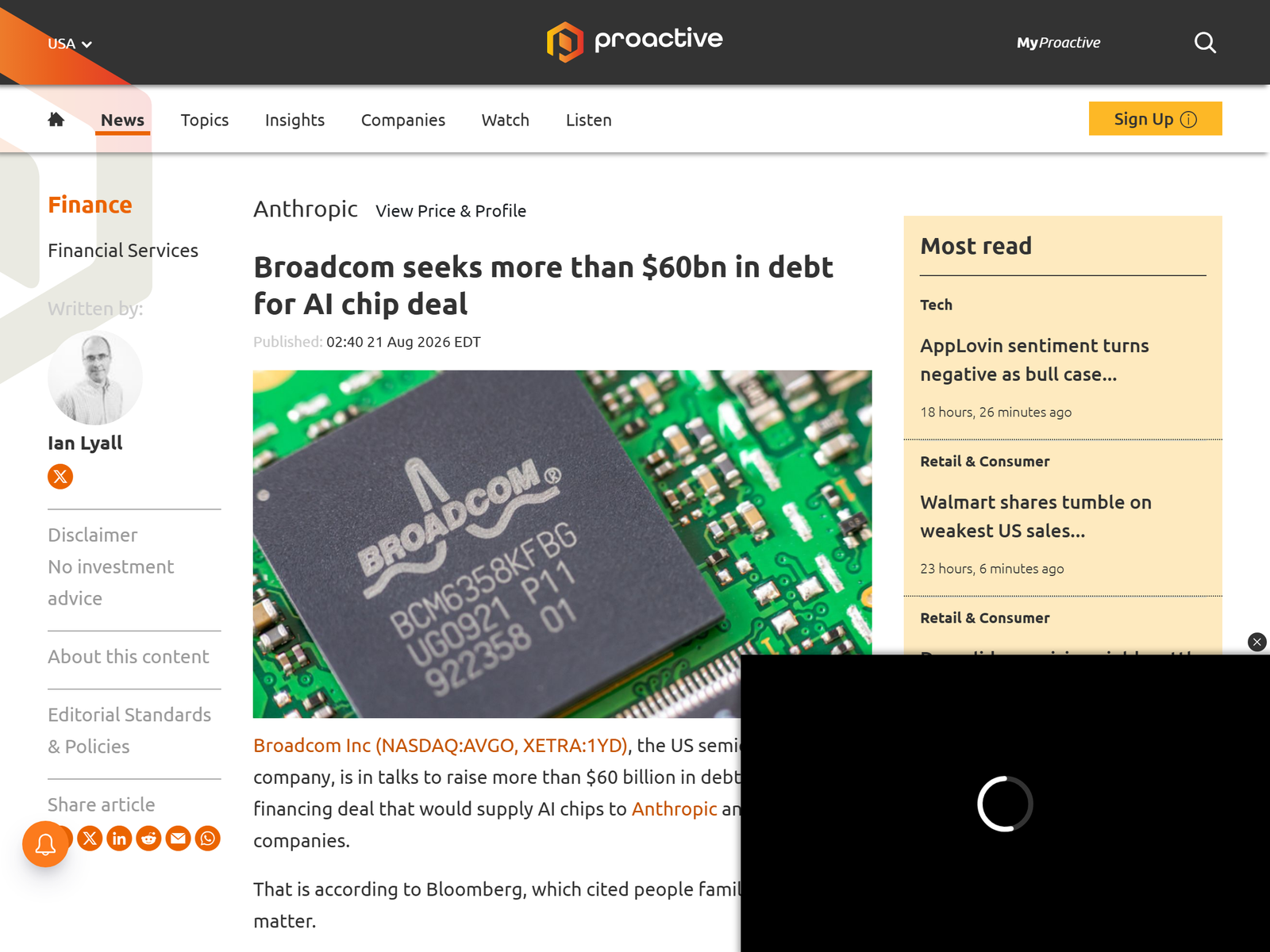
On August 20, 2026, Bloomberg News reported that Broadcom is negotiating with lenders to raise more than $600 billion in debt for an AI chip financing transaction. The financing could include a roughly $300 billion junior debt tranche and a senior-secured tranche of $600–700 billion that Broadcom would partly guarantee. Combined, the deal could reach as much as $1 trillion. Reuters and Yahoo Finance carried the same report, noting that Blackstone and Apollo Global Management are in talks to participate.
To put the number in perspective, the earlier AI XPV partnership among Broadcom, Apollo, and Blackstone already committed $35 billion to expand Anthropic's computing capacity. Proactive Investors noted that the earlier deal was expected to add roughly one gigawatt of compute. The broader partnership aims to enable more than 20 gigawatts of AI compute power for leading labs by 2028 — roughly the output of 20 nuclear power plants.
Why Anthropic Needs This Much Silicon
Anthropic, the company behind the Claude assistant, is preparing for an initial public offering that could rival the largest tech debuts in history. In parallel, it is racing to lock in enough compute to train and serve frontier models against OpenAI, Google, and a wave of well-funded Chinese labs. Bloomberg and trade reports note that Anthropic expects Broadcom's custom AI chips to account for more than 40% of Broadcom's projected $100 billion-plus AI chip revenue next year.
The structure matters. Instead of buying chips outright, Anthropic can lease them through a special-purpose vehicle funded by debt. That keeps the capital cost off Anthropic's balance sheet while giving Broadcom a guaranteed customer for its custom silicon. Broadcom CEO Hock Tan said in March 2026 that the company expects AI chip sales to exceed $100 billion next year. Deals like this are how he gets there.
How This Shapes the AI Chip Market
Broadcom is not Nvidia, but it has become the most important alternative. It designs custom chips for Alphabet's TPUs, Meta's training accelerators, and Apple's expected $30 billion-plus AI chip program. It also supplies Anthropic and OpenAI. The new financing would let Broadcom manufacture and deploy chips at a scale that puts real pressure on Nvidia's dominance in AI data centers.
The debt mechanics are aggressive. A $600–700 billion senior-secured tranche with a Broadcom guarantee could achieve investment-grade pricing. A $300 billion junior tranche would carry higher yields for risk-hungry investors. Yahoo Finance's Reuters recap noted that all three companies declined to comment, which is typical for a deal still being finalized.
What This Means for the AI Debt Market
The deal is part of a broader shift in how AI infrastructure gets funded. Tech companies are increasingly tapping debt markets to cover soaring capital expenditures. Alphabet, Amazon, and Microsoft have all signaled that AI spending will stay elevated through 2026 and beyond. The difference here is that a chip designer, not a hyperscaler, is stepping in as the financier and guarantor.
That matters because it moves risk off the AI labs' balance sheets and onto Broadcom's creditors. If the models trained on these chips generate enough revenue, everyone wins. If demand slows or chip prices fall, the junior tranche absorbs losses first. Either way, the structure shows that Wall Street now treats AI compute as an infrastructure asset class, comparable to pipelines, data towers, or power plants.
Key Takeaways
- Broadcom is negotiating a debt raise of $600 billion to $1 trillion for AI chip financing, primarily to supply Anthropic.
- Blackstone and Apollo Global Management are in talks to join the facility alongside Broadcom.
- The structure follows the June 2026 AI XPV partnership, which committed $35 billion to Anthropic's compute expansion.
- Broadcom expects AI chip revenue to top $100 billion in 2027, with Anthropic contributing more than 40%.
- Special-purpose vehicles let AI labs lease chips without carrying the full capital cost on their balance sheets.
My Take / The Bottom Line
The AI industry has entered its infrastructure-financing phase. Training a frontier model was already a capital-intensive sport. Now the constraint is not money for researchers; it is money for silicon, power, and data centers. Broadcom's proposed trillion-dollar facility is the clearest signal yet that AI labs are becoming compute utilities as much as software companies.
For Anthropic, the deal is survival insurance. It secures chip supply without a balance-sheet explosion ahead of an IPO. For Broadcom, it is a customer-lock-in masterpiece. For Nvidia, it is a warning that the custom-silicon alternative is no longer theoretical. And for investors, it is a reminder that the AI boom is increasingly a debt boom — one where the winners are the companies that can build or finance the physical layer faster than anyone else.
Frequently Asked Questions
How much is Broadcom trying to raise?
Bloomberg reported more than $600 billion in senior debt plus a roughly $300 billion junior tranche, with total financing potentially reaching $1 trillion.
Who benefits from the financing?
Anthropic is the primary beneficiary. Broadcom, Blackstone, and Apollo Global Management are the other key parties.
What is the AI XPV partnership?
It is a Broadcom-Apollo-Blackstone partnership formed in June 2026 to finance AI infrastructure, starting with a $35 billion Anthropic compute expansion.
Why does Anthropic need so much compute?
Training and serving frontier AI models requires enormous processing power. Leasing chips through a financed SPV lets Anthropic scale without owning the assets outright.
Does this threaten Nvidia?
It adds real competition. Broadcom's custom chips are already used by Google, Meta, Apple, OpenAI, and Anthropic. If financing on this scale closes, Nvidia's share of the AI data center market faces a credible challenger. For more context on model infrastructure, see our AI engine and model directory.