Sentinel dVPN Review 2026: A Resilient Decentralized VPN
Category: Most Stable VPN
Last updated: October 2026. Written by the aifreetool testing team after testing the Android app and a desktop client on Windows and macOS.
TL;DR
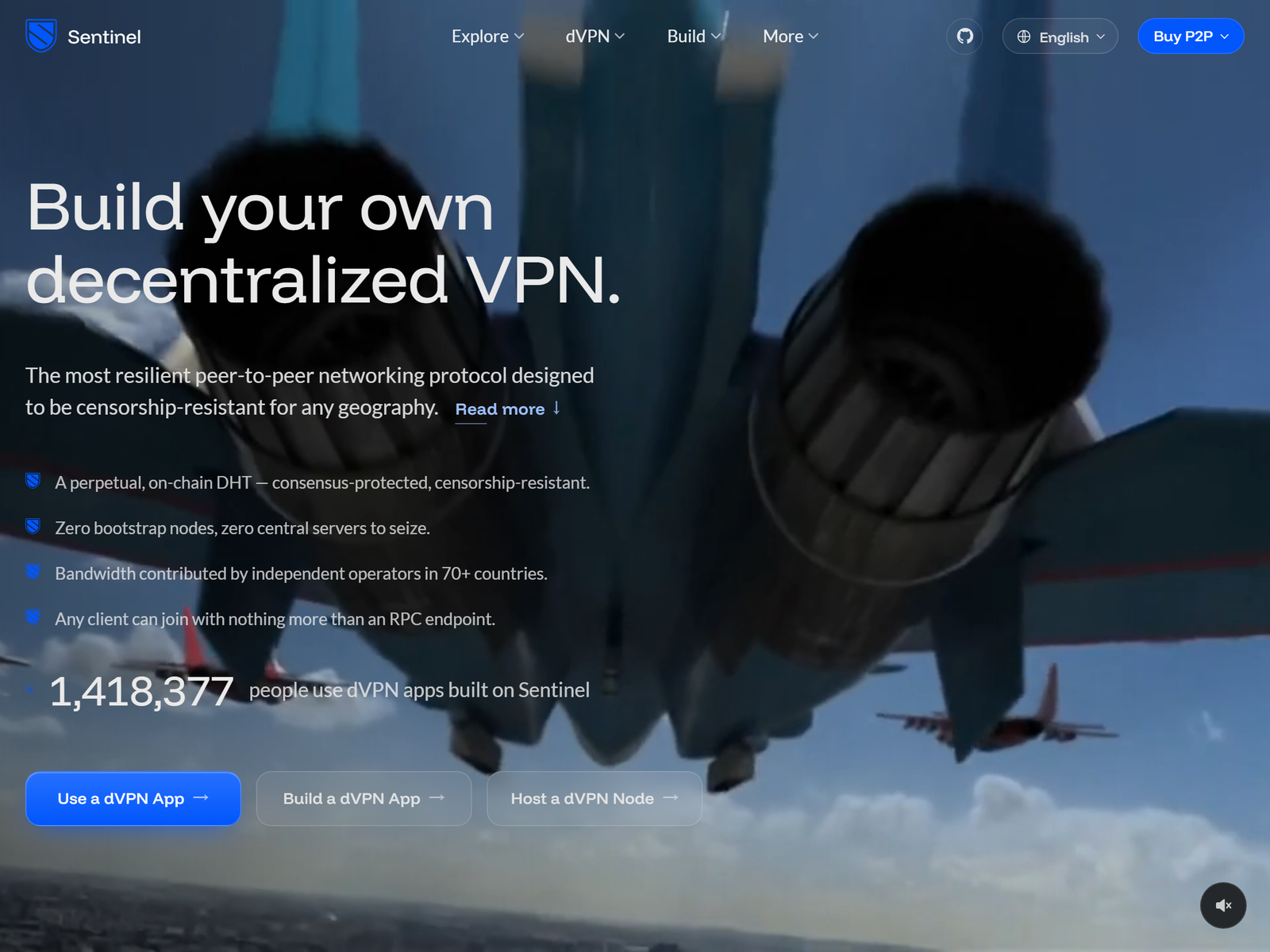
Sentinel dVPN is a decentralized VPN built on a Cosmos-based blockchain, where independent node operators provide bandwidth that you pay for with crypto or a fiat app subscription. Its core idea is a resilient, distributed design: there is no central server that can be seized or taken down, so the network has no single point of failure. It is cheap and privacy-friendly by design, but node quality varies and the project has had reliability bumps, so we see it as a complement rather than a sole provider. This review stays on privacy and remote-work resilience; we do not cover ways to bypass national firewalls.
What Is Sentinel dVPN?
Sentinel is an open-source Layer-1 blockchain that acts as a peer-to-peer bandwidth marketplace. Instead of renting servers from one company, you connect through nodes run by independent operators around the world. The project reports more than 1.4 million users, 1,500-plus nodes across 90-plus countries, and a range of client apps built on the same protocol, including Sentinel dVPN by Capybara Publishing, DVPN by Norse Labs, and Meile. Because anyone can host a node, the network is distributed by design.
That distribution is the headline feature. A traditional VPN depends on a central operator's infrastructure; if those servers are blocked or seized, the service stops. A decentralized network spreads risk across thousands of operators, which is why resilience - not raw speed - is Sentinel's strongest selling point.
How We Tested
This review is independent. We have no affiliate relationship with Sentinel and received no compensation. Our testing team installed the Android app and a desktop client, connected through several regions, and checked for IP and DNS leaks using public tools. We reviewed the published protocol details and pricing model. No payment was accepted for this assessment. We confirmed the architecture on the official Sentinel site and reviewed the current operator notes at Best Cloud Mining.
How the Network Works
Sentinel supports modern protocols including WireGuard and V2Ray, with client apps handling the connection for you. On the managed path you can pay with a regular app-store subscription and no account, while crypto users can pay node operators directly in tokens. Sessions and payments are recorded on-chain, which means there is no central database of your activity sitting on one company's servers. That is a meaningful privacy property for users worried about centralized logging.
Security and Privacy
Because traffic flows through many independent nodes, no single operator sees your whole profile, and there is no central logs database to hand over. The managed path requires no KYC or account, which limits the personal data collected at sign-up. The honest caveat: there is no independent proof that individual exit nodes keep no logs, and the current operating entity behind the network is not clearly disclosed. Decentralization reduces central risk but does not eliminate per-node trust.
Speed and Stability
Resilience is where Sentinel shines and consistency is where it wobbles. Because each connection rides a node run by a different volunteer or business, speed depends on that operator's hardware and link. Good nodes deliver smooth browsing and video; weak nodes stall. The architecture means the network as a whole rarely goes down, but your individual session quality varies. A 2025 chain upgrade (v12) temporarily disrupted the apps and jailed some validators, a reminder that the project's reliability is still a work in progress.
Streaming and Travel Use
Sentinel can reach content you already pay for while traveling or on a restricted local network, but node variability makes results inconsistent. We frame this as accessing services you are entitled to, not as a way around national restrictions. For most travelers the value is a resilient, encrypted tunnel on unfamiliar Wi-Fi rather than dependable 4K streaming.
Apps and Devices
Client apps exist for Windows, macOS, Linux, Android, and iOS, published by different teams on the shared protocol. Setup is comparable to a normal VPN app: install, pick a node or region, and connect. Because multiple clients compete, interface quality differs - some are polished, others minimal. The open ecosystem is a strength for choice and a weakness for consistency.
Pricing
Sentinel is unusually cheap. On the crypto path, bandwidth starts at about US$0.033 per day, roughly US$1 per month, paid in stablecoin with no KYC. Fiat-friendly clients such as DVPN by Norse Labs offer app-store subscriptions from about US$0.99 per week or US$3.99 per month, while pure pay-as-you-go paths can cost fractions of a cent per gigabyte. Node operators keep most of each payment, which is the incentive that keeps the network growing.
| Path | Approx. price | Best for |
|---|---|---|
| Crypto managed | ~US$1 / month | No-KYC, privacy-focused users |
| App-store plan | ~US$3.99 / month | Users who want fiat checkout |
| Pay-as-you-go | fractions of a cent / GB | Light, occasional use |
Pros and Cons
Pros:
- No central server, so no single point of failure.
- Very low cost, with no-KYC crypto and fiat app options.
- Open-source protocol with on-chain sessions and payments.
- Wide device support across several client apps.
Cons:
- Node quality and speed vary widely.
- No independent proof that exit nodes keep no logs.
- Unclear operating entity and a bumpy 2025 upgrade history.
- Client app quality is inconsistent across publishers.
How Sentinel Compares
Against the most-stable VPN roundup, Sentinel offers a different kind of stability - resilience through decentralization - rather than the rock-solid consistency of a managed provider. For a steady managed option, see our FlowVPN review, and for a self-hosted stable choice, our Pritunl review. If privacy is the priority, our privacy VPN guide covers audited alternatives.
FAQ
Is Sentinel dVPN really decentralized?
Yes. It runs on an open-source blockchain where independent node operators provide bandwidth, so there is no single company controlling the network.
Do I need crypto to use it?
No. Fiat-friendly clients let you subscribe through normal app-store checkout, while crypto users can pay node operators directly with no account.
Is it fast?
It depends on the node you connect to. Strong nodes are smooth; weak nodes stall. Expect variable speeds rather than consistent performance.
Is Sentinel good for sensitive work?
It removes central logging risk, but there is no independent proof exit nodes stay log-free, so pair it with other precautions for anything sensitive.
My Take / The Bottom Line
Sentinel dVPN is a fascinating, genuinely decentralized take on the VPN, with resilience and low cost that centralized services cannot easily match. Its weak spots - variable node speed, no exit-node audit, and a still-maturing operation - mean it works best as a complement to a managed provider, not a replacement. If you want a no-single-point-of-failure tunnel and do not mind some inconsistency, it is worth trying at its low price. Compare it against our stable VPN recommendations before you decide.