Patreon Just Built a Wall Around Creators' Work. Cloudflare Made It Possible.
Category: Industry Trends
On July 17, 2026, Patreon stopped asking nicely. The membership platform for creators flipped a switch with Cloudflare that blocks every known AI training crawler at the network level, across every post on the platform. The result, according to Patreon's early testing: weekly AI scraping attempts dropped from thousands to zero. This is not another polite robots.txt request. It is the first time a major content platform has moved from passive consent theater to active infrastructure enforcement, and it signals a real shift in how the internet's creative economy plans to deal with AI data collection.
From Robots.txt to Network-Level Enforcement
For years, the standard defense against unwanted crawling was a text file. Websites listed bots they wanted to block in robots.txt, and crawlers could choose to obey or ignore it. Patreon had that file in place since 2023. The AI training crawlers ignored it. Patreon's testing showed thousands of weekly access attempts persisting despite explicit instructions to stay out, confirming what many publishers have long suspected: robots.txt is a suggestion that AI companies treat as optional.
Cloudflare's AI Crawl Control changes the mechanism. Instead of relying on crawler self-regulation, the system profiles traffic at the network layer using JA4 fingerprints, HTTP version analysis, and behavioral signatures to identify and block training bots before they touch any content. It distinguishes between search crawlers (allowed, because they send traffic back to creators), agent crawlers (blocked by default on new domains starting September 15), and training crawlers (blocked outright). Patreon activated the full training-crawler block across its entire platform, requiring no opt-in from individual creators.
The infrastructure approach matters because it shifts enforcement away from millions of individual creators — most of whom lack the technical resources to fight scraping — and onto the companies that run the pipes. Cloudflare protects roughly 20% of the web. When it changes a default, a significant portion of the internet changes with it.
Jack Conte's Three Demands: Consent, Credit, Compensation
 Cloudflare AI Crawler Block" loading="lazy" style="max-width:100%;height:auto;display:block;border:1px solid #e5e5e5;" />
Patreon CEO Jack Conte has been building toward this moment for months. In May, he posted a 43-minute video laying out why the AI industry's approach to creator data is broken. His framework is simple: creators deserve consent (the right to opt out of having their work used for training), credit (attribution when their style or content is replicated), and compensation (payment when their work generates value for AI companies). His assessment of the current state: "The answer to all three of these questions right now is a big fat 'No.'"
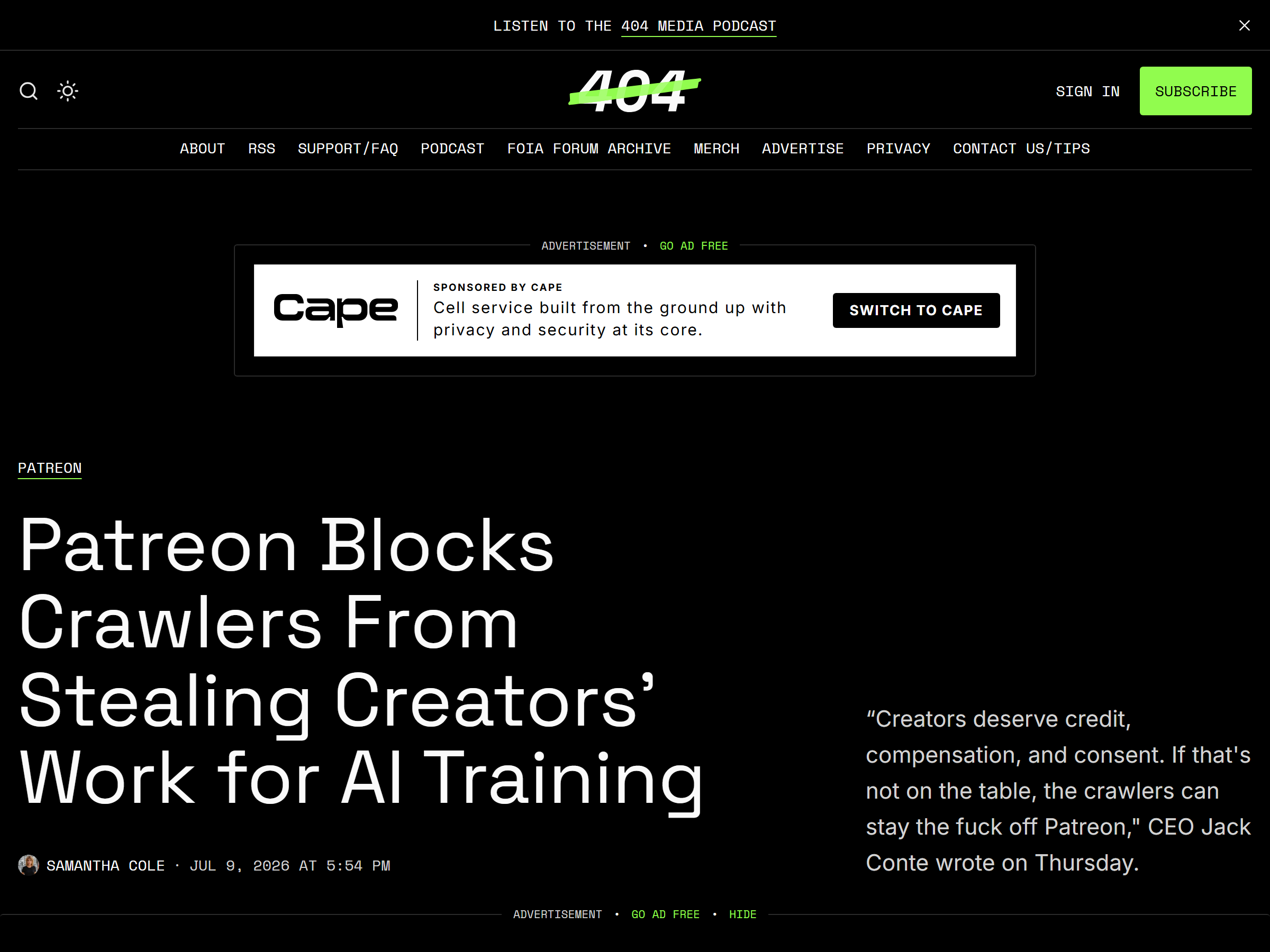
When he announced the Cloudflare partnership, Conte did not soften the language. "Creators deserve credit, compensation, and consent. If that's not on the table, the crawlers can stay the fuck off Patreon," he wrote on Instagram. "The free internet is alive and happening. The rebellion has already started."
Drew Rowny, Patreon's SVP of Product, framed the move as a structural fix: "On most of the Internet, creators have to accept AI training on their work just to reach and grow an audience. Patreon has a different vision: creators should be able to grow their audience and control how their work is used."
What the Block Does — and What It Cannot Undo
The block covers all posts published on Patreon going forward and stops future scraping of existing content. What it cannot do is remove creator content already ingested into training datasets. If an AI company scraped Patreon before July 17, those images, posts, audio files, and videos are still inside models that have already been trained. The block is a forward-looking defense, not a retroactive cure.
There is also a legitimate question about detection coverage. Cloudflare identifies training bots through fingerprinting and behavioral analysis, but a determined scraper that perfectly mimics a legitimate browser or search crawler can still slip through. Neither Patreon nor Cloudflare has published detection-rate data, and the "thousands to zero" claim covers known training bots, not zero-day scrapers or sophisticated evasion attempts.
Patreon is also drawing a line the company itself finds awkward: AI-generated content is still permitted on the platform, as long as it complies with existing content guidelines. Blocking AI training while hosting AI creation puts Patreon in the position of saying "train on someone else's data, just not ours" — a defensible but incomplete position.
Key Takeaways
- Patreon activated Cloudflare's AI Crawl Control on July 17, blocking all known AI training crawlers at the network level across every post on the platform.
- Testing showed weekly AI scraping attempts dropping from thousands to zero after activation, confirming that existing robots.txt requests were being widely ignored.
- Cloudflare will begin blocking training and agent bots by default on all new ad-supported domains starting September 15, 2026 — extending the approach far beyond Patreon.
- The block is forward-looking only. Content scraped before July 17 remains in existing training datasets with no removal mechanism.
- Patreon still permits AI-generated content on its platform, creating a distinction between blocking AI training and hosting AI creation.
My Take
This is the first shot in a war that changes the economics of AI training data. When Cloudflare's defaults kick in for all new domains in September, a meaningful chunk of the open web will become inaccessible to training crawlers by default. That does not kill AI training — companies will shift to licensed data, synthetic data, or direct partnerships — but it raises the cost and reduces the diversity of freely available training material. The long-term consequence is that the era of "scrape everything and sort it out later" is ending, replaced by a patchwork of paid access, opt-in regimes, and infrastructure blocks. Creators get a seat at the table they never had. Whether they get paid is the next question.
FAQ
How does Cloudflare's AI Crawl Control actually work?
It identifies bot traffic at the network level using JA4 fingerprints, HTTP version analysis, cryptographic signatures, and behavioral profiling. It categorizes bots into three types — search, agent, and training crawlers — and applies different access rules to each. Training crawlers are blocked by default when the feature is activated.
Does this block affect Google Search indexing?
No. Cloudflare's system distinguishes between search crawlers (which index pages and send traffic back to websites) and training crawlers (which collect data for AI model training). Google Search and other legitimate search engines are explicitly allowed through.
What happens on September 15, 2026?
Cloudflare announced that starting September 15, all new domains onboarding to Cloudflare will have training and agent crawlers blocked by default on pages that display ads. Search crawlers will remain allowed. This effectively extends Patreon's approach to every new website that uses Cloudflare.
Can AI companies legally challenge these blocks?
It is possible but difficult. Network-level blocking is well-established infrastructure practice. Recent court rulings have also established a "market-harm" test that exposes AI firms to liability if their output competes with the original works they scraped, which strengthens platforms' legal position in blocking scrapers. The FTC has also signaled interest in regulating AI data collection under Section 5 of the FTC Act.
For more on how AI companies are navigating data rights, browse our AI search and data tools directory.