Palantir Q2 2026 Revenue Jumped 93%. Its Real Product Is AI Sovereignty.
Category: Industry Trends
Reviewed by the aifreetool Editorial Team — a group of full-time AI-tool researchers and writers who verify every product claim against primary sources and independent testing.
Last updated August 12, 2026.
We keep no affiliate relationship with the products covered here and earn nothing if you click through. Where a claim could not be verified, we say so.
Palantir reported second-quarter 2026 results on August 3, and the top-line numbers are hard to dismiss. Revenue hit $1.935 billion, up 93 percent year over year, while the U.S. commercial segment soared 149 percent to $764 million. The full-year forecast was lifted to $8.15 billion, roughly $500 million above the prior range. But the most important line in the release is not a financial figure. The real product, CEO Alex Karp argues, is AI sovereignty.
What Palantir's Q2 Results Actually Say
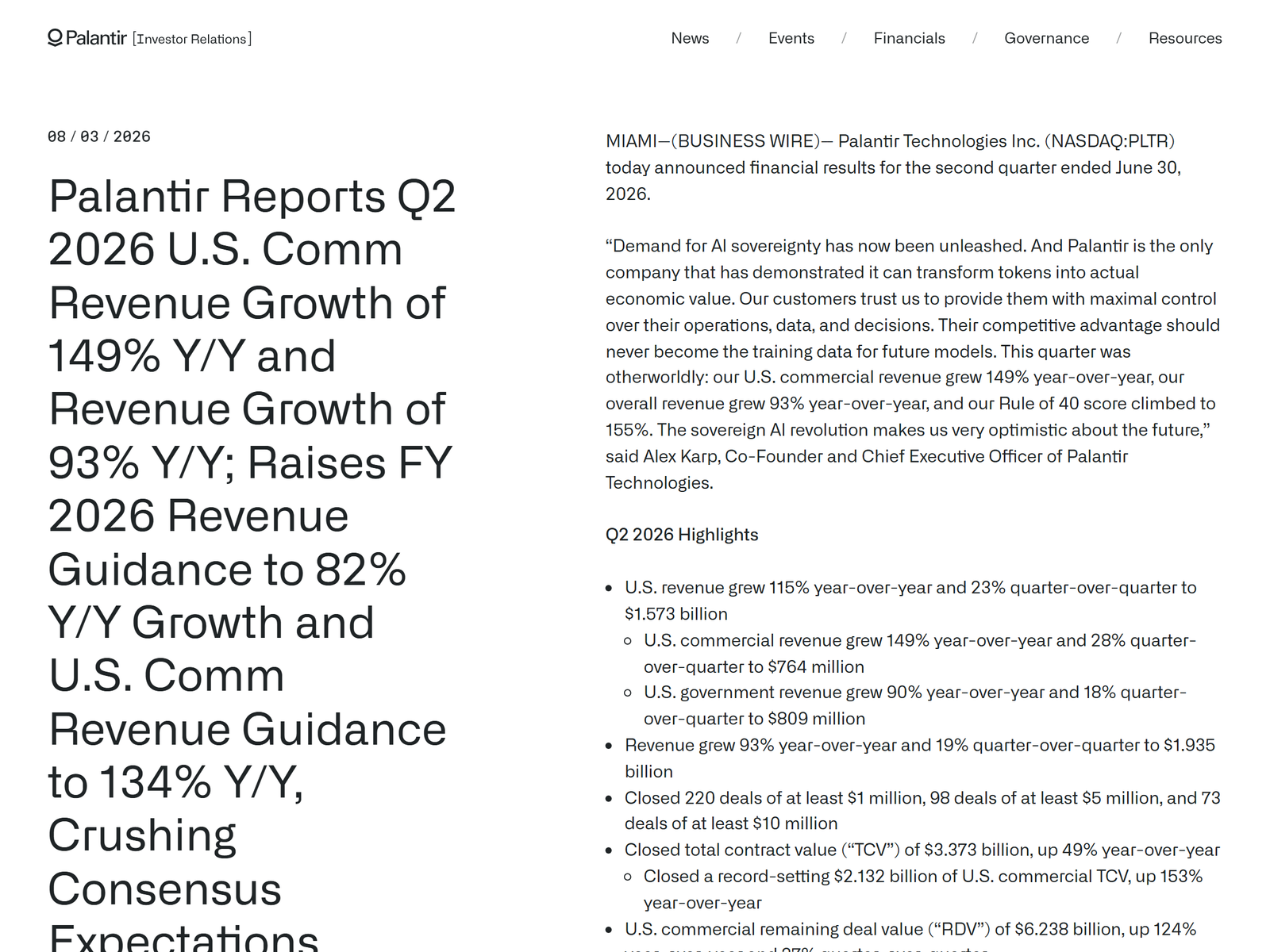
The headline growth is real across every segment. U.S. sales climbed 115 percent to $1.573 billion. U.S. government revenue grew 90 percent to $809 million. The company closed 220 deals worth at least $1 million, 98 deals worth at least $5 million, and 73 deals worth at least $10 million. Total contract value reached $3.373 billion, up 49 percent year over year, and U.S. commercial remaining deal value doubled to $6.238 billion.
Profitability is equally striking. GAAP operating income was $912 million, a 47 percent margin. Adjusted operating income hit $1.194 billion, a 62 percent margin. GAAP net income came in at $1.062 billion, and adjusted free cash flow was $1.22 billion, both equal to 63 percent of the top line. Palantir ended the quarter with $9.2 billion in cash and short-term Treasuries.
The guidance raise is what moved the stock. Full-year 2026 sales are now expected between $8.15 billion and $8.158 billion, implying 82 percent growth. U.S. commercial guidance was lifted to more than $3.424 billion, representing at least 134 percent growth. Third-quarter sales are projected at roughly $2.16 billion.
Why Palantir's Product Is AI Sovereignty, Not Just Software

Karp has spent the last year reframing the company's pitch. The argument is simple: enterprises that plug their data into closed frontier models are paying to give away their competitive advantage. Its platform, by contrast, is supposed to let customers host models inside their own environments, switch models, and keep control of workflows and data.
The messaging is resonating with governments first. U.S. government sales grew 90 percent, and the company has leaned into defense and intelligence work. But the faster-growing segment is U.S. commercial, up 149 percent. That suggests the control pitch is crossing over from public-sector buyers to large enterprises that do not want their operations to become training data for someone else's model.
The risk is that this positioning invites political pushback. The company has faced scrutiny in the UK and Europe over NHS contracts and data-control concerns, and Karp has not shied away from culture-war rhetoric. If more European governments decide to favor domestic vendors, Its international growth could stall. International commercial revenue grew only 26 percent in the quarter, a sharp contrast to the U.S. figures.
The Competitive Squeeze Palantir Is Trying to Avoid
It is not the only company chasing the enterprise AI platform layer. Databricks and Snowflake are building model-agnostic data platforms, and Anthropic is pitching its own enterprise deployments. Microsoft and Amazon can bundle AI tools with cloud contracts at scale. Its bet is that its ontology-based data integration and government-grade security give it an edge in regulated industries where model switching and auditability matter.
The numbers suggest the bet is working in the United States, at least for now. The question is whether it can replicate that success abroad and whether its AIP bootcamps can convert pilots into long-term contracts. The company added U.S. commercial customers at a brisk pace, but the average deal size and renewal rates will determine if the current growth is durable or a one-off deployment boom.
The broader implication is that enterprise buyers are no longer buying AI as a toy. They want systems that run on their own infrastructure, respect their compliance rules, and do not leak proprietary data into a shared training pool. That shift favors platform vendors over raw model providers, at least for large regulated customers.
Key Takeaways
- Palantir's Q2 2026 revenue was $1.935 billion, up 93 percent year over year.
- U.S. commercial revenue jumped 149 percent to $764 million, while U.S. government revenue rose 90 percent to $809 million.
- The company raised full-year guidance to $8.15 billion and U.S. commercial guidance to more than $3.424 billion.
- CEO Alex Karp is framing Palantir as the AI sovereignty alternative to closed frontier labs.
My Take / The Bottom Line
The company is becoming a sentiment stock for a specific idea: that enterprises will demand control over their own AI stack. The numbers back the story for now, but the valuation already assumes the trend continues. What matters over the next four quarters is whether Palantir can keep growing U.S. commercial revenue at triple digits while expanding margins and converting international pilots into meaningful business.
For readers running data-heavy operations, the lesson is practical. You do not have to bet everything on a single frontier model. It is betting that the winning architecture is a private platform that lets you swap models, keep your data, and enforce your own rules. Whether you use Palantir or not, that architecture is worth designing toward. If you are looking for tools to compare, start at aifreetool.site/efficiency-improvement.
Frequently Asked Questions
What was Palantir's Q2 2026 revenue?
Palantir reported $1.935 billion in revenue, up 93 percent year over year.
How fast is Palantir's U.S. commercial business growing?
U.S. commercial revenue grew 149 percent year over year to $764 million, and the company guided full-year U.S. commercial revenue to more than $3.424 billion.
What is AI sovereignty?
In Palantir's framing, AI sovereignty means running AI systems inside an organization's own environment, retaining control of data and workflows, and avoiding dependence on a single closed model provider.
Did Palantir beat analyst estimates?
Yes. Revenue beat the roughly $1.80 billion consensus, and adjusted earnings per share of $0.41 topped the $0.35 estimate.
Is Palantir profitable?
Yes. GAAP net income was $1.062 billion, and adjusted free cash flow was $1.22 billion, both representing about 63 percent of revenue.