How to Make Money Designing Patterns With PatternedAI
Category: Monetization Guide
Quick answer: You can make money designing patterns with PatternedAI by creating seamless surface patterns for print-on-demand products (fabric, wallpaper, home decor, phone cases) and by offering custom pattern design to brands. A POD catalogue can earn $200 to $1,500 a month in royalties, while custom pattern work runs $50 to $300 per design. This guide is written by the aifreetool.site editorial team. We have no affiliate relationship with PatternedAI, and links point to the official site or our own pages.
Key Takeaways
- PatternedAI turns a text prompt into a seamless, tileable pattern in seconds, then vectorizes it to SVG and upscales to 16x for 300 DPI print.
- A catalogue of 100 to 200 patterns on POD platforms builds passive royalties; custom work pays faster per project.
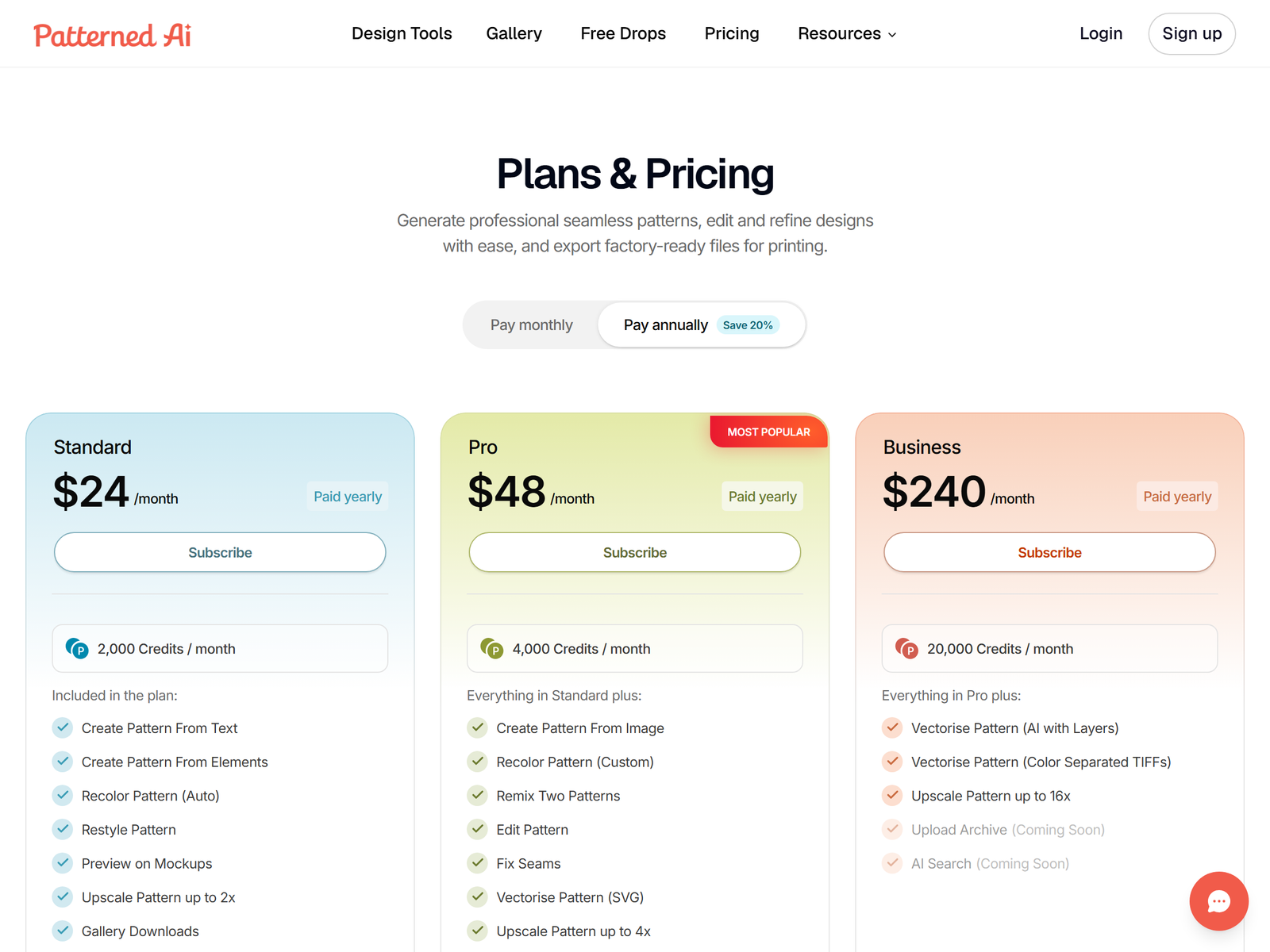
- Tool cost is about $30 a month on the Standard plan, far below the value of one sold collection.
- Avoid the free plan: it watermarks outputs and shows your patterns in the public gallery.
- Internal link: see the feature list on the PatternedAI tool page (https://aifreetool.site/tool/patterned-ai/) before you start a shop.
What PatternedAI Does (and the Plan You'd Use)

PatternedAI is an AI seamless pattern generator. You describe a style in text, or upload a reference image, and it returns a looping, tileable design you can test on fabric and product mockups. The editor recolors, remixes two patterns, fixes seams, and exports factory-ready files, including SVG vectorization and upscaling up to 16x for high-resolution print. Per PatternedAI's pricing page, plans are Standard at $30 a month (2,000 credits), Pro at $60 a month (4,000 credits, patterns kept private), and Business at $300 a month (20,000 credits, layered SVG and 16x upscale). Paid plans include a commercial license; Pro and above keep your work out of the public gallery. As of 2026 the tool ships layered SVG export and 16x upscale on higher plans, which is what makes the output print-ready for fabric and wallpaper rather than screen-only, so you can sell into physical product niches that reject low-res AI art.
The Service: POD Catalogue Plus Custom Design
Two income streams fit this tool. First, a passive print-on-demand catalogue: you upload patterns to Spoonflower, Contrado, Etsy, Redbubble, and Society6 for fabric, wallpaper, mugs, and phone cases, then earn royalties as they sell. Second, custom pattern design for brands that need packaging wraps, stationery, or on-trend surface art. A strong operator runs both: the catalogue pays while they sleep, and custom jobs pay the bills.
Step-by-Step: From Prompt to Published Pattern
- Learn prompt-to-pattern by generating florals, geometrics, and kid themes, then check seamlessness on a mockup.
- Build 10 to 20 patterns per collection around a clear theme (cottagecore, boho, animal prints).
- Upload to two or three POD platforms, write keyword-rich titles, and link collections.
- Scale to 100 to 200 patterns over a few months; trends compound as your shop ages.
- Offer custom design on Fiverr and LinkedIn, quoting per pattern or per collection.
Pricing Your Pattern Work
| Offer | Effort | Price | Notes |
|---|---|---|---|
| POD royalties | Build catalogue once | $200 to $1,500 a month | Passive, grows with volume |
| Custom pattern | 1 to 3 revisions | $50 to $150 | Fast turnaround |
| Collection (10 to 20) | Themed set | $200 to $500 | Brand packages |
| Monthly brand retainer | Seasonal drops | $150 to $400 a month | Recurring |
Client Management and What You Can't Promise
Confirm the commercial license in writing and use a paid plan so the client's pattern stays private. Deliver PNG for print and SVG when the platform accepts vectors, and always run the seam check before sending files. Set a fixed number of revision rounds, because pattern tweaking can run forever. Do not promise exact pantone matches from a text prompt; offer colorways instead.
Pro Tips and Pitfalls
Win on niches and timing: holiday collections listed in October, back-to-school in July, and evergreen botanicals that sell year round. Bundle patterns into collections so one buyer lifts several designs. The pitfalls are the free plan (watermark and public gallery kill client work), thin catalogues with too few patterns to be found, and ignoring seam checks so prints show a visible line. Check every tile on a real mockup before publishing.
Who This Is and Isn't For
This suits people with a design eye and patience for trends: surface designers, crafters, and Etsy sellers. If you already run an Etsy shop, pattern design is a natural extension because you reuse the same audience and storefront while adding a higher-margin digital product. It is a poor fit if you need income this week (POD royalties take months to build) or if you dislike repetitive production work such as exporting and titling dozens of files.
My Take: The Bottom Line
PatternedAI is the rare AI tool where the output is a real, sellable product, not just a service hour. The smart play is a growing POD catalogue for passive income plus custom design for cash flow, not one or the other. Spend the $30 Standard plan from day one so your work is licensed and private, and treat pattern design like publishing: volume and consistency beat one perfect design. A part-time operator realistically reaches $200 to $1,500 a month within four to six months of steady uploads.
FAQ
Can I use the patterns commercially?
Yes, on any paid plan. The free plan is for personal use and shows a watermark, so upgrade before client work.
Which file formats should I deliver?
PNG for most POD platforms and SVG when the printer accepts vectors; SVG also scales cleanly for wallpaper and fabric.
How many patterns do I need to earn?
Shops typically need 100 to 200 patterns before royalties become meaningful, so batch your production.
Is PatternedAI better than hiring a designer?
For volume and speed it wins; for a one-off hero print, a human designer may match a specific brand better.
What sells best on POD?
Evergreen botanicals, kids themes, and holiday collections perform well, with seasonal drops timed two months ahead.