How to Make Money Building Lead Lists With Clay in 2026
Category: Monetization Guide
Written by the aifreetool.site editorial team. Last updated August 10, 2026. We verified every price in this guide against Clay's own pricing page before publishing. No affiliate links and no sponsorship.
TL;DR: Building lead lists with Clay is a service you can sell for $400 to $900 per finished list, or $1,200 to $2,500 a month on retainer. Two steady clients put most freelancers in the $1,500 to $4,000 a month range. Your main input cost is credits, which start at $149 a month once you outgrow the free tier.
Making money with Clay comes down to one unglamorous fact: most B2B sales teams still cannot build a clean, enriched prospect list. They own a CRM, they pay for a sending tool, and nobody on staff knows how to fill the top of it. Building that list is the paid job, and Clay is the machine that does the heavy part of it.
What Clay Actually Does
Clay is a spreadsheet-shaped data platform. You drop in a set of companies or people, then add columns that call outside data providers — Apollo, Clearbit, BuiltWith, job boards, LinkedIn-sourced datasets — and each column fills itself row by row.
The feature that matters commercially is waterfall enrichment. If provider one has no email for a contact, Clay falls through to provider two, then three, until something lands. It aggregates 75 or more providers behind a single credit pool, so you stop paying five separate subscriptions to cover the gaps.
Its research agent, Claygent, goes one step further. It reads a company website or a careers page and answers a question you write, such as whether that company is hiring account executives right now. No static database sells that signal.
One thing Clay does not do: send email. It is the research and orchestration layer. Sequencing happens somewhere else, in a platform like Instantly.ai or whatever your client already runs. Say that out loud on your first sales call, because buyers confuse the two constantly.
The Service You Sell and What It Pays
Never sell hours of Clay expertise. Sell a finished artifact: a target list of 500 verified contacts inside one defined customer profile, where every row carries firmographics, a verified work email, a trigger event, and a one-line opener written from that trigger.
Here is what your input costs look like at the time of writing.
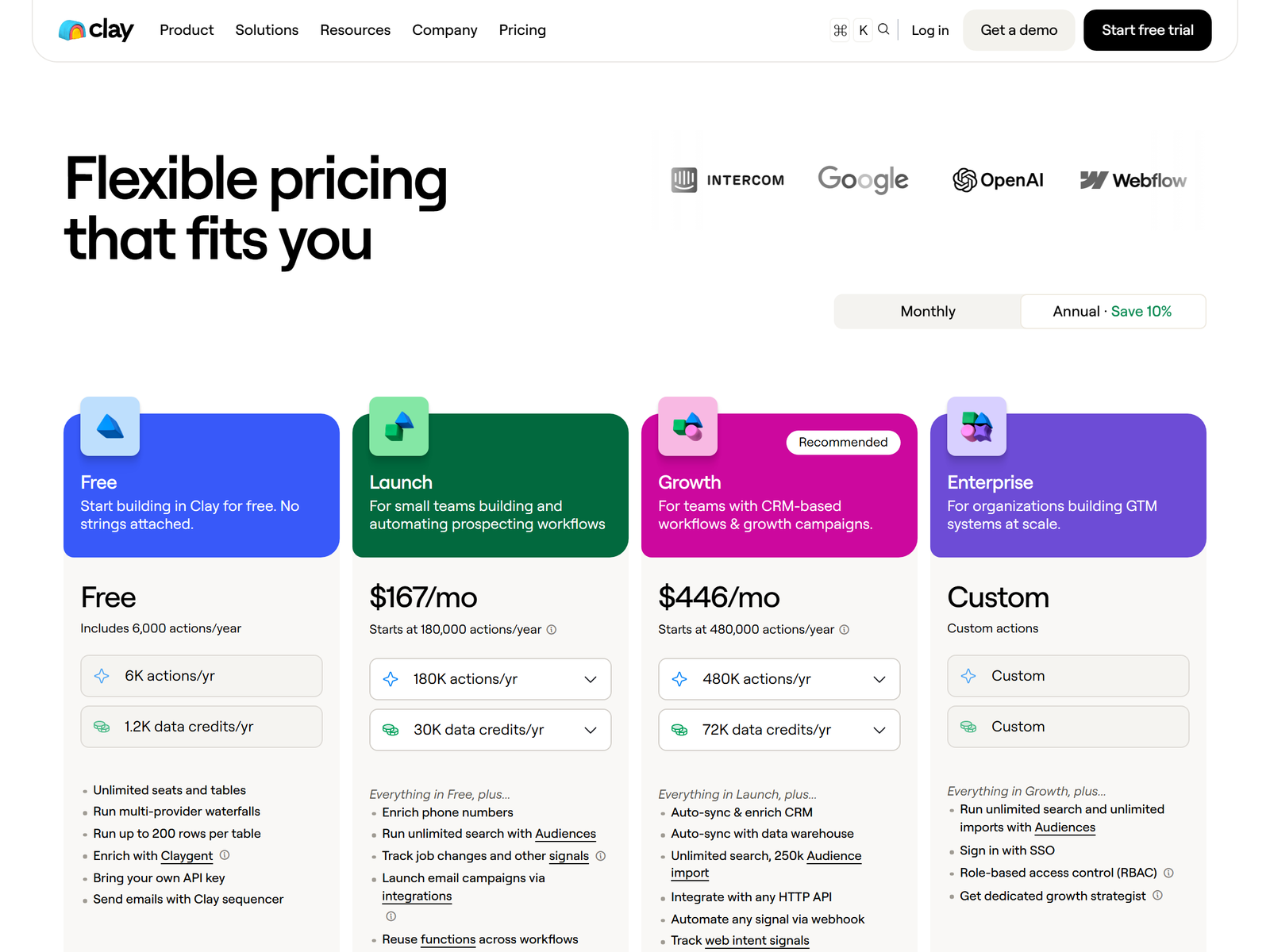
| Clay plan | Monthly price | Credits | Who it fits |
|---|---|---|---|
| Free | $0 | 100 | Learning the interface, nothing more |
| Starter | $149 | 2,000 | One small client, light enrichment |
| Explorer | $349 | 10,000 | The realistic freelance tier |
| Pro | $800 | 50,000 | Three or more retainers running |
| Enterprise | Custom | Custom | Agencies needing SSO and support |
Annual billing trims roughly 10% to 20% off those figures. Read Clay's pricing page before you quote anyone, because credit allocations shift more often than the headline prices do.
Credit maths decides your margin. A fully enriched contact — company data, verified email, one research column, one generated opener — usually burns 4 to 15 credits depending on how deep the waterfall runs. On the $349 Explorer plan that works out to roughly 700 to 2,000 finished contacts a month.
Price the output, never the credits. A 500-row enriched list sells for $400 to $900. A retainer that refreshes 500 to 1,000 rows and watches for triggers sells for $1,200 to $2,500. Run two retainers on one Explorer seat and your tooling stays under 15% of revenue.
Your First 30 Days, Step by Step
- Days 1 to 5: learn on the free plan. One hundred credits is enough to build a single table and watch how each column eats them. Clay University and the public template library cut this learning time sharply.
- Days 6 to 10: build one reusable recipe. Choose a narrow niche — Shopify agencies, dental groups, Series A fintech. Build a table that finds the right role, verifies the email, pulls one trigger, and drafts one opener. That table is your product.
- Days 11 to 15: produce a sample. Run the recipe on 50 rows for a company you would love as a client, then export it as a clean spreadsheet. That file is your entire portfolio.
- Days 16 to 25: pitch 40 prospects. Agencies, founders selling into one vertical, and fractional sales leaders buy this fastest. Send the sample, ask for nothing else in the first message.
- Days 26 to 30: close a paid pilot. Quote $400 for 500 rows on a five-day turnaround. Upgrade your plan only after the deposit clears.
Scope, Quality, and the Line You Should Not Cross
Three limits will bite you if you sell around them.
- Failed lookups still cost credits. Teams commonly report 20% to 30% miss rates, and email finding fails more often than company data. Budget credits for the misses and quote match rate as a range, never as a promise.
- There is a throughput ceiling. The Explorer tier throttles around 400 records an hour, so a 5,000-row job is a multi-day run rather than an overnight one. Set the deadline from that number.
- Deliverability is not your deliverable. You hand over data. Whether the client's mail reaches an inbox depends on domain warm-up, volume, and copy. Put that sentence in the contract.
On the legal side, keep enrichment to business contact data, honour suppression lists, and let the client own the sending domain. If they sell into the EU, ask them to confirm their lawful basis in writing before you deliver a single row.
Pro Tips and Pitfalls
- Cap the AI columns. One research column and one opener column per table is plenty; a third doubles your burn rate for a marginal gain in quality.
- Charge a setup fee. The first recipe in a new niche takes four to eight hours, so bill $500 to $1,000 for it separately from the list fee.
- Sell the trigger, not the volume. Two hundred companies that just posted a relevant job opening beat a 5,000-row dump, and they are far easier to defend at renewal.
- Ask retainer clients to fund their own seat once their usage passes about $500 a month in credits. Keep one-off projects on your account.
- Pair Clay with a scraper for niches no database covers. Browse AI handles directory sites that Apollo has never indexed.
Who This Is Realistic For
This works if you already understand B2B sales motions, enjoy data plumbing, and can survive a two-week learning curve. Former sales development reps, revenue operations people, and technically comfortable marketers pick it up in days.
It fails as passive income. Every list is bespoke, every niche needs a fresh recipe, and the credit meter runs whether or not the campaign performs. It also fails if you cannot prospect for yourself, because almost nobody searches for a lead-list builder. You have to go and find these buyers.
FAQ: Making Money With Clay
Do I need to be technical? No coding is required, but you need spreadsheet fluency and patience with conditional logic. Plan on one to two weeks before your output is client-ready.
Can I start on the free plan? For learning, yes. One hundred credits a month covers roughly 10 to 20 enrichments, enough for one practice table. Move to Starter the day a pilot is paid for.
How fast can I deliver 500 rows? Once the recipe exists, a clean run needs a few hours of machine time plus an hour of manual review. A brand-new niche takes a day or two, because you will rebuild columns at least twice.
What should I charge my first client? $400 for 500 rows is a fair opening price that still leaves margin on a $149 plan. Move to $700 or $900 once you can show match rates from two completed jobs.
My Take: The Bottom Line
Clay is one of the few AI products where the freelance opportunity is bigger than the software licence. The tool is genuinely hard to learn, which is exactly why buyers pay somebody else to run it. That difficulty is your moat, and it will hold for at least another year.
What I would avoid is the agency fantasy sold on social feeds, where a beginner charges $5,000 a month for outbound they cannot control. Deliver data, not pipeline promises, and a durable $2,000 to $4,000 a month service is well within reach. Start with the Clay listing on aifreetool.site, browse related workflow software in our efficiency improvement category, then sign up at clay.com and build one working table before you pitch a soul.