How to Make Money Selling Custom Songs With Suno
Category: Monetization Guide
Reviewed by the aifreetool Editorial Team — a group of full-time AI-tool researchers and writers who verify every product claim against primary sources and independent testing.
Last updated August 12, 2026.
We keep no affiliate relationship with the products covered here and earn nothing if you click through. Where a claim could not be verified, we say so.
You can make money selling custom songs with Suno at $30 to $150 a track while your raw production cost stays under five cents. Suno turns a text prompt into a finished recording with lyrics, vocals, instrumentation, and a mix in roughly a minute. The $10 Pro plan carries commercial use rights and 2,500 credits, which is about 500 songs a month at five credits each. A wedding singer charges $400 for the same emotional deliverable and needs three weeks. That gap between cost and perceived value is the entire opportunity.
The Plan You Need and the One That Will Get You Sued
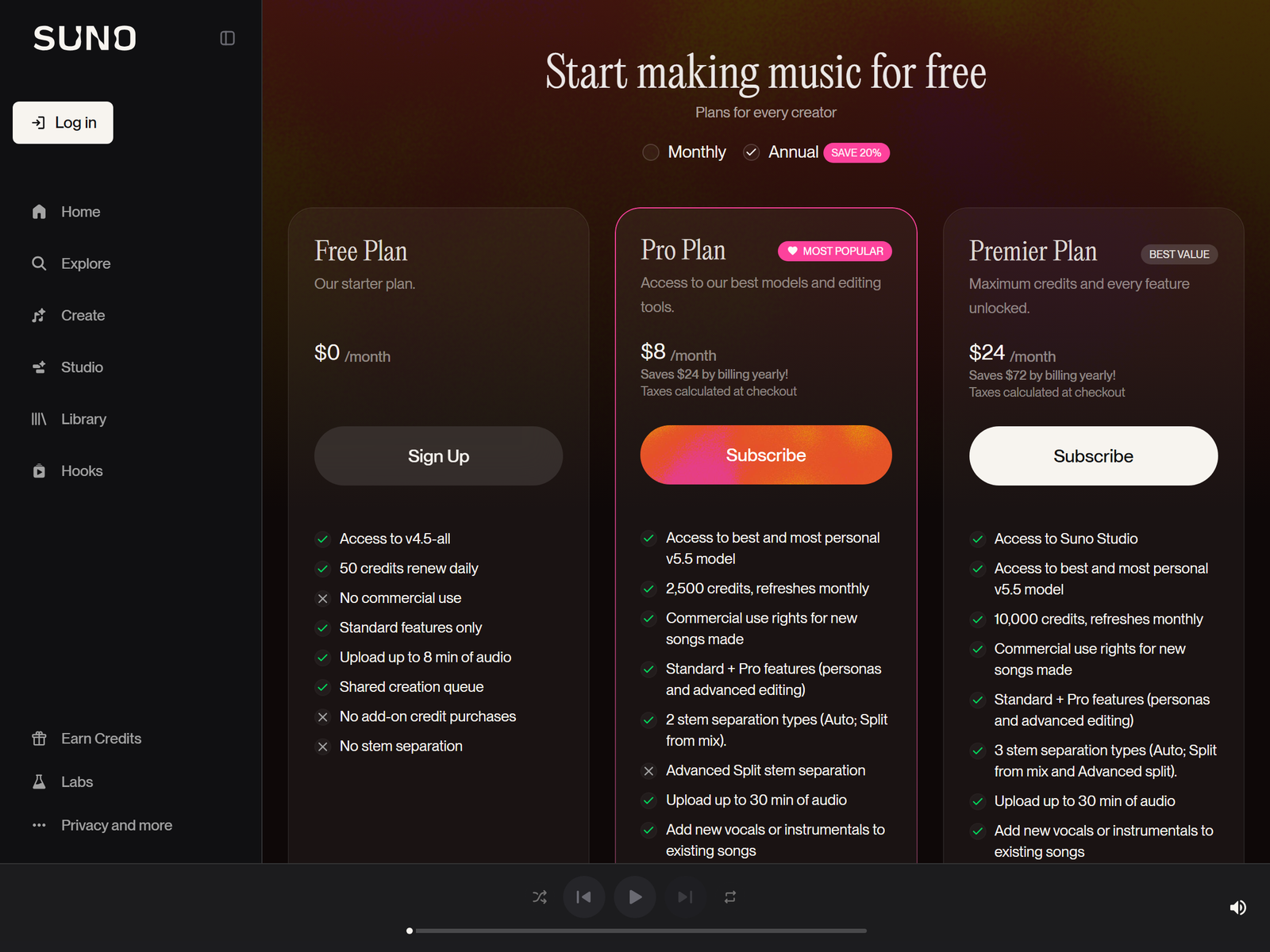
Suno's Free tier hands out 50 credits daily, about 10 songs, running the older v4.5-all model. It also carries personal, non-commercial rights only. Selling a free-tier track is the single fastest way to blow up this business, so read that line twice before you list anything.
Pro costs $10 monthly or $8 when billed yearly. It unlocks v5.5, 2,500 monthly credits, commercial use rights for songs created while subscribed, stem splitting into up to 12 vocal and instrument tracks, 30-minute audio uploads, personas, and a priority queue with 10 concurrent generations. Premier at $30 monthly ($24 annual) adds 10,000 credits and Suno Studio, a multitrack editor with MIDI export.
| Plan | Price | Credits | Songs | Commercial rights | Stems |
|---|---|---|---|---|---|
| Free | $0 | 50 daily | ~10/day | No | No |
| Pro | $10/mo ($8 annual) | 2,500/mo | ~500 | Yes | Up to 12 |
| Premier | $30/mo ($24 annual) | 10,000/mo | ~2,000 | Yes | Up to 12 + Studio |
One detail people miss: rights are not retroactive. Songs generated on Free stay non-commercial forever, even after you upgrade. Rights on paid songs survive cancellation, so a track you sold in March is still yours to license in December. Credits do not roll over on any tier.
Three Buyers Who Pay, Ranked by How Fast They Close
The personalized gift market closes fastest. Anniversary songs, proposal songs, birthday tracks for a parent, and pet memorial songs sell on Fiverr and Etsy at $35 to $150 depending on whether you include a lyric video. These buyers are emotional, decide in a day, and rarely negotiate. Volume peaks between April and October for weddings and again in December.
Small-business jingles are the second tier. A dental clinic, a food truck, or a local gym will pay $150 to $400 for a 30-second radio and social jingle with two revisions and stems delivered. Close rates are lower but the ticket triples.
Podcast and YouTube intro themes are the quiet money. Creators need a 15-second sting, a full-length theme, and an outro, and they need them once. Bundle all three at $120 to $250. Then upsell a seasonal refresh.
A part-timer taking 10 to 20 orders monthly lands at $400 to $1,500. Add two jingle clients and a wedding-season surge and $2,500 to $4,000 is achievable, though it stops being passive at that point because revisions eat the evenings.
How to Run an Order Without Burning Your Rating
- Intake form, not a chat. Ask for names, relationship, three specific shared memories, the recipient's favourite genre, and a reference artist. Vague briefs produce generic songs and refund requests.
- Write lyrics first, separately. Draft the lyrics yourself or with a text model, get client approval on the words before you generate audio. This kills 80% of revisions.
- Generate in Custom mode. Paste approved lyrics, add structure tags like [Verse] and [Chorus], and be specific in the style prompt about instruments, tempo, and vocal character. "Close-mic female vocal, warm low end, 96 BPM, acoustic folk" beats "a nice happy song."
- Deliver three takes, not one. Each generation returns two versions. Send the client a shortlist and let them pick. Choice feels like service and costs you nothing.
- Package the delivery. Final WAV, an MP3, the lyric sheet as a PDF, and stems for anyone paying over $100. Presentation is what separates a $40 seller from a $150 seller.
Pitfalls That Actually Cost Money
- Name pronunciation. Unusual names get mangled by the vocal model. Spell them phonetically in the lyrics and regenerate until it lands.
- Genre drift. Long prompts wander. Keep the style prompt under about 20 words and control structure with tags instead.
- Over-promising a specific artist sound. Do not accept briefs asking for a named singer's voice. Describe the style, never the person.
- Silent AI use. State on your listing that songs are AI-produced with human-written lyrics and human curation. Buyers who care will self-select out, and platform disputes disappear.
- Credit planning. Credits reset each cycle without rolling over, so front-load heavy iteration early in the month.
Key Takeaways
- Pro at $10 is the floor for any paid work; Free-tier output has no commercial rights.
- Approve lyrics before generating audio to cut revision rounds sharply.
- Stems and a lyric-sheet PDF justify a $150 price where a bare MP3 justifies $40.
- Gift songs close fastest, jingles pay best per hour, intro themes bundle well.
Frequently Asked Questions
Can I legally sell songs made with Suno? Yes, for tracks generated while on a paid Pro or Premier subscription. Those commercial rights persist after you cancel. Anything made on the free tier stays personal-use only.
Do I need music theory or a DAW? No for gift songs. For jingle clients who ask for tempo edits or a shorter cut, Premier's Studio with multitrack editing and MIDI export covers it, or you can hand stems to a freelance mixer.
How long does one order take? Around 45 to 90 minutes end to end, and most of that is lyric writing and client back-and-forth, not generation.
Will Spotify or YouTube block AI music? Distribution platforms increasingly require AI disclosure. For client work this rarely matters because the song is used privately or in the client's own marketing, but tell buyers who plan to distribute commercially to check their distributor's policy.
What should I charge as a beginner? Start at $35 with a two-revision cap, raise to $75 after 10 five-star reviews, then to $125 with stems included. Do not start at $15; cheap buyers demand the most revisions.
My Take: The Bottom Line
Suno is the rare tool where the unit economics are almost silly. Twenty iterations on one order costs about 100 credits, which is roughly 40 cents of a $10 subscription, and you sell the result for $75. The scarce resource is not the tool, it is taste and the willingness to write decent lyrics about a stranger's grandmother.
The honest risk is commoditisation. Every month more sellers list AI song gigs, and the floor price drifts down. My view is that the defensible version of this business is not "custom song" but a narrow niche done well: wedding-only, or Portuguese-language gift songs, or jingles for one trade like dental clinics. Narrow listings rank better, attract fewer price shoppers, and let you reuse prompt structures that already work. If you want to size up Suno against other music generators before paying, the tool page at https://aifreetool.site/tool/suno-text-prompt-music-generation-with-real-vocals/ lays out the current feature set.