Mysterium VPN Review 2026 - Residential Exit IPs, Unpredictable Speeds, and the Basic Plan Catch
Category: Best Privacy VPN
Reviewed by the aifreetool Security & Privacy Editorial Team — a group of full-time VPN users and writers who cross-check every vendor claim against independent lab testing and primary documentation.
Last updated August 12, 2026.
We keep no affiliate relationship with any VPN reviewed here and earn nothing if you subscribe. Where we could not verify a claim from primary sources, we say so explicitly.
TL;DR – The 30-Second Verdict
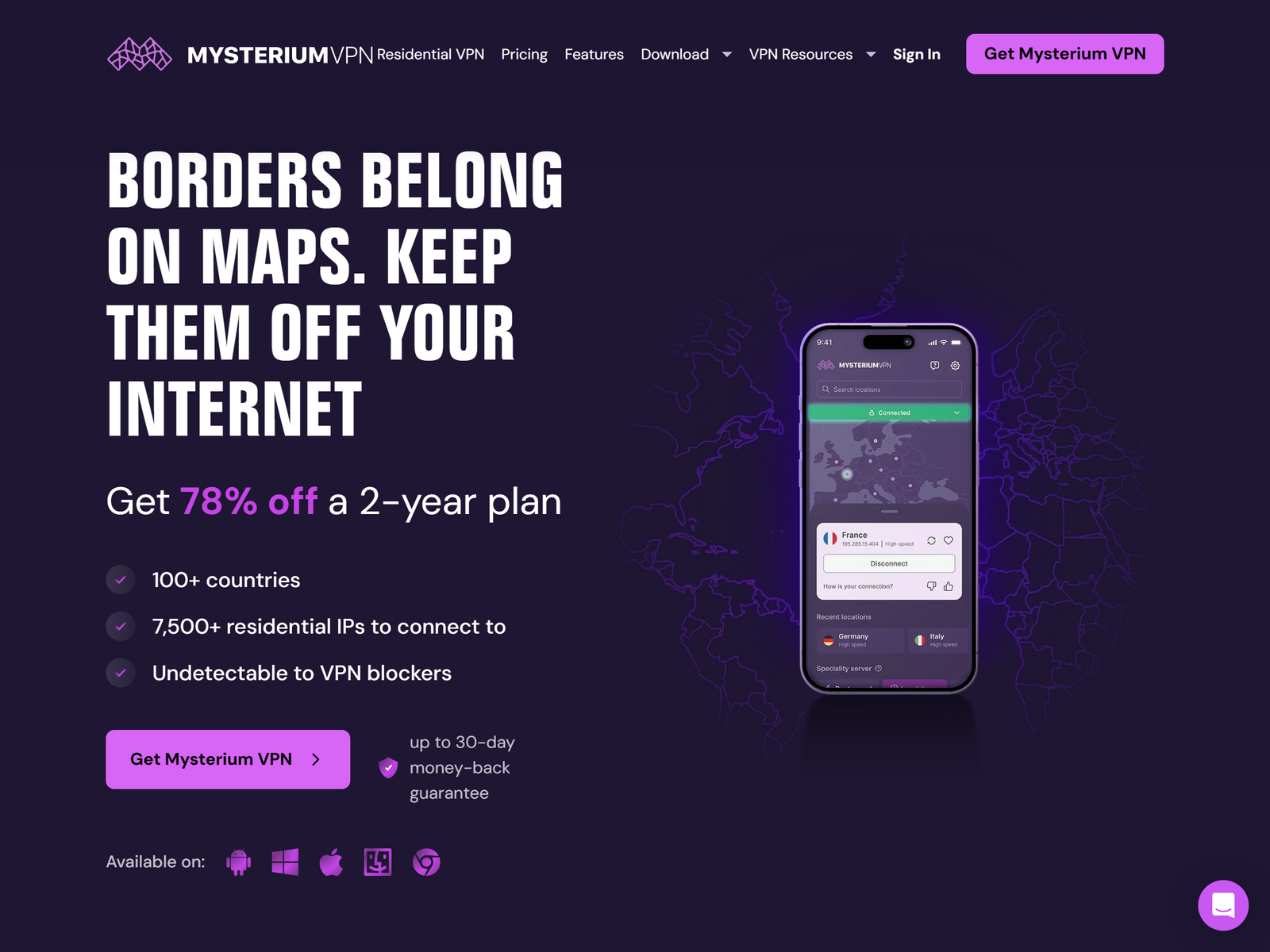
Mysterium VPN sends your traffic out through a decentralized pool of home broadband lines, so the exit point is a residential IP belonging to a real household instead of a rented data-centre block. That single design decision drives everything else in this Mysterium review: fewer “you appear to be on a proxy” walls, and throughput that stays unpredictable because every node's upload capacity belongs to a stranger. Our verdict: a reasonable pick for privacy-first readers who care how their exit IP gets classified, and a poor one if you need steady bandwidth at 9pm on a Friday. Read the tier table before paying, though — the cheapest plan leaves the residential pool out completely.
How We Tested Mysterium VPN
Our routine for community-powered networks differs from the one we use on server-based providers, because there is no fixed infrastructure to benchmark. We ran the Windows and Android clients on a 500 Mbps fibre line, cycling through nodes in the United States, Germany, Japan and Brazil across morning, evening and late-night windows. Each session followed the same checklist:
- Connect, hold the tunnel for 20 minutes, watch for silent drops.
- Run DNS and WebRTC leak checks on every new node.
- Force a disconnect to confirm the kill switch actually severs traffic.
- Reconnect to the same country flag hours later and compare behaviour.
We deliberately publish no invented megabit figures for a network whose capacity shifts hour to hour. A number measured on a Tuesday node tells you close to nothing about Thursday. Pricing and feature limits quoted below come from the vendor's own checkout page as displayed in August 2026.
Speed and Performance: Unpredictable by Design
A conventional provider rents machines with committed uplinks and can promise a floor. Mysterium buys nothing of the sort. Exit capacity is contributed by node operators who are paid to share a slice of their home connection, which means the ceiling on any given hop is whatever that household's ISP plan allows minus whatever the household is doing right now. Same flag, same app, wildly different experience.
Density helps. Nodes in Germany, the United States and the United Kingdom behaved far more consistently than the long tail of thinly covered countries, where we sometimes cycled through three or four operators before landing on one that held. Latency also runs higher than a data-centre tunnel, since residential uplinks are asymmetric and rarely sit near a major internet exchange. For browsing, messaging, email and casual video this barely registers. For a 4K stream or a ranked match, it does.
Security and Privacy: Open Source, No Published Audit
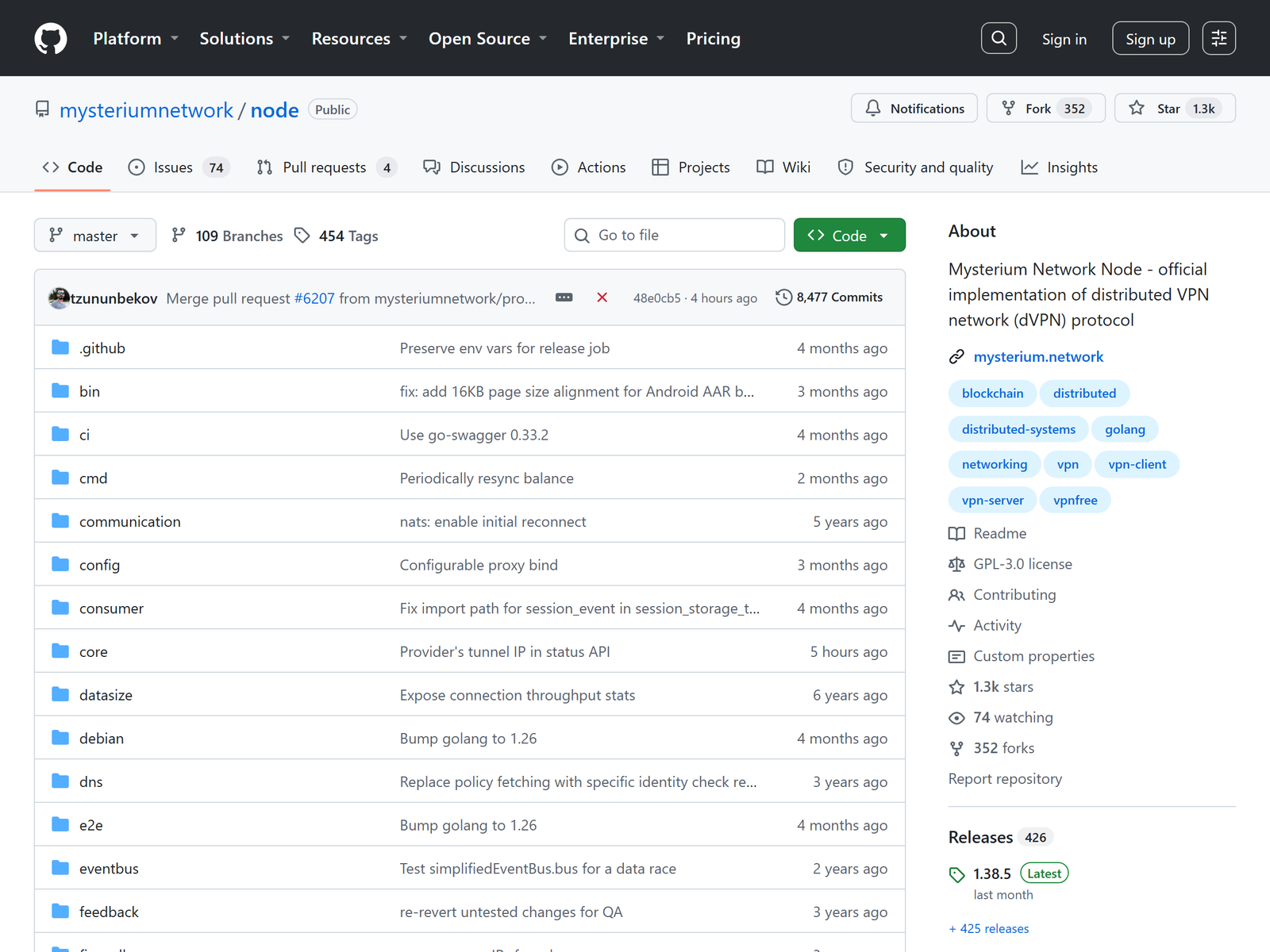
WireGuard is the default protocol, with a kill switch and DNS leak protection on the desktop and mobile builds. The company behind the network is registered in Zug, Switzerland — outside the Five Eyes intelligence-sharing arrangement — with engineering historically run from Lithuania, and the node software has been public on GitHub since the project started in 2017. Open code is a genuine advantage over closed clients you have to take on faith.
The no-logs question deserves the usual discipline. Mysterium markets itself as keeping no activity records, and its distributed shape does remove one classic failure mode: there is no central server farm to subpoena. We found no published third-party audit of that claim, so file it as claimed-but-unverified, and note that the company's own privacy policy discloses collection of some connection metadata — which softens the “no logs whatsoever” line in its advertising. The honest framing for a residential mesh is distributed trust, not zero trust: your packets leave through hardware owned by someone who was paid to route them. If a formally audited no-logs position matters more to you than IP classification, the audited providers we cover on aifreetool.site are the safer lane — IVPN being the obvious comparison point.
Streaming and Unblocking
Residential exit IPs are the whole reason people try this service for streaming. Platforms that reject entire data-centre ranges have a harder time flagging a connection that looks like a family in Ohio. In practice the results were inconsistent rather than magical: node churn means the address that worked last night may be offline today, and there are no streaming-optimised pools to fall back on. If one specific catalogue is your priority, a provider with maintained unblocking infrastructure remains the steadier buy. Mysterium's own marketing also runs broader access claims that we do not evaluate here; this review stays on privacy protection, public Wi-Fi safety and tracking resistance.
Device Compatibility
Clients cover Windows, macOS, Linux, Android and iOS. Simultaneous connections scale with the tier rather than being uncapped: six devices on Basic, ten on Plus, fifteen on Pro. There is no first-party router firmware, so whole-home coverage means installing per device — a real limitation for smart TVs and consoles. A separate application lets you run a node yourself and earn from shared bandwidth, which is how the supply side of the network gets fed.
Pricing and Value: The Basic Plan Catch
| Plan | Monthly | 1-Year | 2-Year | Devices | Residential IPs |
|---|---|---|---|---|---|
| Basic | $10.49/mo | $3.69/mo ($44.28/yr) | $2.59/mo ($62.16) | 6 | No — 57 countries only |
| Plus | $13.49/mo | $4.29/mo ($51.48/yr) | $2.99/mo ($71.76) | 10 | Yes — 7,500+ IPs, 100+ countries |
| Pro | $18.49/mo | $6.99/mo ($83.88/yr) | $4.79/mo ($114.96) | 15 | Yes, plus malware blocker |
Here is the catch buried in that grid. The advertised $2.59 entry point is the Basic two-year tier, and Basic ships without the residential pool, without city-level selection and with 57 countries rather than 100+. In other words, the cheapest plan strips out the feature the brand is known for. The tier that delivers the actual proposition is Plus at $2.99 per month on a two-year commitment, billed as $71.76 up front, or $4.29 per month annually. Refund windows differ too: seven days on monthly and annual plans, thirty days only on the two-year options. Pay month to month and you are looking at $10.49 to $18.49 for variable performance, which is premium money for a service that cannot promise a speed floor. Crypto payment is accepted at checkout, and the underlying network settles operator payouts in its own MYST token — a familiar pattern for anyone who has used token-funded services such as CryptoStorm.
Pros and Cons
- Pro: Real residential exit IPs that sidestep blanket data-centre blocklists.
- Pro: Open-source node software and a Swiss corporate base.
- Pro: Up to 15 devices and crypto payment on every tier.
- Pro: No single server estate that one legal order can compromise.
- Con: Speeds swing with whichever household you land on.
- Con: No published independent audit of the no-logs claim.
- Con: Basic tier omits residential IPs while carrying the headline price.
- Con: Seven-day refund window on anything shorter than two years.
Mysterium VPN vs NymVPN vs IVPN
| Criterion | Mysterium VPN | NymVPN | IVPN |
|---|---|---|---|
| Network model | Peer-to-peer residential nodes | Mixnet plus dVPN modes | Operator-run server estate |
| Exit IP type | Residential | Data centre | Data centre |
| Payment | Subscription, crypto accepted | Subscription, crypto accepted | Subscription, cash and crypto |
| Independent audit | None published | Public protocol research | Published third-party audits |
| Speed consistency | Low — node dependent | Medium, mode dependent | High |
| Best suited to | Looking like a home user | Metadata-level privacy | Audited, predictable privacy |
The three solve different problems. NymVPN attacks traffic-analysis metadata with a mixnet; IVPN sells verified, boringly reliable engineering; Mysterium sells the classification of your exit address. Only one of those is about how websites categorise you, and that is the reason to shortlist it.
Frequently Asked Questions
Is Mysterium VPN safe to use?
The tunnel uses WireGuard encryption, so node operators handle encrypted bytes rather than readable page content. The residual risk sits in the trust model: you are routing through consumer hardware run by strangers rather than racks the provider controls.
Does Mysterium VPN keep logs?
The company advertises a no-logs stance and there is no central point where session records would naturally accumulate. No independent auditor has verified this publicly, and the privacy policy admits to some connection metadata, so treat the claim as unverified.
Why does the speed change so much?
Because capacity comes from household broadband rather than provisioned servers. Whatever the node operator's family is streaming competes with your traffic in real time.
Is the $2.59 two-year plan worth buying?
Only if you want a cheap general-purpose tunnel. That tier excludes residential IPs, so it removes the reason to choose this provider over a conventional budget service. Plus at $2.99 per month on the same term is the sensible floor.
Can I earn money running a node?
Yes. Operators install separate node software, share bandwidth and receive MYST token payouts. Check your ISP terms first, since some home contracts forbid resale of connectivity.
My Take – The Bottom Line
Mysterium is one of the few consumer services where the architecture, rather than the marketing, is the product. Residential exit IPs genuinely change how sites treat you, and the open-source node stack plus a Swiss registration gives the privacy story more substance than most budget brands manage. The costs are equally real: variance you cannot plan around, an unaudited logging claim, and a pricing grid whose cheapest line quietly withholds the headline feature. I would put it on a shortlist for a second, privacy-oriented connection rather than as the tunnel that carries your whole household. Buy the Plus tier or skip it, and compare against the audited options in our Best Privacy VPN archive before committing to two years.