How to Make Money Selling Royalty-Free Music With Mubert in 2026
Category: Monetization Guide
Reviewed by the aifreetool.site editorial team. We do not earn commissions from Mubert or any tool in this guide — it is an independent walkthrough.
Quick answer
In 2026, you can make money selling royalty-free music with Mubert by scoring client videos, podcasts, and ads, or by embedding its generative engine into apps and games through the API. A $39/mo Pro plan covers commercial client work, and a steady roster of five to ten creators can earn you $300–$1,800/mo with almost no per-track cost.
What Mubert is (and the plan you would use)
Mubert is a generative music engine. You describe a mood, genre, and duration, and it returns a royalty-free track trained on its own dataset. Unlike song tools such as Suno, Mubert produces instrumental, loopable background music — up to 25 minutes long — with clear commercial licensing per plan. That makes it built for content, not for topping the charts.
The plan you would run your service on:
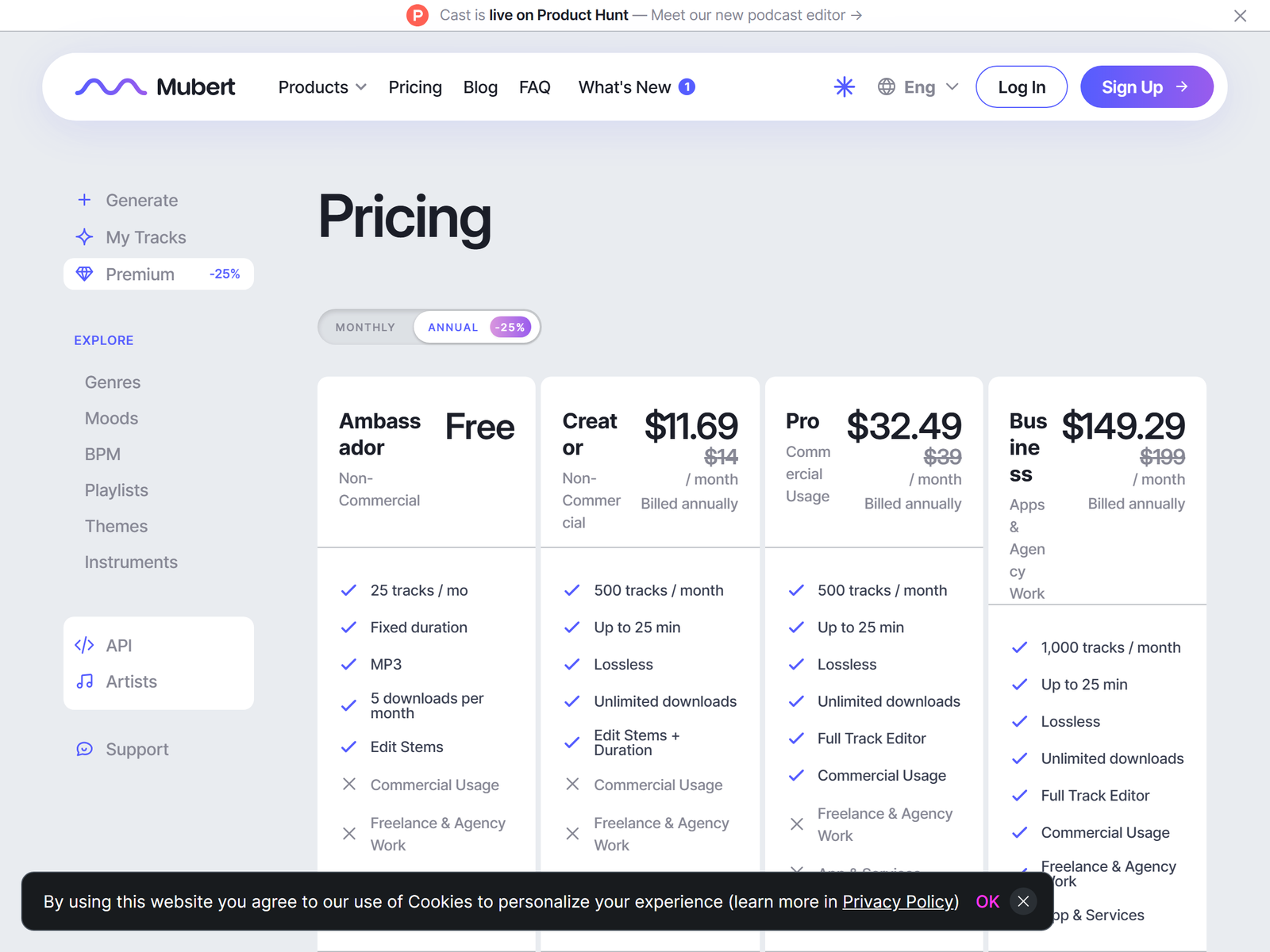
| Plan | Price (annual) | Tracks / mo | License |
|---|---|---|---|
| Ambassador (Free) | $0 | 25 | Personal, non-commercial, attribution required |
| Creator | $11.69 / mo | 500 | Social media, podcasts, NFT |
| Pro | $32.49 / mo | 500 | Ads, TV, radio, client work + full editor |
| Business | $149.29 / mo | 1,000 | Apps, games, agency, API access |
For client scoring you need Pro at minimum because Creator is non-commercial. Business matters only if you ship music inside a product via the API.
The monetization idea: a background-music desk
The offer is “custom, copyright-safe background music for your content.” Most creators hate hunting stock libraries and worrying about claims. You remove that fear.
Three ways to package it:
- Per-project scoring ($25–$120 per video): deliver 2–3 matched tracks with a license certificate.
- Monthly retainer ($100–$400): a YouTuber or podcaster gets a fresh batch of intros, outros, and loopable beds each month.
- API integration ($500–$2,000 build): embed adaptive Mubert music into a client’s app, game, or livestream so audio changes with user actions.
Realistic income: ten creators at $80/mo is $800/mo, and your only hard cost is the $32.49 Pro subscription because each track is effectively free to generate. The API path is slower to land but bills $1,500+ per integration.
Your step-by-step action plan
- Pick a lane. Gaming streamers, meditation channels, and e-commerce ads all need different moods. Specialize so your portfolio looks intentional.
- Generate a demo reel. Make ten 30-second samples across genres and post them as a public playlist.
- Set up the workspace. Use the Pro Track Editor to fix duration, BPM, and structure so tracks fit client specs exactly.
- Find clients. Pitch small YouTubers directly, join creator Discords, or list “royalty-free music” in the Fiverr music category.
- Deliver with certificates. Mubert issues a license certificate per track. Send it with every file so clients never fear a Content ID strike.
Client and quality management
Be clear about what Mubert is and is not. It is background music, not a vocal song, and tracks cannot be registered in Content ID or sold as standalone music. Say so upfront.
- Do: deliver WAV for ads, offer loopable beds for long streams, and keep a certificate on file for every paid track.
- Don’t: promise “hit songs,” upload Mubert tracks to Spotify as your own, or skip the license tier a client’s use requires.
Pro tips and pitfalls to avoid
- Use Image to Music and mood prompts to match a client’s brand color and pace instead of guessing.
- Batch generate, then curate. Generating 20 options and picking 3 reads as taste, which is what clients pay for.
- For streams, lean on loopable 25-minute renders so the audio never obviously repeats.
- Keep the Business plan in reserve only if an integration client appears; do not pay for it idle.
Who this is and isn’t for
For: producers, editors, and anyone comfortable in a music tool who wants a near-zero marginal cost product to resell.
Not for: people who want to “make songs.” If vocals and verses matter, a different engine fits better, and you can compare approaches in our guide to selling AI music with Soundraw.
My Take / The Bottom Line
Mubert’s edge is the license clarity and the near-zero cost per track. Once you are on Pro, every extra client is almost pure margin, which is rare in creative services. The work is curation, not composition — and curation scales. Pair it with voice work from our Murf voiceover guide to sell a full audio package. Start on the Mubert pricing page and read our Mubert tool breakdown on aifreetool.site, then explore the Monetization Guide hub.
FAQ
Can I really use Mubert music commercially?
Yes, on paid plans. Pro covers client work, ads, and broadcasts; Creator is limited to social and podcast use without attribution.
Why not just use the free tier for clients?
The free Ambassador plan is personal and non-commercial, and it requires attribution. Charging a client for it breaks the license.
How is Mubert different from Suno or Udio?
Those generate vocal songs; Mubert generates instrumental background beds you can loop for hours. Different job, different license.
Is the API worth it for a solo operator?
Only if you land a client building an app or game. For content scoring, the Pro web app is enough.
What should I charge first?
A $25–$60 per-video starter rate builds a portfolio fast; move steady creators to a $100–$300/mo retainer once they reorder.