How to Make Money Restyling Real Estate Photos With AI Home Design
Category: Monetization Guide
Reviewed by the aifreetool Editorial Team — a group of full-time AI-tool researchers and writers who verify every product claim against primary sources and independent testing.
Last updated August 12, 2026.
We keep no affiliate relationship with the products covered here and earn nothing if you click through. Where a claim could not be verified, we say so.
You can make money restyling real estate photos with AI Home Design at $20 to $45 an image, on work that costs you roughly 15 cents to generate. Estate agents, landlords and short-let hosts all want the same thing before a listing goes live: a believable picture of what a tired room looks like after a refresh. The tool rebuilds a room from one uploaded photo in about 20 seconds while keeping the walls, windows and layout intact, which is the difference between a useful sales asset and an obvious fake.
What AI Home Design Does, and What It Does Not
Upload a JPEG, PNG or WebP up to 30MB, choose a room type and a style, and the platform returns a redesigned version of that same space. Styles on offer include Japanese Zen, Scandinavian, Modern Minimalist, Industrial, Mid-Century Modern and Bohemian, with a custom-style field for anything else. Each redesign consumes 10 credits and takes roughly 20 seconds.
Three extras matter commercially. There is an 8-second cinematic video walkthrough, a 360-degree panoramic tour generated from the design, and furniture recognition that identifies each piece and links it to a matching Amazon product. That last feature turns a pretty picture into a shopping list, which is exactly what a landlord planning a refurbishment wants.
Be clear about the boundary. This is a restyling engine that works from an existing room, not a vacant-property stager. Point it at a completely empty shell and the results get inconsistent, because the model has less structure to hold onto. Sell it as renovation preview and style conversion, and the output holds up. Sell it as empty-room staging and you will be redoing jobs for free.
The Margin: What It Costs You and What You Charge

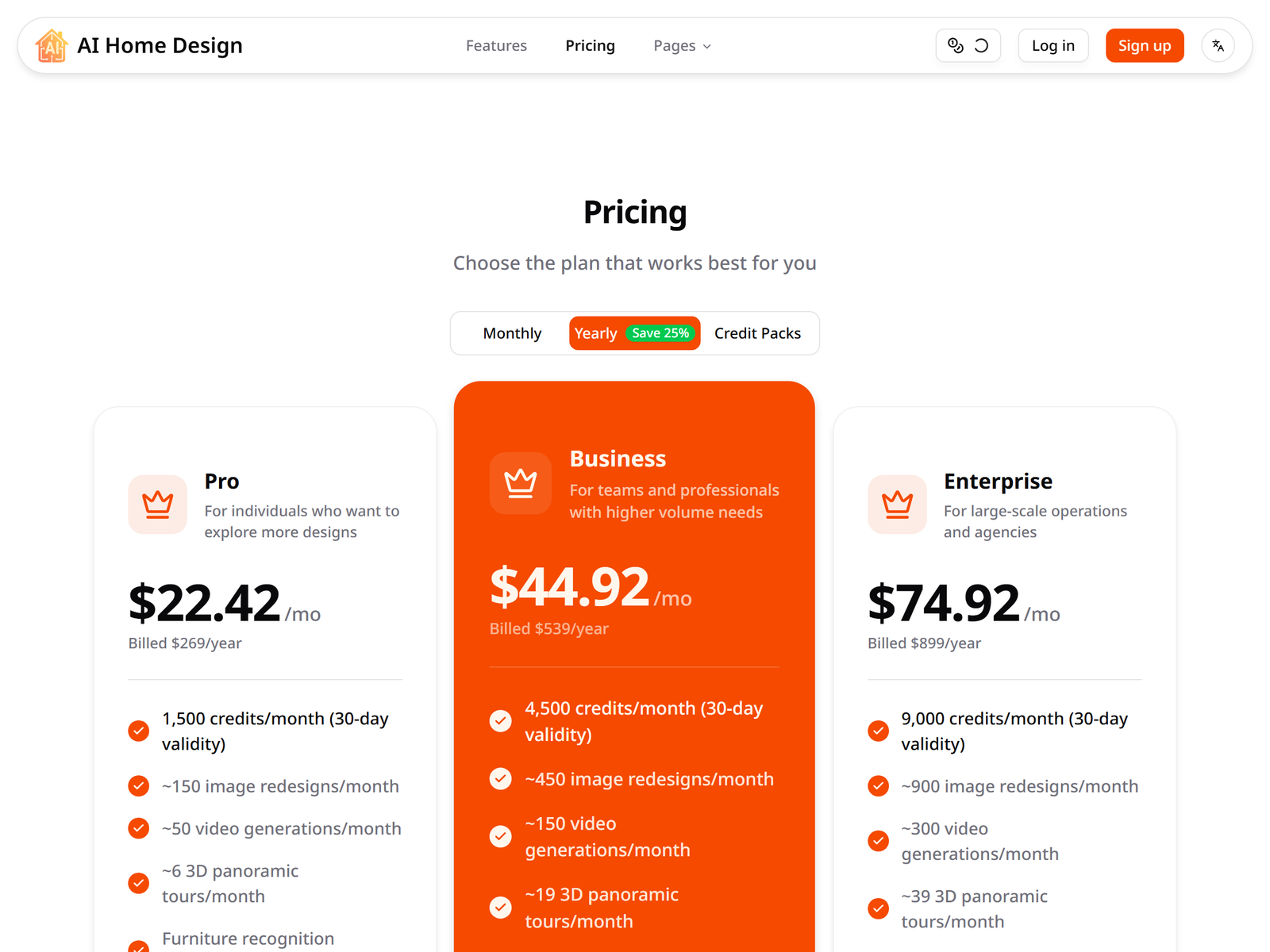
| Plan | Price | Monthly credits | Cost per image |
|---|---|---|---|
| Pro | $22.42/mo, billed $269 yearly | 1,500 credits, about 150 redesigns | about $0.15 |
| Business | $44.92/mo, billed $539 yearly | 4,500 credits, about 450 redesigns | about $0.10 |
| Enterprise | $74.92/mo, billed $899 yearly | 9,000 credits, about 900 redesigns | about $0.08 |
Video generation runs about $0.45 a clip on Pro and a 3D panorama about $3.44. Against that, a reasonable rate card looks like this:
- Single restyled image: $20 to $45, depending on turnaround.
- Listing pack of 6 to 8 rooms: $120 to $250.
- 8-second video walkthrough add-on: $35 to $60.
- 360-degree panoramic tour: $90 to $150.
- Renovation concept board with the Amazon shopping list: $150 to $300 for a landlord or short-let host.
Five to eight regular agents at two listings a month each puts you between $500 and $1,500 a month part time. Partner with one property photographer who already shoots forty listings a month and offers your restyling as an upsell, and $2,500 becomes realistic without any cold outreach at all. The 30-day credit expiry means the Pro plan only makes sense once you are shipping 30 or more images a month, so start on the smallest tier and upgrade when a photographer relationship lands.
Building the Service From Scratch, Step by Step
- Collect twelve dated interior photos from expired public listings in your area, and restyle each one into two styles. That is 24 images and roughly $3.60 of credits.
- Build a before-and-after grid. This portfolio does more selling than any pitch, because the value is visual and obvious in one second.
- Pick one buyer type first. Letting agents want speed. Landlords want the shopping list. Short-let hosts want the video for their listing page. The pitch changes for each.
- Approach three property photographers before you approach any agent. They already own the client relationship and the source images, and a revenue split beats cold email.
- Set a 24-hour turnaround as standard and charge a premium for same-day. Agents work to listing deadlines, and reliability wins repeat work faster than price.
- Deliver a matched pair every time: the original and the restyled version, side by side, with a visible label on the altered image.
- Invoice per listing, not per image. It is simpler to approve and it stops the client cherry-picking two rooms out of eight.
Disclosure, Standards and Staying Out of Trouble
This is the part freelancers skip and later regret. Altered listing photography sits under advertising standards in most markets, and agents who publish a digitally restyled room without labelling it risk a complaint from a buyer who viewed the property expecting that kitchen. Every restyled image you hand over should carry a caption along the lines of "digitally restyled, for illustration only," and your invoice terms should say the client is responsible for complying with their local board and portal rules.
Two practical rules keep the work defensible. Never change anything structural: no removing walls, no adding windows, no widening a room. And never restyle a photo of a property you have no permission to use, even for a portfolio, unless the listing has expired and you have removed the address. Protecting the agent's licence is part of the service, and saying so in the first email makes you look like a professional rather than someone with a subscription.
Pitfalls That Waste Credits and Clients
- Ignoring the 30-day credit expiry. Unused credits on a monthly cycle are money burnt. Match the plan to actual volume.
- Feeding it bad source photos. Dark, cluttered, wide-angle-distorted shots produce bad output. Ask for the photographer's originals, not the portal's compressed versions.
- Over-styling. A Bohemian conversion of a 1970s bungalow amuses nobody. Match the style to the local market and the buyer profile.
- Charging per image on big jobs. Per-listing pricing protects the margin and simplifies approval.
- Skipping the label. One undisclosed image can end a relationship with an agency that sends you work every week.
FAQ: Making Money With AI Home Design
Is this the same as virtual staging?
Not quite. Virtual staging furnishes an empty room. This tool restyles a room that already has structure and usually furniture in it, keeping the layout while changing the look. There is overlap, but the reliable, sellable use is renovation preview rather than filling a bare shell.
How much do I need to spend before my first sale?
Under $25. One month on the smallest plan gives you enough credits for a 24-image portfolio and your first two paid jobs, with room to spare.
Can clients tell it was generated?
Sometimes, and that is fine as long as it is labelled. The images are marketing illustrations, not evidence. Problems only start when someone presents an altered photo as the current condition of the property.
Which client type pays best?
Landlords and short-let hosts planning an actual refurbishment, because the concept board plus the furniture shopping list saves them a designer's fee. Agents pay less per job but come back every few weeks.
Do I need design skills?
You need taste more than skills. Choosing which of six styles suits a two-bedroom terrace in a particular postcode is the judgement clients pay for. The software handles the rendering; you handle the choice and the quality control.
My Take: The Bottom Line
The economics here are hard to argue with. Fifteen cents in, twenty-five dollars out, on a deliverable that takes twenty seconds to produce and maybe five minutes to check and label. Very few AI services carry that spread, and the reason it survives is that property professionals value speed and consistency over craft, and they buy again every month.
The catch is that the moat is thin. Anyone can subscribe tomorrow, so the business is not the software. It is the photographer partnership, the 24-hour turnaround you actually hit, and the disclosure discipline that makes agencies comfortable putting your work on a public listing. Build those three things and the tool becomes a line item rather than the product.
Plans and per-image credit costs are listed on the official AI Home Design pricing page. Our own listing for the tool is at https://aifreetool.site/tool/ai-home-design-free-ai-interior-design-room-redesign-tool/ if you want the feature summary first.