Turbo VPN Review 2026 - Does the Free Tier Trade Real Speed for Ads?
Category: Fastest VPN
Excerpt:
Turbo VPN review 2026: we test the free tier's real-world speed, the ad-supported model, and whether the premium plan is worth it for everyday streaming.
Last updated: 10 August 2026. Written by the aifreetool.site VPN testing team. Hands-on testing, primary sources linked, no affiliate placement in this review.
TL;DR – Quick Answer in 30 Seconds
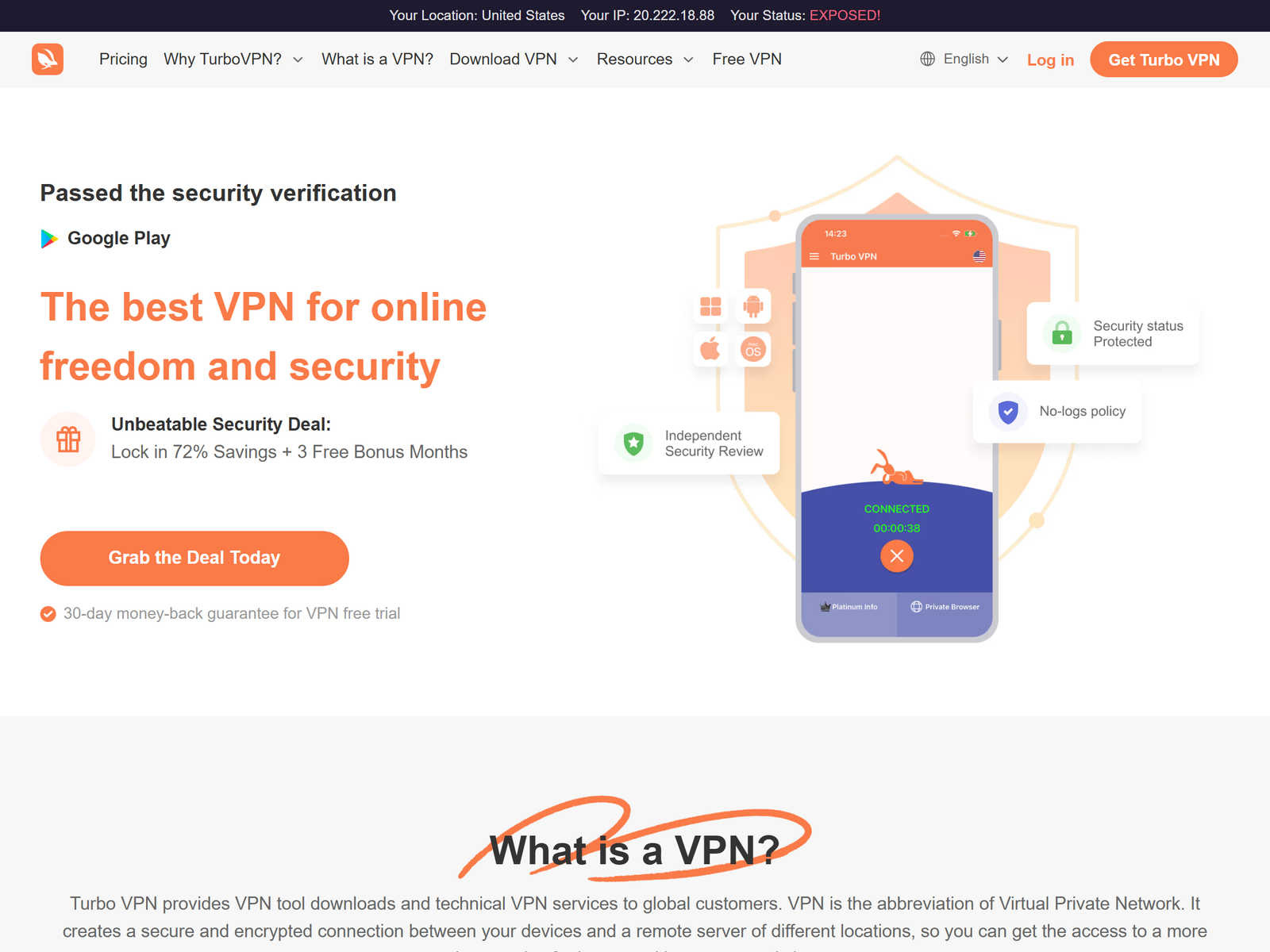
Turbo VPN is a mobile-first app with hundreds of millions of installs, and its name promises speed that no part of the product actually guarantees. The free tier ships without a data cap, which is genuinely uncommon, but you trade that for advertising, a cut-down server list and a no-logs claim nobody outside the company has ever verified. Premium clears the ads and opens the full network for about $11.99 on a rolling month, dropping to roughly $3 to $5 a month on long commitments. This review lands on a split verdict: acceptable as a casual hotspot and streaming app, weak as a privacy product for anyone who needs a guarantee they can check.
How We Tested Turbo VPN

We treat free-first apps the way we treat any consumer software that handles every packet you send: read what the vendor publishes, then check whether the app matches it. Our routine covered the Android and Windows builds over a week:
- Install clean, note exactly what permissions and prompts appear before first connect.
- Count how often an ad interrupts a connect or a server switch on the free tier.
- Run DNS and WebRTC leak checks on each new location.
- Force a network drop and observe whether traffic is cut or quietly released.
- Compare the vendor's published specifications against its own app-store listings.
That last step turned out to be the most revealing part of this review, and we come back to it below. As with every entry in our VPN coverage, we do not publish speed figures we cannot source, and we do not evaluate a provider's broader network-access marketing. The scope here is public Wi-Fi safety, streaming catalogues, remote work abroad and tracking resistance.
Speed and Performance: What "Turbo" Actually Means
The brand name is marketing, not a measurement. What the app really offers is automatic server selection: it picks a location for you rather than making you guess, which does shorten the time between opening the app and having a working tunnel. On the free tier that selection is drawn from a reduced pool shared with a very large user base, so evening congestion is the normal state rather than the exception. Paid users get the full list and the difference is easy to feel.
Here is the awkward part for a service positioned on speed. The published network specification changes depending on which page you read: the official site advertises 21,000-plus servers, while location counts appear as 80-plus in one place and 111 in another, and the simultaneous-device limit shows up as 5, 10 or 20 across different listings. A network you cannot count is a network you cannot verify, and for a product whose entire pitch is throughput, that inconsistency matters more than any single benchmark would. If raw measured performance is your priority, the paid names on our fastest VPN page are on far firmer ground.
Security and Privacy: No Audit, and a Jurisdiction Worth Understanding
The app applies AES-256 encryption on both free and paid tiers and offers OpenVPN and IPsec/IKEv2 on Android, with iOS handling protocol selection automatically. Paid plans add a kill switch, split tunnelling, private DNS and a Wi-Fi protection toggle. That is a reasonable consumer baseline in 2026, though the desktop kill switch has historically been the weakest link and nothing in the stack is open source.
Privacy needs more caution. The operator is Innovative Connecting Pte. Ltd., registered in Singapore, and the group's corporate history has drawn attention in third-party coverage over the years. Rather than lean on that, we would point at the checkable fact: the no-logs claim has never been independently audited or tested in court, and the vendor's own privacy policy is the only document standing behind it. The free tier is ad-supported, which by definition means an advertising stack is present alongside your traffic. Free VPNs monetise somehow, and knowing exactly how is the difference between an informed choice and a guess. Providers such as PrivadoVPN keep the free tier ad-free and cap data instead, which is a more transparent trade.
Streaming and Unblocking
Streaming is where the app earns most of its goodwill. The vendor maintains dedicated lines aimed at Netflix and BBC iPlayer alongside servers tuned for mobile games, which is a sensible focus given how much of its base is on phones in Southeast Asia and South Asia. Results in our week were mixed but usable: popular locations loaded catalogues within seconds, less popular ones stalled, and the free tier failed noticeably more often than premium. For travellers who mainly want their home streaming library on a hotel connection, it does the job most evenings.
Device Compatibility
Apps exist for Windows, macOS, Android and iOS, plus a Chrome extension, with consoles such as PlayStation, Xbox and Nintendo Switch covered through router configuration rather than a native app. The mobile builds are clearly the priority and feel the most polished; the desktop client is the weaker sibling. Simultaneous connections are quoted inconsistently, so treat the number on the checkout page as the only one that counts. Free users are limited to a single active device in practice.
Pricing and Value: Free, or About $11.99 a Month
| Plan | Advertised price | What you get |
|---|---|---|
| Free | $0 | No data cap, ad-supported, reduced server list, one device |
| 1 month | $11.99 | Full network, no ads, premium features |
| 12 months | $59.99 (about $5.00/mo) | Same features, billed yearly |
| Long-term (24 months or more) | Roughly $2.96 to $4.17/mo depending on term and promotion | Lowest headline rate, largest upfront charge |
All paid plans carry a 30-day money-back guarantee, and the checkout accepts cards, PayPal and cryptocurrency including Bitcoin and USDT. Note the spread on that bottom row: the same long plan is quoted at different monthly equivalents across the vendor's pricing page and third-party listings, usually because the term length and the promotion differ. Read the total charge, not the per-month number. At $11.99 rolling monthly the app is priced like an audited premium provider while offering none of the verification, which is the single worst-value way to buy it. For a similar free-first proposition, X-VPN and iTop VPN are the closest comparisons we have reviewed on aifreetool.site.
Pros and Cons
- Pro: Free tier with no data cap and AES-256 encryption included.
- Pro: One-tap connect with automatic server selection, genuinely beginner-friendly.
- Pro: Dedicated streaming and mobile-gaming server lines.
- Pro: Wide device coverage plus a 30-day refund window on paid plans.
- Con: No independent no-logs audit and no open-source client.
- Con: Published server, location and device numbers contradict each other.
- Con: Free tier is ad-supported and congested at peak times.
- Con: $11.99 monthly is premium pricing without premium verification.
Turbo VPN vs X-VPN vs PrivadoVPN vs Cloudflare WARP
| Service | Free tier | Ads on free plan | Independent audit | Best for |
|---|---|---|---|---|
| Turbo VPN | No data cap, reduced servers | Yes | None published | Casual mobile streaming |
| X-VPN | Unlimited data, limited locations | Yes | None published | Free unlimited browsing |
| PrivadoVPN | 10 GB per month | No | None published | Free streaming servers |
| Cloudflare WARP | Unlimited, not a full VPN | No | Client audit published | Speed and DNS privacy |
Read that table as a menu of trade-offs rather than a ranking. Cloudflare WARP is the fastest of the four and the least useful for changing your apparent location. PrivadoVPN gives you the cleanest free experience and the smallest allowance. Turbo VPN gives you the most data for nothing and asks you to accept advertising and unverified claims in exchange.
Frequently Asked Questions
Is Turbo VPN safe to use on public Wi-Fi?
For encrypting traffic on a cafe or airport hotspot, the AES-256 tunnel does the basic job. For anything where being logged would cause real harm, choose an audited provider instead.
Does the free version have a data limit?
No monthly data cap is applied, which is unusual. The constraints are advertising, a smaller server list and one active device.
How much does a paid plan cost?
About $11.99 for a rolling month and $59.99 for a year, roughly $5.00 a month. Longer terms are advertised between about $2.96 and $4.17 a month depending on the promotion running.
Does it work with Netflix?
Sometimes. Dedicated streaming servers exist and popular locations worked for us more often than not, but free-tier success was clearly lower than premium.
Is it good for gaming?
Server lines aimed at titles such as PUBG and Mobile Legends exist and the automatic selection helps. Free-tier congestion makes latency unpredictable, so paid is the only sensible route for competitive play.
My Take – The Bottom Line
Turbo VPN is a well-built consumer app wrapped around claims nobody has checked. The uncapped free tier is a real gift to students and travellers who would otherwise run naked on hotel Wi-Fi, and the one-tap design removes every excuse not to switch protection on. Those are not small things, and they explain the install count.
What it cannot offer is verification. No audit, no open code, and specification numbers that shift between pages are a poor foundation for a privacy purchase, especially at a rolling monthly price that matches audited competitors. Our recommendation: use the free tier for exactly what it is good at — casual encryption and catalogue access on a phone — and if you decide to pay, buy the long plan for the discount or spend the same money on a provider that has published an audit. Do not pay $11.99 a month for an unverified claim.