Riseup VPN Review 2026 - A Free Nonprofit VPN With No Accounts
Category: Best Privacy VPN
Excerpt:
Riseup VPN review 2026: a free, donation-funded nonprofit VPN with no account and a PGP warrant canary. We test its privacy model, real-world speed, and hard limits.
Last updated: 10 August 2026. Written by the aifreetool.site VPN testing team. Hands-on testing, primary sources linked, no affiliate placement in this review.
TL;DR – Quick Answer in 30 Seconds
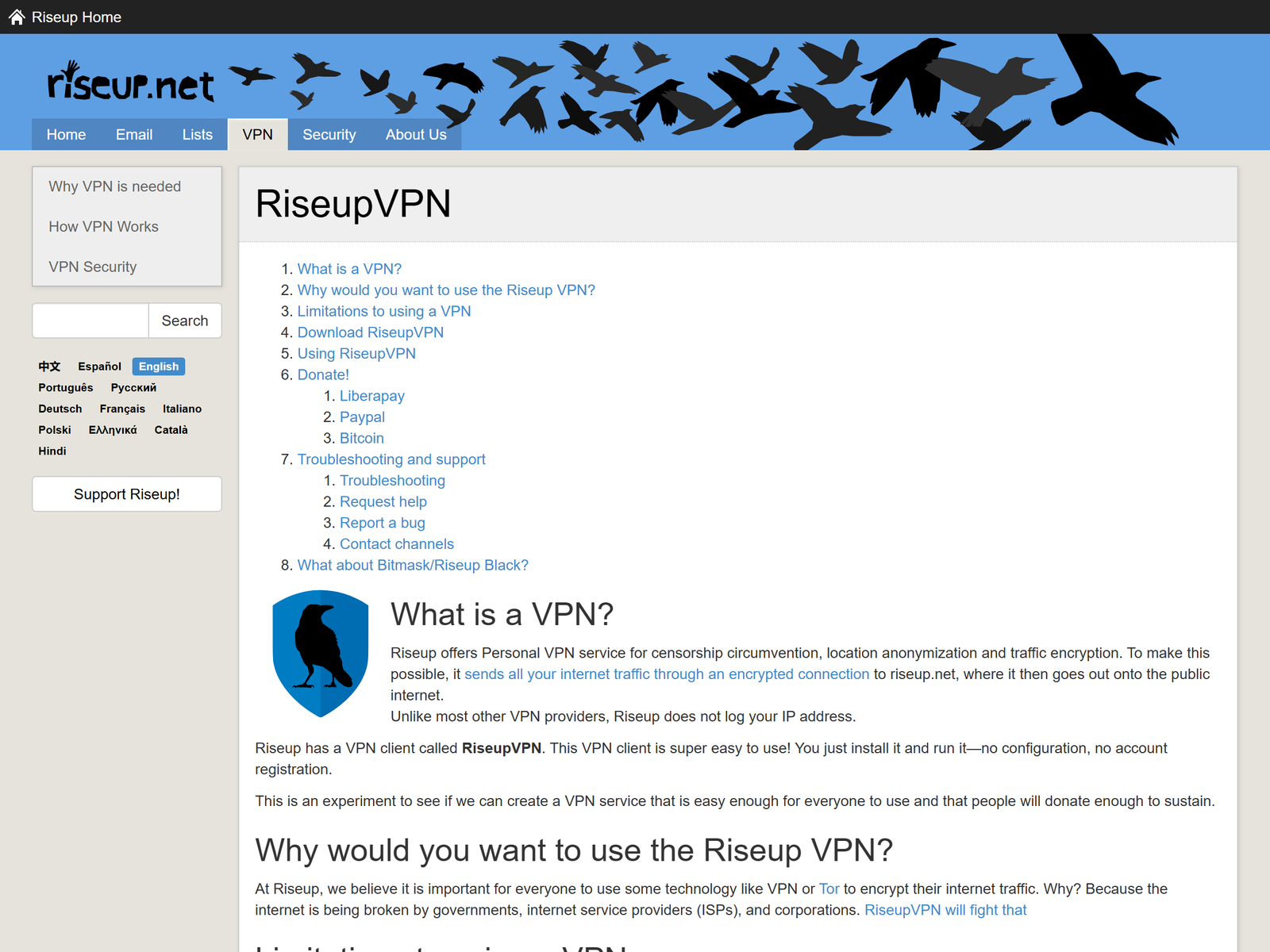
RiseupVPN is the rarest thing in this category: a client with no accounts, no checkout page and no customer record. It comes from Riseup, a Seattle tech collective that has been running communication infrastructure for organisers, researchers and journalists for more than 25 years, and the service is donation-funded rather than sold. You install it, you click a shield in the system tray, you are connected. No email address, no password, no subscription ID sitting next to your traffic. That nonprofit structure is the entire appeal — and it draws the limits too: gateway capacity is thin, there is no iPhone build, and the no-logs position has never been through a published third-party audit. Worth installing as a free privacy layer for hotel and cafe networks. Not worth installing if you want a streaming tunnel.
How We Tested RiseupVPN
Free tools funded by donations do not get graded on the same curve as a $70-a-year subscription, but they still have to do what they claim. We installed the Windows and Android builds, ran them for a week across a home fibre line and two public hotspots, and worked through a fixed checklist rather than a stopwatch:
- Hold the tunnel open for 30 minutes and watch for silent drops.
- Run DNS and WebRTC leak checks after each reconnect.
- Pull the connection deliberately and confirm what happens to traffic.
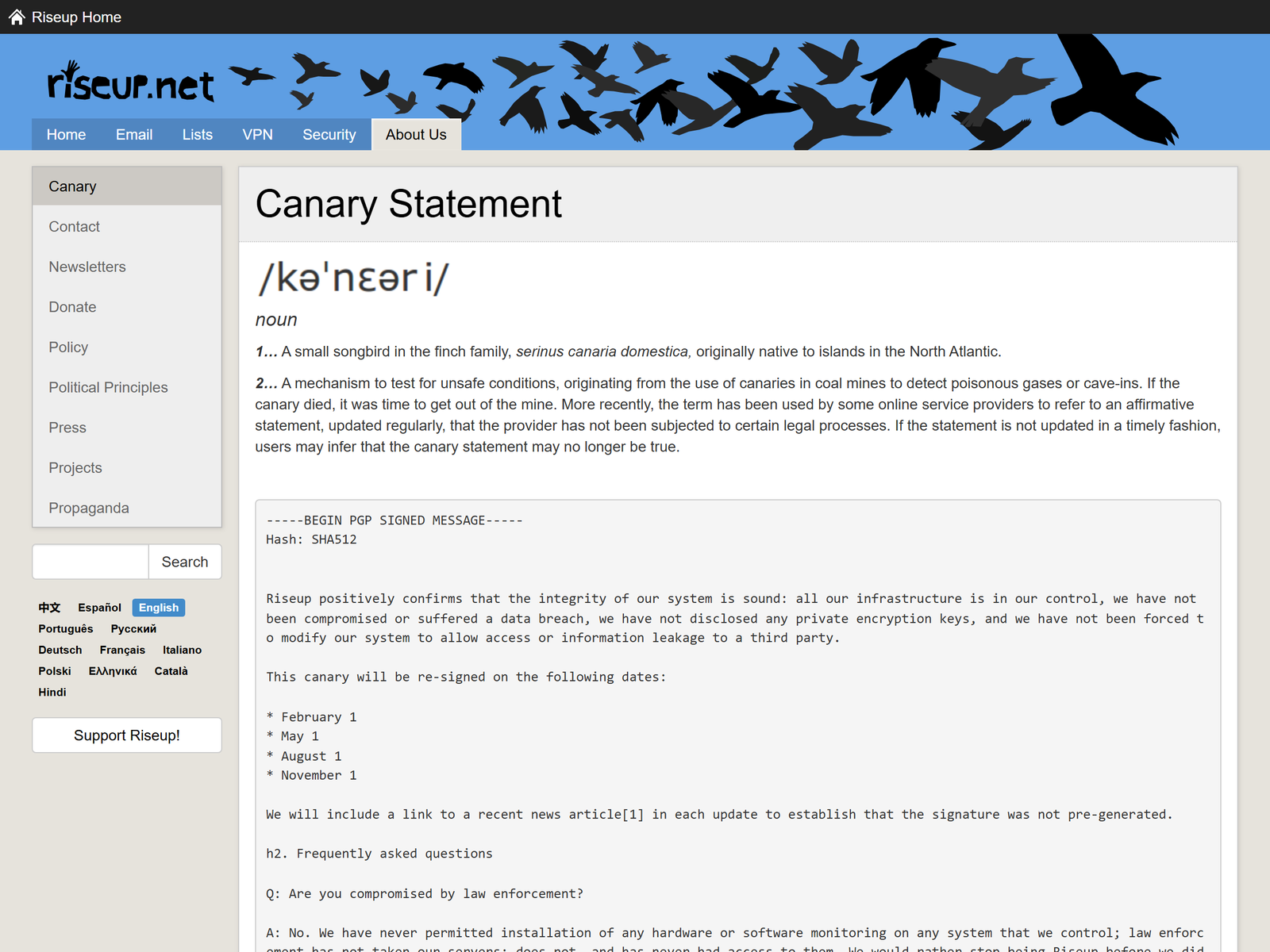
- Read the published warrant canary and check its signature date.
- Cross-check the client against its public source repository.
We publish no invented megabit figures here. Riseup runs a small donated gateway pool with no service-level commitment, so a throughput number measured on a Tuesday evening would tell you almost nothing about Thursday morning. Everything quoted below comes from Riseup's own VPN documentation as it stood in August 2026.
Speed and Performance: Donated Capacity, Not a Backbone
Commercial providers rent racks with committed uplinks and can therefore promise a floor. Riseup buys bandwidth with donations, and it says plainly on its own site that running the service costs roughly $60 per user per year. That figure explains the performance profile better than any benchmark would: the pool is sized by what people give, not by what marketing needs.
In practice, browsing, email, messaging and ordinary video calls held up fine. Large downloads and evening streaming were noticeably slower than a paid tunnel, and reconnects during peak hours sometimes took a few attempts. The client is deliberately minimal — connect, disconnect, and very little manual tuning — so there is no server picker to escape a congested gateway with. If you want granular control over exit locations, an advanced provider such as IVPN is a different class of product.
Security and Privacy: No Accounts, a Canary, and No Audit
The client is built on the Bitmask codebase from the LEAP Encryption Access Project, and the source is public rather than a binary you have to take on faith. Riseup states that it does not log IP addresses, and the structural design backs that up in one specific way most providers cannot match: since there is no registration, no username and no payment record, there is no identity file to correlate a session against in the first place. Riseup also retired its older Bitmask-based client, once branded Riseup Black, and folded its capabilities into RiseupVPN.
Two things deserve a sober read. First, Riseup operates from the United States, which means US legal process applies. The mitigation is a PGP-signed warrant canary; if that statement stops being refreshed, users are meant to treat the silence as the signal. A canary is a warning system, not immunity, and readers should weigh that honestly. Second, we found no published independent audit of the no-logs claim, so the accurate description is claims no-logs, unverified by third-party audit. Compare that with Mullvad, which has been audited repeatedly and still charges a flat monthly rate.
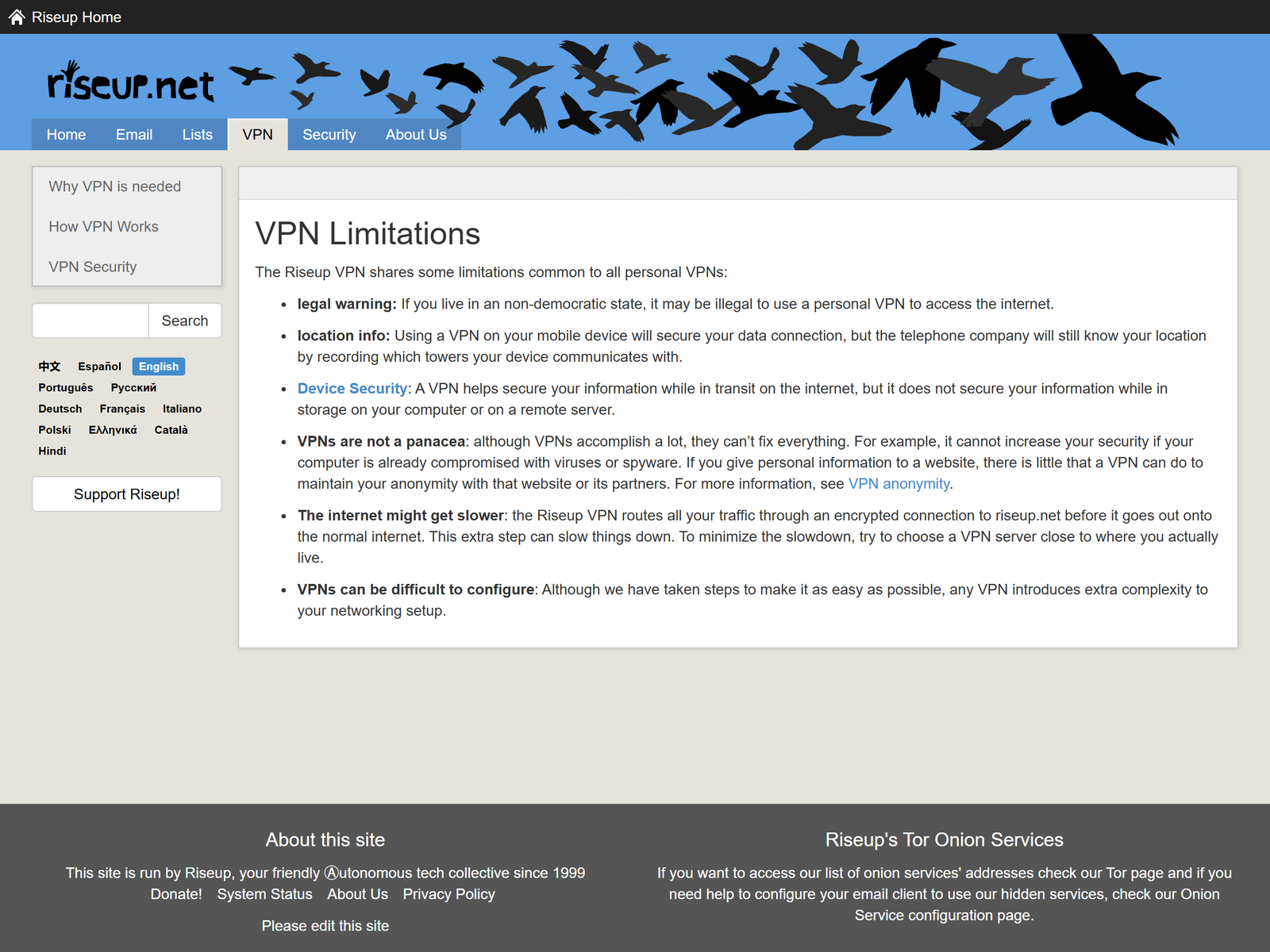
One detail we liked: the desktop tray has a state where the VPN is off and all traffic is blocked, which is fail-closed behaviour rather than quietly leaking to the open network. Riseup also maintains a page listing what a VPN does not protect you from. Publishing your own limitations is unusual candour in a market built on absolute claims, and it is the sort of thing we flag in the privacy write-ups on aifreetool.site.
Streaming and Unblocking: Not What This Is For
Expect little here. The gateway pool is small, its addresses are well known to major platforms, there are no streaming-optimised servers and there is no support queue to escalate a failure to. Occasional catalogue access worked; consistency did not. If a specific library is the reason you want a VPN, buy a provider that maintains unblocking infrastructure. Riseup describes its own project goals in broader political terms on its site; this review deliberately stays inside the lane we cover — privacy protection, public Wi-Fi safety, remote work abroad and tracking resistance.
Device Compatibility
Official builds cover GNU/Linux, macOS, Windows and Android, distributed straight from riseup.net. There is no iOS client, which is a hard stop for anyone whose main device is an iPhone or iPad, and there is no router firmware or browser extension. Anyone still running the retired Bitmask app should uninstall it before installing the current client. Coverage is narrower than Mozilla VPN, which ships on every mainstream platform, and narrower again than the mainstream paid field.
Pricing and Value: $0, With a $60 Honesty Test
The price is zero. There is no premium tier, no upsell prompt and no ad slot. Riseup asks users who can afford it to donate around $60 a year through Liberapay, PayPal or Bitcoin, and asks that donations be made through the VPN page specifically so the collective can tell whether the service is sustainable.
Run the maths and the picture gets interesting. That $60 suggestion works out near $5 a month, which is roughly what Mullvad charges as a flat rate and close to what a discounted annual plan costs elsewhere. Riseup is not cheaper because it is worth less — it is asking the same money and making payment voluntary. If you use it daily and never contribute, the pool stays thin and so do your speeds.
Pros and Cons
- Pro: No account, no email, no payment record tied to your traffic.
- Pro: Public source code and a 25-year operating track record.
- Pro: PGP-signed warrant canary and a published limitations page.
- Pro: Fail-closed tray state that blocks traffic when the tunnel is down.
- Con: No iOS app at all.
- Con: No published third-party audit of the no-logs claim.
- Con: Small gateway pool, slower peak-hour performance, no server picker.
- Con: US jurisdiction, with a canary as the only structural warning device.
Riseup VPN vs Mullvad vs Mozilla VPN vs Proton VPN Free
| Service | Cost | Account required | Independent audit | iOS app | Best for |
|---|---|---|---|---|---|
| RiseupVPN | $0, ~$60/yr donation suggested | None | None published | No | No-identity privacy basics |
| Mullvad | Flat monthly rate, no discounts | Random account number | Yes, repeated | Yes | Audited anonymity |
| Mozilla VPN | Around $4.99/mo on annual billing | Mozilla account | Yes, client audited | Yes | Simple branded privacy |
| Proton VPN Free | $0 | Proton account | Yes, open source | Yes | Free tier with no data cap |
The row that matters is the second column. Every alternative wants an identifier before it will route a packet. Riseup wants nothing, and that single difference is why it keeps appearing in security guides written for people who cannot safely register for anything. Activist-run paid services such as Njalla and free-tier commercial options like Hide.me sit either side of it, and the full set is collected on our best privacy VPN page.
Frequently Asked Questions
Is Riseup VPN really free?
Yes. There is no paid tier and no advertising. Riseup covers costs through donations and states its own operating cost at roughly $60 per user each year.
Do you need a Riseup email account to use the VPN?
No. Riseup email accounts require an invite or an application, but the VPN client is a separate download that needs no registration, username or password.
Does RiseupVPN work on iPhone?
No. Official builds exist for Windows, macOS, GNU/Linux and Android only. iOS users should choose a different provider.
Is a US-based VPN safe to trust?
US jurisdiction is a genuine trade-off. Riseup's answers are minimal data collection, no account records and a signed canary. Anyone whose threat model includes a well-resourced state actor should read that canary before relying on any single tool.
Is it fast enough for video calls?
In our week of use, standard video calls and normal browsing held steady. Heavy downloads and evening high-bitrate streaming were where the donated capacity showed.
My Take – The Bottom Line
Judge RiseupVPN against what it sets out to be and it does the job well. It removes the identity layer that every commercial provider insists on, ships open code, publishes its own weaknesses and asks for money instead of demanding it. Judge it against a $5-a-month subscription on raw throughput and it loses, because donated bandwidth cannot outrun rented bandwidth.
Our recommendation: install it as the tunnel you switch on for airport Wi-Fi, a shared office network or any session where you would rather not create yet another account, and keep a paid provider alongside it for streaming and large transfers. If you end up using it every week, send the $60. A free service that survives on goodwill only stays free while the goodwill arrives.