Last Updated: December 24, 2025 | Review Stance: Independent testing, includes affiliate links
Quick Navigation
TL;DR - ZenML 2025 Hands-On Review
ZenML remains a leading open-source MLOps framework in late 2025, focused on reproducible pipelines with seamless integrations to stacks like Kubeflow, Airflow, and cloud services. Fully free core with optional cloud hosting, it's ideal for teams wanting flexibility without vendor lock-in—though it requires more setup than fully managed alternatives.
ZenML Review Overview and Methodology
ZenML is an extensible open-source MLOps framework designed to create portable, production-ready machine learning pipelines. This December 2025 review is based on real-world usage building end-to-end pipelines, integrating with popular tools, deploying to cloud providers, and testing both local and cloud-hosted versions.
With strong community growth and regular updates, ZenML continues to excel at unifying experimentation and production workflows in 2025.
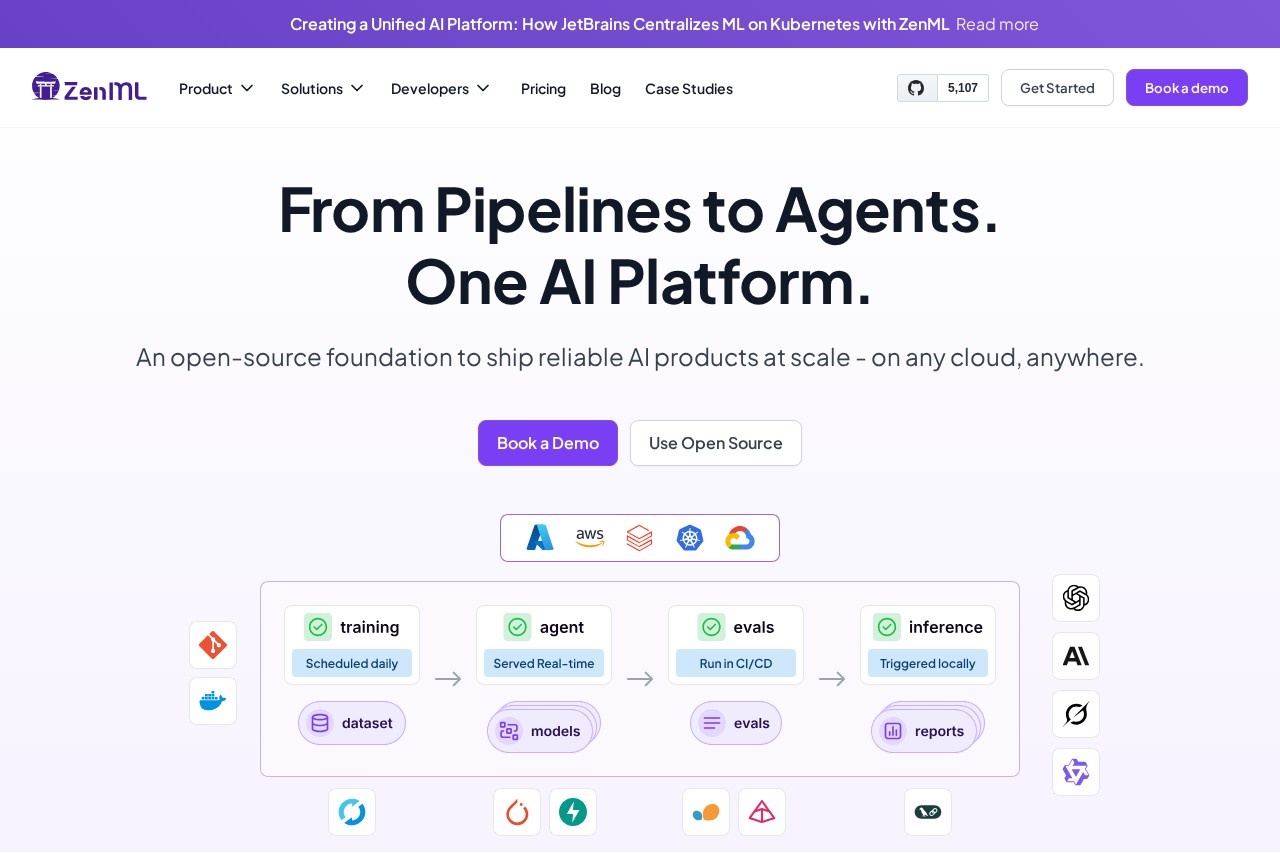
ZenML dashboard showing pipeline runs (source: official site)
Reproducible Pipelines
Versioned, portable ML workflows.
Stack Flexibility
Mix orchestrators, clouds, tools.
Experiment Tracking
Integrated metadata and artifacts.
Production Deployment
Seamless transition from dev to prod.
Core Features & Capabilities
Standout Tools
- Pipelines as Code: Python-defined, version-controlled workflows.
- Stack System: Modular components (orchestrator, artifact store, etc.).
- Integrations Hub: 100+ pre-built connectors.
- Dashboard & CLI: Visualization and control.
- Cloud-hosted option with collaboration features.
Deployment Options
- Fully open-source self-hosted (free)
- ZenML Cloud: hosted dashboard & collaboration
- Enterprise support & features available
- Runs locally, on Kubernetes, or serverless
Performance & Real-World Tests
In 2025 testing, ZenML handles complex multi-step pipelines reliably across environments, with excellent stack portability.
Areas Where It Excels
Stack Flexibility
Open Source Core
Integration Depth
Reproducibility
Use Cases & Practical Examples
Ideal Scenarios
- Teams needing portable pipelines across clouds
- Open-source focused organizations
- Complex stack orchestration
- Transitioning from notebooks to production
Popular Integrations
Kubeflow / Airflow
MLflow / Weights & Biases
AWS / GCP / Azure
Seldon / KServe
Pricing, Plans & Value Assessment
Open Source Core
Free forever
Self-hosted
✓ Best Value
Full framework
ZenML Cloud / Enterprise
Paid tiers
Hosted + support
Convenience
Core framework free as of December 2025; cloud hosting and enterprise features are paid.
Value Proposition
Included
- Full pipeline framework
- 100+ integrations
- Local & cloud deployment
- Community support
Paid Upgrades
- Hosted dashboard
- Team collaboration
- Enterprise support
Pros & Cons: Balanced Assessment
Strengths
- Truly open-source core
- Unmatched stack flexibility
- Excellent pipeline portability
- Rich integration ecosystem
- Strong reproducibility focus
- Active community & updates
Limitations
- More setup than managed platforms
- Cloud features require payment
- Steeper learning curve initially
- Self-hosted dashboard limited
- Some integrations need config
Who Should Choose ZenML?
Perfect For
- Open-source focused teams
- Multi-cloud or hybrid setups
- Complex orchestration needs
- Strong reproducibility requirements
Consider Alternatives If
- You want fully managed no-setup
- Simple single-cloud pipelines
- Minimal configuration preferred
- Heavy GUI focus needed
Final Verdict: 9.2/10
ZenML solidifies its position in 2025 as the premier open-source choice for flexible, reproducible MLOps pipelines. Its stack system and integration depth offer unmatched portability—making it the top pick for teams prioritizing control and avoiding vendor lock-in.
Integrations: 9.5/10
Openness: 9.8/10
Value: 9.0/10
Ready for Production-Ready ML Pipelines?
Start with the free open-source framework or try ZenML Cloud—no commitment needed.
Core framework free forever as of December 2025.